KASI Recognized for Technological Excellence, Joint Development with NASA
First Study of Cosmic Ice Distribution through All-Sky Infrared Spectroscopic Observation
The next-generation space telescope developed with the Korea Astronomy and Space Science Institute (KASI) as a key participant is set to be launched.
The Korea Aerospace Administration announced on the 12th that the space telescope SPHEREx, jointly developed by KASI and NASA, is scheduled to be launched at noon on the 28th (7 p.m. local time on the 27th) from the Vandenberg Space Force Base in California, USA.
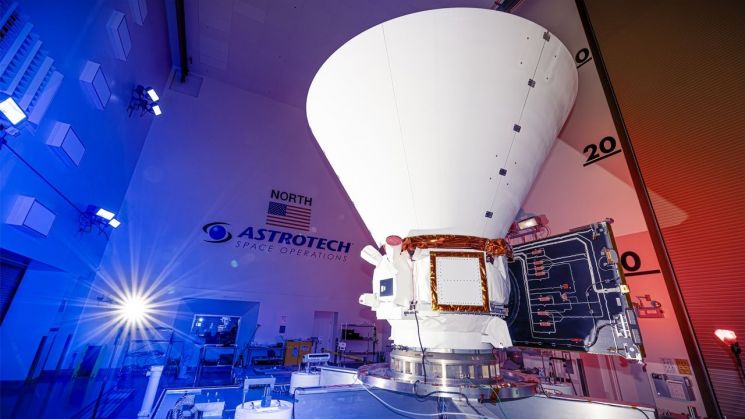
SPHEREx stands for 'Spectro-Photometer for the History of the Universe, Epoch of Reionization, and Ices Explorer.' It is a space telescope capable of observing infrared light, which is difficult to detect from the ground due to atmospheric absorption.
SPHEREx will observe the entire sky in 102 different colors to obtain physical information on about one billion celestial bodies and will create the world's first three-dimensional infrared space map. Through this, it aims to map the distribution of water and carbon dioxide in ice form within our galaxy to identify environments where life could exist.
SPHEREx measures 1.5 meters in width, 1.5 meters in length, 1.3 meters in height, with a telescope diameter of 20 cm. It will be launched on the 28th into a sun-synchronous orbit approximately 650 km above Earth and will conduct exploration for about two years and six months until the end of August 2027, covering a wavelength range of 0.75 to 5.0 μm.
Jung Woong-seop, the principal investigator at KASI, said, "Although it is a small telescope with a diameter of about 20 cm, it is a wide-field space telescope with a very broad observation field of view," adding, "KASI supplied the equipment for overall performance verification and successfully completed performance tests under all stress conditions."
SPHEREx is a NASA medium-class exploration mission worth 280 billion KRW that began in 2019. The project is led by the California Institute of Technology (Caltech) and involves 12 institutions, including KASI under the Space Administration and NASA's Jet Propulsion Laboratory (NASA JPL). KASI is the only international partner participating in the joint development of SPHEREx.
KASI was recognized for its technology in the independently developed Near-infrared Imaging Spectrometer for Star formation history (NISS) and has been involved in SPHEREx since the planning stage in 2016, continuing international joint development since its selection in 2019.
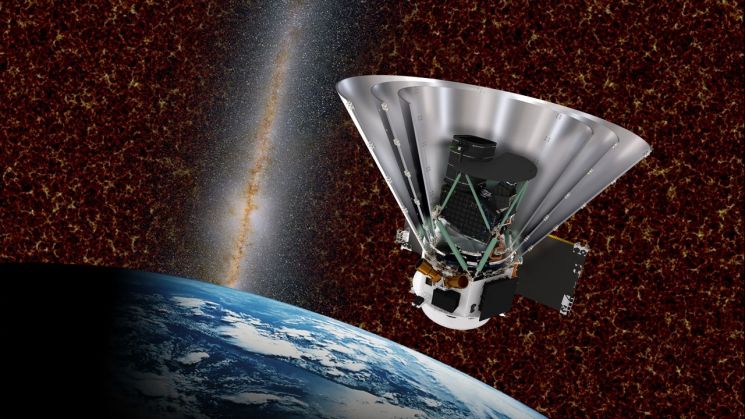 Cross-sectional view of SPHEREx showing cosmic structures in the background. Provided by the Aerospace Agency
KASI developed an ultra-low temperature vacuum chamber simulating the space environment at minus 220 degrees Celsius to lead optical and spectroscopic performance testing of the space telescope and also collaborated on software development for processing observation data. The KASI development team will actively participate in scientific research analyzing data captured by SPHEREx.
Professor Lee Jung-eun of the Department of Physics and Astronomy at Seoul National University, a participant in the SPHEREx research, said, "Existing space telescopes measured the amount of ice molecules by observing specific regions, but SPHEREx plans to create distribution maps of various ice molecules across the entire galaxy," adding, "Through this, we plan to study when, where, and how ice was formed and evolved, and how this ice affects the formation process of stars and planets." Researcher Yang Yoo-jin of KASI added, "If the James Webb Telescope explores very narrow areas deeply and in detail, SPHEREx is a telescope that explores the entire sky thinly but widely."
The core technology of SPHEREx is imaging spectroscopic survey technology, which combines 'imaging observation' that captures wide areas and 'spectroscopic observation' that measures light brightness by wavelength. Nicky Fox, director of NASA's Science Mission Directorate, described observing the universe with imaging spectroscopy as "a groundbreaking attempt to observe the entire universe in 102 different colors for the first time in the world."
Yoon Young-bin, head of the Korea Aerospace Administration, said, "It is significant that our researchers are collaborating with NASA to develop and utilize imaging spectroscopic observation technology applied for the first time to a space telescope," adding, "The Space Administration will continue to expand international collaborative research in astronomy to strengthen Korea's space research capabilities and lay the foundation for the development of the space industry."
SPHEREx will be launched via the Falcon 9 launch vehicle, which weighs 549 tons and measures 70 meters in total length. Principal investigator Jung Woong-seop explained, "The SPHEREx mission was highlighted as one of the notable events to watch this year by Nature," adding, "Fifteen days before launch, we successfully completed acoustic and vibration tests to prepare for launch shock."
© The Asia Business Daily(www.asiae.co.kr). All rights reserved.













