Hamas Postpones Hostage Release
"Complete Chaos Will Ensue," Immediate Warning Issued Just Hours After Statement
Palestinian Relocation to Neighboring Countries
Trump's 'Gaza Resort City Development' Plan
Strong Opposition from Middle Eastern States
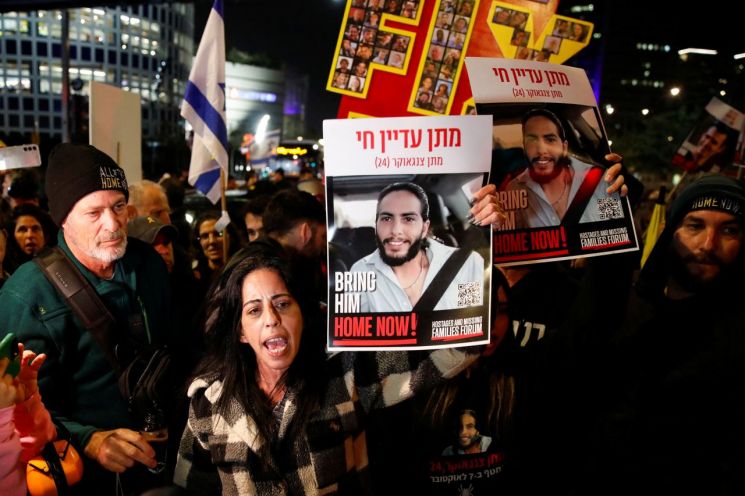 On the 10th (local time) in Tel Aviv, Israel, the mother of one of the hostages, Matan Jangauker, is participating in a protest urging the release of hostages kidnapped since Hamas's attack last October. / Photo by Reuters and Yonhap News Agency
U.S. President Donald Trump warned on the 10th (local time) that if the Palestinian armed group Hamas does not release hostages by noon on the 15th, Israel will be allowed to cancel the ceasefire. This came just hours after Hamas issued a public statement saying it would postpone the scheduled hostage release deadline, claiming that Israel was not properly implementing the ceasefire agreement.
Trump Warns of "Complete Chaos" in Response to Hamas Provocation
According to the British Guardian and Reuters on the day, President Trump told reporters after signing an executive order that if all Israeli hostages held in the Gaza Strip are not returned by noon on Saturday, the ceasefire between Israel and Hamas would be canceled, adding that "all hell will break loose."
When asked by reporters what he meant by "complete chaos," Trump replied, "Hamas will find out." The president also speculated that many hostages may have already died but emphasized that this was just his opinion. He said Israel might ignore his stance.
This warning was a response to Hamas changing its position by postponing the scheduled hostage release on the 15th, citing Israel's failure to properly implement the ceasefire agreement. Abu Obeida, spokesperson for Hamas's military wing Al-Qassam Brigades, said in an official Telegram statement that "the delivery of Zionist (Israeli) hostages is postponed until further notice."
Obeida claimed, "We have observed over the past three weeks that the enemy (Israel) has not kept the terms of the agreement," adding, "They delayed the return of residents in northern Gaza, fired weapons, and relief supplies have not been distributed in several areas of the Gaza Strip."
According to Reuters, mediators from both sides, concerned about the possibility of the ceasefire being suspended, have postponed hostage-related negotiations until they receive a clear signal from Washington that it intends to continue with a phased agreement. Israel's security cabinet advanced a meeting originally scheduled for the evening of the 11th to discuss the second phase of negotiations. According to Israel's public broadcaster Kan News, the Israeli military has canceled all leave for troops stationed in the Gaza Strip. The Guardian interpreted this as another sign that Israeli authorities are preparing for the resumption of war.
However, Hamas clarified that the announcement was deliberately made five days ahead of the scheduled hostage exchange date (the 15th), emphasizing it as a "negotiation card." Hamas stated, "We intentionally announced it five days before the return date to give mediators enough time to pressure (Israel) to fulfill its obligations," and stressed, "The door remains open for the hostage exchange to proceed as planned as soon as the occupying forces (Israel) comply with the agreement."
Deepening Conflict... 'Gaza Plan' vs. 'Arab States' Self-Help Measures'
The conflict between Israel and Hamas surrounding the Gaza Strip appears to be deepening. Both sides maintained tension during the ceasefire period by blaming each other. On the 19th of last month, both sides entered a phased ceasefire to halt hostilities in the Gaza Strip for six weeks (42 days), but since then, both parties have accused each other of violating the agreement. The Palestinian Authority expressed dissatisfaction the day before, stating that several civilians were killed by Israeli gunfire in the West Bank and Gaza Strip. According to AFP, on the 9th (local time), Israel also bombed underground tunnels used by Hezbollah for weapons smuggling near the Lebanon-Syria border.
To resolve the Middle East war, President Trump has proposed the "Gaza Plan." In a recorded Fox News broadcast released on the 10th (local time), Donald Trump said, "We will not allow Palestinians to return to the Gaza Strip," describing his Gaza development plan as a "real estate development for the future." Trump also mentioned that if Jordan and Egypt refuse to accept Palestinian refugees, the U.S. might consider cutting aid to those two countries.
Ultimately, Trump's intention appears to be to resettle the more than two million residents of the Gaza Strip in neighboring countries such as Egypt and Jordan during the Gaza development process, with the aim of having them live there permanently.
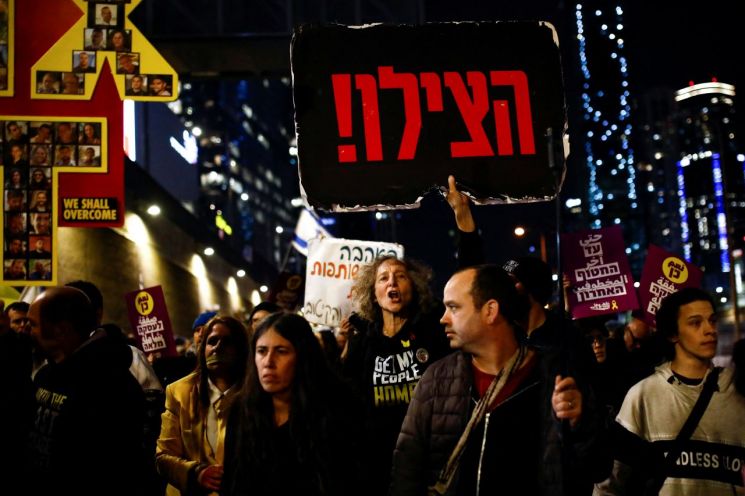 People are participating in a protest urging the release of Hamas hostages held on the 10th (local time) in Tel Aviv. / Reuters·Yonhap Photo by Reuters Yonhap
This proposal was first announced last week when Israeli Prime Minister Benjamin Netanyahu visited the White House. It is a bold plan to relocate Palestinian residents within the Gaza Strip to nearby countries like Jordan and then have the U.S. own the Gaza Strip to develop it into a coastal resort city. Foreign media widely noted this as highlighting Trump's persona as a "real estate developer."
Arab countries, including Saudi Arabia, the Arab world's leader, and Egypt, have strongly opposed Trump's plan, which reflects U.S. interests. They have also begun preparing their own mediation proposals to counter Trump's Gaza Plan. According to CNBC and others, Egypt will hold an Arab Summit on the 27th to discuss Palestinian-related issues and work together to resolve the "Gaza Strip" problem. The Arab Summit is a forum where leaders of Arab League (AL) member states gather to discuss international issues; the Arab League consists of 22 countries in the Middle East and North Africa.
© The Asia Business Daily(www.asiae.co.kr). All rights reserved.













