"Global AI Systems Consume as Much Power as an Entire Country"
Global Experts, Including IT and Semiconductor Leaders, Seek Solutions
Korea Steps Up with Low-Power AI Semiconductors
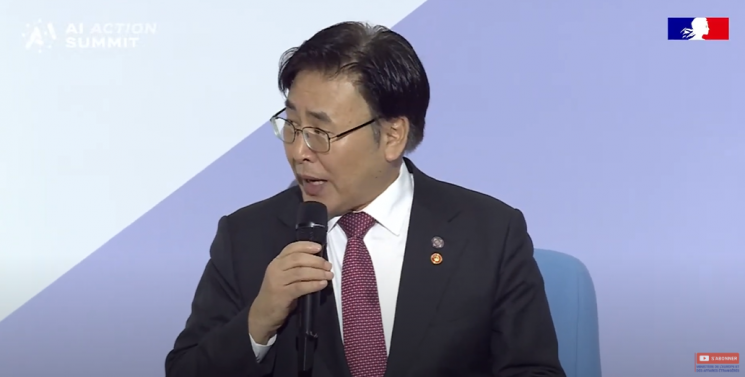 On the 10th (local time), Yoo Sang-im, Minister of Science and ICT, attended the session on "Securing Competitiveness and Sustainability of the Global AI Ecosystem" at the 3rd "International AI Summit" held in Paris, France. Photo by French Ministry of Foreign Affairs YouTube capture
Yoo Sang-im, Minister of Science and ICT, emphasized the need for technical solutions, stating, "There is growing concern as power consumption due to artificial intelligence (AI) is rapidly increasing."
On the 10th (local time), Minister Yoo attended the 3rd International AI Summit held in Paris, France, and pointed out the issue of AI power consumption during the session on ‘Securing Competitiveness and Sustainability of the Global AI Ecosystem.’ He stated, "According to recent studies, the current global power consumption of AI systems is comparable to the total power consumption of a single country," and added, "There are studies suggesting that power consumption due to AI systems could increase up to tenfold."
This remark is particularly noteworthy as it came at a time when France announced an AI investment plan worth 163 trillion won, and the United States is advancing the ‘Stargate’ project, accelerating the AI development competition among major countries.
The background to Minister Yoo raising AI power consumption as a key issue lies in the ‘Jevons Paradox’ phenomenon that has emerged amid intensified AI development competition. This theory, discovered by 19th-century British economist Jevons, refers to the phenomenon where improvements in technological efficiency paradoxically increase resource consumption. While AI aims to improve efficiency, concerns are being raised worldwide that it ultimately consumes more energy.
Professor Choi Byung-ho of Korea University’s AI Research Institute said, "The larger the model to achieve better AI performance, the more computing power and electricity are required," adding, "Since higher energy consumption harms the environment, there is an issue of balancing for sustainable growth."
During the session, Minister Yoo indicated that Korea is developing low-power, high-performance AI semiconductors and related hardware and software technologies, signaling efforts to find technical solutions. The Korean government is promoting the introduction of low-power, high-performance AI semiconductors to the ‘National AI Computing Center’ in cooperation with the private sector.
Also attending the session, Kim Sang-hyup, Secretary-General of the Global Green Growth Institute (GGGI), pointed out the energy efficiency issue of AI, stating, "AlphaGo consumed more than 100,000 times the energy of the human brain during its match against Lee Sedol 9-dan." He forecasted, "By 2026, data centers will account for half of the increase in U.S. power demand."
Meanwhile, Lisa Su, CEO of U.S. semiconductor company AMD, stated, "Sustainability and performance are not conflicting concepts," and announced plans to improve AI solution efficiency by 30 times over the next five years. Aiman Ezzat, CEO of global consulting firm Capgemini, also introduced a case where an AI-based energy management system was implemented at a facility in India, reducing power consumption by 29%.
© The Asia Business Daily(www.asiae.co.kr). All rights reserved.











