A technology has been developed that can screen for lung cancer at an early stage using exhaled breath. This technology demonstrated 95% accuracy in clinical settings. It is expected to contribute to early detection, disease prevention, and treatment of lung cancer at a low cost without the risk of radiation exposure in the future.
The Electronics and Telecommunications Research Institute (ETRI) announced on the 11th that it has developed a sensor system that detects various volatile organic compounds (VOCs) caused by cancer cells in the lungs through exhaled breath, along with an artificial intelligence (AI) deep learning algorithm technology that can identify lung cancer patients using the sensing data obtained.
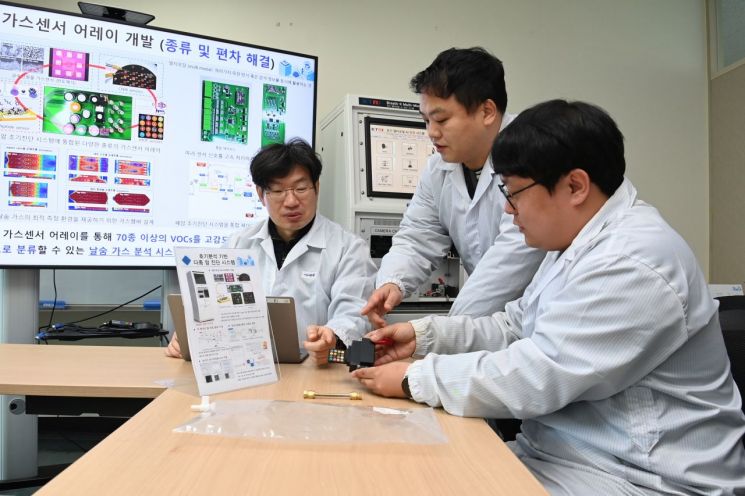 ETRI researchers are discussing the multimodal sensor array embedded in the early lung cancer diagnosis system. Photo by Electronics and Telecommunications Research Institute of Korea
The lung cancer early diagnosis system developed by ETRI consists of three parts: ▲exhaled breath sampling unit ▲exhaled breath detection sensor module ▲data signal processing unit. This system enables simple lung cancer screening using only the exhaled breath emitted during a person’s breathing process.
First, the examinee’s exhaled breath is collected in a plastic kit, and then a Teflon-based bag containing the breath is connected to a carbon adsorption tube stick, which captures various gas components emitted during breathing onto the stick. When the stick is inserted into the lung cancer early diagnosis system and the system is activated, it is possible to observe changes in electrical signals from the built-in array of 20 multimodal sensors depending on the composition of the exhaled gas and the amount of VOCs attached to the carbon tube stick.
The research team explained that by reflecting the compositional data of the exhaled breath into the AI deep learning algorithm for training and analysis, it is possible to determine the presence or absence of lung cancer.
The research team conducted joint research for over 10 years with the thoracic surgery research team led by Professor Jeon Sang-hoon at Bundang Seoul National University Hospital, resulting in these findings. They collected clinical exhaled breath samples from 107 lung cancer patients and 74 healthy individuals, analyzed them using standard equipment and gas sensors, and applied the data to the AI deep learning algorithm model, which showed a screening accuracy of over 95%. This confirmed clinical validity and demonstrated that the technology can serve as a complementary tool for lung cancer patient screening and early diagnosis.
The technology developed by ETRI is also regarded as a next-generation lung cancer early diagnosis technology that encompasses the advantages of both existing immunodiagnosis and molecular diagnosis. Compared to existing hospital diagnostic equipment, it is cheaper to produce and faster, and it offers higher accuracy compared to the price of existing medical equipment (low-dose lung CT scans). Based on this, the research team anticipates that it can be used not only for monitoring surgery and treatment prognosis of lung cancer patients but also for self-health management by the general public in the future.
ETRI plans to transfer and invest the related technology to medical device companies to commercialize it.
Dr. Lee Dae-sik of ETRI’s Diagnostic and Therapeutic Research Lab said, “If the lung cancer screening technology using exhaled breath is commercialized, it is expected to improve the treatment and survival rates of lung cancer patients.”
Professor Jeon Sang-hoon of the Thoracic Surgery Department at Bundang Seoul National University Hospital said, “It is meaningful that joint research with ETRI has opened the possibility of testing for lung cancer occurrence cheaply and conveniently,” adding, “We will expand the clinical scale to improve system reproducibility and reliability, and advance the system through big data application to contribute to the promotion of public health.”
© The Asia Business Daily(www.asiae.co.kr). All rights reserved.












