Atmosphere Focused on Monitoring the Situation and Seeking Countermeasures
Companies Without Local Factories May Lose Competitiveness
Concerns are rising in the domestic pharmaceutical and bio industries following remarks by U.S. President Donald Trump that tariffs on pharmaceuticals are also under consideration, after those on automobiles and semiconductors. If a tariff war breaks out in the United States, the world's largest pharmaceutical market and the biggest export destination for Korean companies, significant damage, both large and small, will be inevitable.
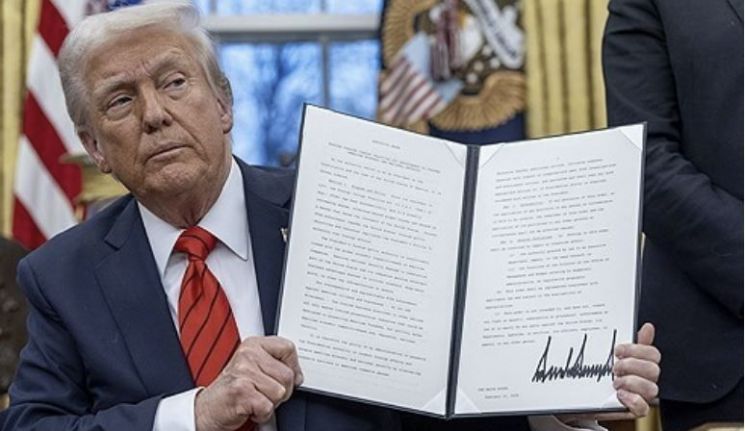
On the afternoon of the 10th (local time), President Trump signed a proclamation in the White House Oval Office imposing a 25% tariff on imported steel and aluminum products, stating that "tariffs on automobiles, semiconductors, and pharmaceuticals are also under review."
According to the related industry, last year, Korean companies' pharmaceutical exports to the U.S. amounted to $1.53 billion (approximately 2.2 trillion KRW), an increase of about 50% compared to 2023. Companies driving this trend include Celltrion and Samsung Bioepis, which export biosimilars; Daewoong Pharmaceutical and Hugel, which export botulinum toxin products; and SK Biopharm, which exports epilepsy treatments. If tariffs become a reality, most will be exposed to direct or indirect impacts.
Celltrion recently revealed in a shareholder letter a mid- to long-term response scenario to overcome tariff pressures by acquiring or newly establishing production bases in the U.S. However, considering time and cost issues, it is analyzed that this will not easily serve as an immediate measure to completely avoid the impact of tariffs. The feasibility varies depending on financial strength.
For this reason, most companies are currently monitoring the situation closely and planning response measures. This implies that it is difficult to come up with a sharp solution.
There is also analysis that Korean companies' competitiveness may decline as Japanese bio companies gain prominence. Japanese bio companies such as Fujifilm and Lonza are currently building factories in the U.S., and if the close relationship between the U.S. and Japan continues, this trend may accelerate. Lee Seung-gyu, Executive Vice Chairman of the Korea Bio Association, explained, "Even if the U.S. local market does not artificially discriminate, the structure naturally benefits those operating local factories."
In the case of pharmaceuticals, price increases due to tariffs have a particularly significant impact on domestic consumer sentiment, so it is uncertain to what extent President Trump's plan will materialize. There are calls for not only efforts at the company level but also for government-level support to begin in earnest from now on.
Vice Chairman Lee said, "Since the relationship between the U.S. and Japan is very good, Japan may be able to resolve the issue politically," adding, "Korea must not confine this issue to an industrial perspective but approach it from a diplomatic and trade perspective to proactively reduce the shock."
© The Asia Business Daily(www.asiae.co.kr). All rights reserved.












