Outsourcing Manufacturing to TSMC
Strategy to Reduce Dependence on NVIDIA Chips
Altman: "AGI Will Arrive Within 10 Years"
OpenAI is partnering with U.S. semiconductor company Broadcom and Taiwanese foundry (semiconductor contract manufacturing) firm TSMC to develop its own artificial intelligence (AI) chips. The plan is to focus on design while outsourcing manufacturing, aiming to reduce dependence on NVIDIA and implement a cost-saving strategy.
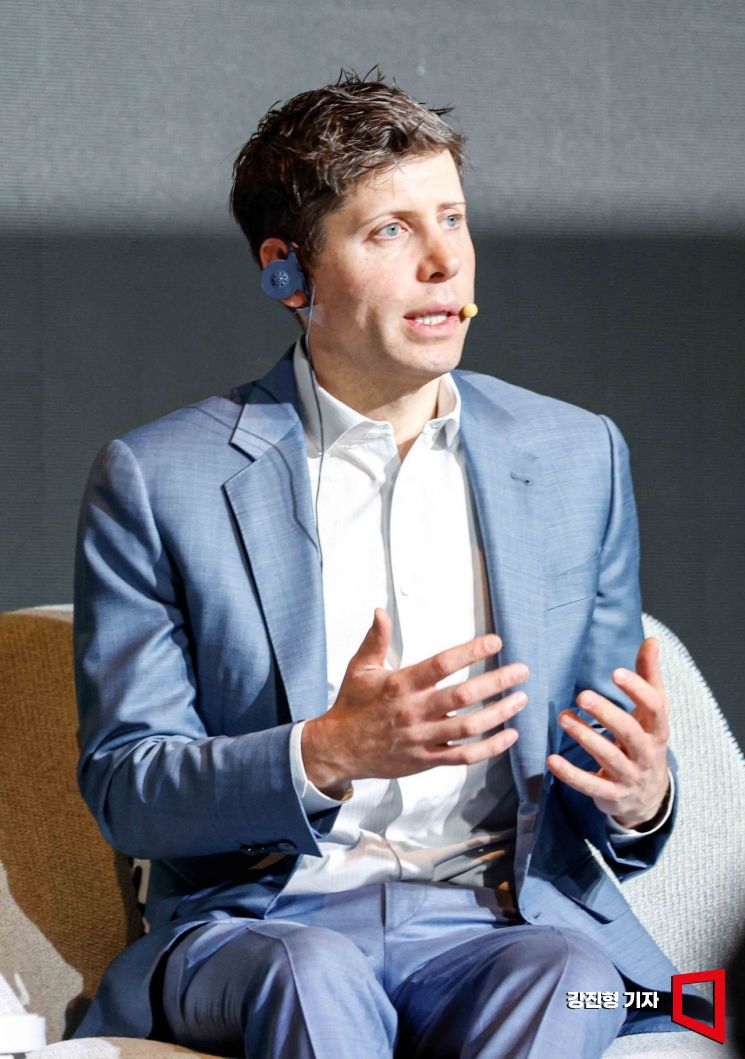 Sam Altman, CEO and founder of OpenAI, the developer of ChatGPT, is attending the 'Kakao Media Day' held at the Plaza Hotel in Jung-gu, Seoul on the 4th, having a conversation with Jeong Sin-ah, CEO of Kakao. Photo by Kang Jin-hyung
According to Reuters on the 10th (local time), OpenAI is developing chips together with Broadcom. Once the design is complete, TSMC will handle production. OpenAI has reportedly recruited personnel from Google's chip development team to form a chip division of about 20 people. In addition to its own chips, OpenAI plans to use NVIDIA chips as well as AMD chips, a competitor to NVIDIA, through Microsoft (MS).
OpenAI and Broadcom are understood to have initiated this collaboration to reduce reliance on NVIDIA chips used for AI development and advancement. Developing AI models requires at least hundreds to thousands of accelerators, and the price of NVIDIA's advanced AI accelerators exceeds 60 million KRW per unit. Operating a single data center can cost trillions to tens of trillions of KRW. Currently, NVIDIA holds over 90% of the global AI chip market share.
OpenAI’s own chips are expected to be specialized for inference. Currently, demand for chips used in AI training is high. However, as AI applications (apps) increase, it is widely anticipated that future demand for AI inference chips will surpass that for training chips.
However, OpenAI’s plan to lead chip production directly by building a global network appears to have been abandoned. Reuters reported that OpenAI has currently given up on the project due to the enormous costs and time required to establish a foundry.
Meanwhile, OpenAI CEO Sam Altman predicted that artificial general intelligence (AGI) comparable to human level will emerge within 10 years. He cited the reason that the pace of AI development is much faster than Moore’s Law, which states that computer performance doubles every 18 months.
On the 9th (local time), Altman wrote in a blog post titled “Three Observations” that “Our goal is to ensure AGI benefits all of humanity,” and “Systems moving toward AGI are gradually taking shape.”
He further predicted, “Thanks to AGI, within 10 years, an era will come when probably everyone on Earth can achieve more than today’s most influential people.”
He pointed to the speed of AI development as evidence. Altman said, “AI development continues to make rapid progress,” and “The pace of AI advancement is much faster than Moore’s Law.”
He also emphasized the socio-economic changes that AI performance improvements will bring. He stated, “Even a slight improvement in AI performance has much greater socio-economic ripple effects,” and “This is why we must not stop exponential investment in AI.”
© The Asia Business Daily(www.asiae.co.kr). All rights reserved.












