As major airlines worldwide expand their size through mergers and acquisitions (M&A), the composition of airline alliance members is also changing one after another. Passengers who fully utilize services such as code sharing, mileage accumulation and usage, and lounges among alliance airlines cannot help but be sensitive to these changes, drawing attention to the alliance changes following the merger of Korean Air and Asiana Airlines.
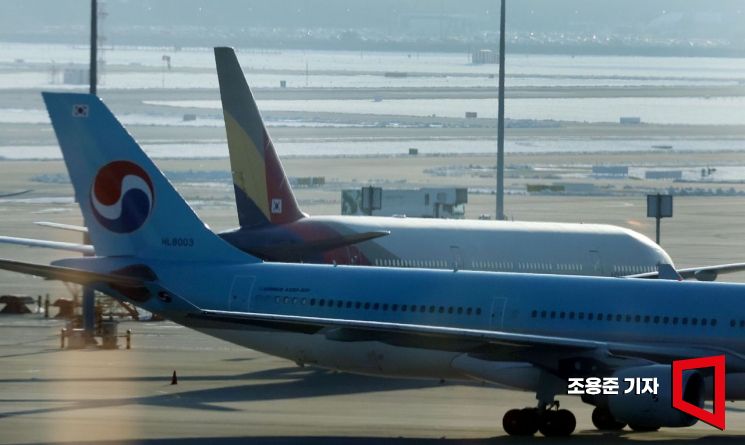 Passenger aircraft of Korean Air and Asiana Airlines are waiting on the runway and apron at Incheon International Airport, Yeongjongdo, Incheon. Photo by Jo Yong-jun
According to the aviation industry on the 12th, as of the 31st of last month, the partnership terms between Korean Air and Italy's national airline (ITA) changed from a SkyTeam alliance to another type of partnership. This is because ITA withdrew from SkyTeam to switch alliances to Star Alliance, following its shareholder, the German airline Lufthansa. Accordingly, mileage exchange and accumulation remain, but benefits such as priority airport waiting treatment that Korean Air's elite members received when using ITA have disappeared.
There are three major airline alliances: SkyTeam, which Korean Air belongs to; Star Alliance, which Asiana Airlines has joined; and Oneworld, which includes British Airways and Finnair. Among these, Star Alliance is the oldest and largest in scale. Currently, 25 airlines including Lufthansa, Air Canada, and Thai Airways are allied. SkyTeam and Oneworld share services such as routes, mileage, and lounges with 18 and 13 airlines respectively. Representative members of SkyTeam include Delta Air Lines and Air France.
Airlines switching alliances have become more frequent since COVID-19. As the number of airlines facing bankruptcy increases, some major airlines actively pursue M&A to expand market influence, resulting in changes to the alliance affiliations of acquired airlines.
Scandinavian Airlines (SAS), one of the founding members of Star Alliance, joined SkyTeam on September 1 last year. This is because the Air France-KLM group, which is part of SkyTeam, invested in SAS to help its recovery after filing for bankruptcy following COVID-19. Czech Airlines, unable to avoid deficits, ceased operations on October 26 last year and merged with Smartwings, withdrawing from SkyTeam. TAP Portugal, which is a member of Star Alliance but is undergoing privatization due to financial difficulties, may change its affiliation to SkyTeam in the future as Air France plans to participate in equity investment.
Asiana Airlines, which completed its corporate merger with Korean Air in December last year, is also expected to withdraw from Star Alliance after operating as a subsidiary for two years. Regarding this matter, both airlines stated, "Nothing has been specifically decided yet." However, since Korean Air is a founding member of SkyTeam and it is common for the acquired airline to move, it is highly likely that Asiana Airlines will belong to SkyTeam after two years.
However, since Star Alliance is larger in scale, some loyal customers of Asiana Airlines express regret. In response, Korean Air said, "Even if we are not in the same alliance, we have separate partnerships to enhance customer convenience," adding, "In the midst of changes in the aviation market such as the emergence of mega airlines and ranking reshuffles, we will focus more on services to satisfy customers rather than simply expanding size."
© The Asia Business Daily(www.asiae.co.kr). All rights reserved.












