"Possible Restrictions on Entry into the US and Europe"
"Cloud Collaboration and Hardware Acquisition Are Essential"
Professor Moon Hyungnam: "Companies Should Learn from DeepSeek's Case"
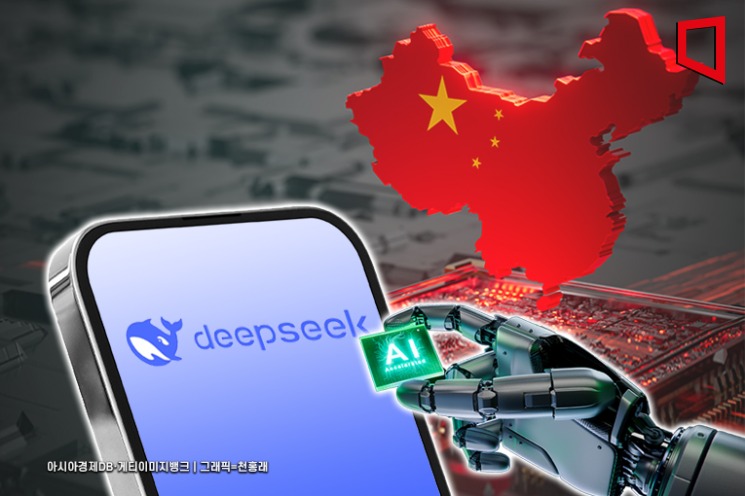
"For DeepSeek to win in competition against global big tech companies, it must implement a balanced strategy based on three pillars: technological innovation, ecosystem building, and securing global trust."
This is the 'DeepSeek Strategy' presented by China's generative artificial intelligence (AI) DeepSeek. Moon Hyung-nam, dean of the Global Convergence College and professor of the Global Convergence Department at Sookmyung Women's University, together with the Korea AI Education Association and AI Convergence Research Institute, examined DeepSeek's strengths, weaknesses, and mid-to-long-term prospects through DeepSeek. Professor Moon announced on the 11th, "After several trials and errors, we obtained answers recognized as the most objective, honest, and accurate, which we are now disclosing."
First, DeepSeek diagnosed that its service has a foundation for rapid growth based on data accessibility within China, government support, and understanding of the local market. It also stated, "It is rapidly acquiring technological capabilities in the fields of generative AI and large language models (LLM)," and evaluated that "it is highly likely to show strengths particularly in Chinese natural language processing (NLP) technologies."
Along with this, it responded, "China's data regulations and censorship make it difficult for foreign companies to enter," and "DeepSeek holds a monopolistic advantage in developing localized AI models by utilizing data within China."
However, DeepSeek acknowledged that it will take time to narrow the gap in technology and infrastructure with global big tech companies such as OpenAI, Google, and Microsoft (MS). It also expressed opinions that, due to being a Chinese company, its entry into Western markets such as the US and Europe may be restricted, and that it may be difficult to gain trust because of data security and privacy issues. Additionally, it answered that it could face difficulties securing high-performance AI chips like Nvidia graphics processing units (GPUs) due to US semiconductor export regulations.
It then suggested, "For DeepSeek to be competitive in the global market, it needs not only technological capabilities but also strategies to build trust and overcome international regulations," and "It must secure competitiveness in developing English and multilingual AI models." It added that establishing global partnerships, cooperating with cloud service providers, and securing hardware supply chains are essential.
In conclusion, it stated, "In the global market, many challenges must be overcome to win against big tech," and "To overcome barriers such as technological gaps, international regulations, and ecosystem competition, continuous investment and strategic cooperation are essential." DeepSeek advised, "To win in competition with big tech, a balanced strategy based on the three pillars of technological innovation, ecosystem building, and securing global trust must be implemented."
Professor Moon, who oversaw this research, emphasized, "DeepSeek is well aware of its weaknesses, and if it overcomes them, it could become a company that competes with or surpasses global big tech." He added, "Our companies should take DeepSeek as a lesson, study it well, and strive to surpass DeepSeek."
© The Asia Business Daily(www.asiae.co.kr). All rights reserved.












