Gasoline Prices Drop Slightly Nationwide After 17 Weeks
Gwangju Sees Continuous Increases Since Last October
Vehicles Flock to Some Cheaper Gas Stations
Shrinking Consumer Sentiment Triggers Management Difficulties
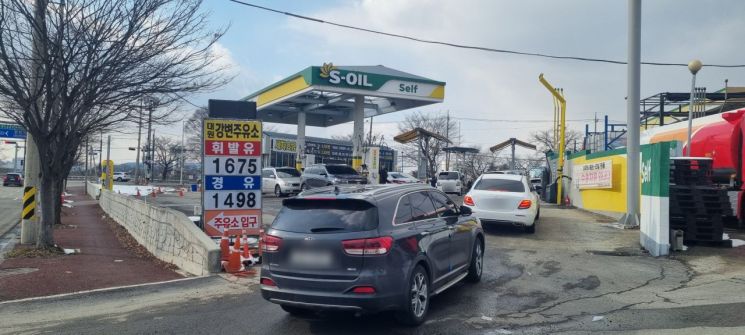 On the afternoon of the 10th, Daewon Gas Station in Chipyeong-dong, Seo-gu, Gwangju, was lined up with vehicles waiting to refuel from the entrance. Photo by Min Chanki
"As fuel prices keep rising, even driving a car has become a burden. I came from far away to refuel at a cheaper place, even if it's just to save a little money."
Daewon Gas Station in Chipyeong-dong, Seo-gu, Gwangju, on the afternoon of the 10th.
The price of gasoline at this station is 1,675 won per liter, which is relatively low compared to other stations in Gwangju, including Seo-gu. The price of diesel is 1,498 won per liter, making it the cheapest in Gwangju on this day.
As a result, more than 3,000 refueling transactions take place here on average each day, with people from various parts of the region coming to fill up their tanks. Even though domestic gasoline prices dropped slightly for the first time in 17 weeks, a long line of cars waiting to refuel continued without pause on this day as well.
About 10 fuel dispensers had dozens of cars queued up, and as soon as one car finished refueling, another quickly took its place. As of 2 p.m. that day, there had already been about 1,300 refueling transactions, showing that many vehicles were crowding in to save on fuel costs.
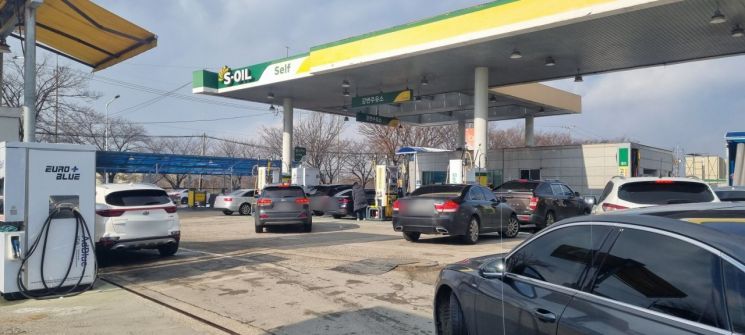 On the afternoon of the 10th, vehicles are waiting to refuel at the gas pumps of Daewon Gas Station in Chipyeong-dong, Seo-gu, Gwangju. Photo by Min Chanki
In particular, while gasoline prices have dropped nationwide, prices in Gwangju continue to rise, prompting citizens to go on "refueling expeditions" to find even slightly cheaper stations.
Mr. Park (49), a resident of Nam-gu, said, "I spend 30,000 to 50,000 won a week on fuel, and even a 10-won difference adds up over time, so I try to find the cheapest gas station possible. Even with the same amount of money, the amount of fuel I can buy changes every week, which is frustrating."
Some people responded that the ongoing rise in fuel and other prices has made them turn to public transportation due to the burden of fuel costs.
Kim (46), an office worker, said, "Compared to other stations, the price here can be more than 100 won per liter cheaper, so I refuel here whenever I'm in the area. As fuel prices keep going up, I usually use public transportation instead of driving."
Due to high exchange rates and rising international oil prices, domestic gasoline prices had been increasing continuously, but after 17 weeks, they have finally shown a slight decline.
According to Opinet, the oil price information system of Korea National Oil Corporation, the average retail price of gasoline at gas stations nationwide during the first week of February (2nd to 6th) was 1,733.06 won per liter, down 0.04 won from the previous week. For diesel, the average price was 1,597.73 won per liter, up 1.1 won, but the increase was much smaller compared to last week's 11.3 won rise.
On the other hand, the average gasoline price in Gwangju during the first week of February was 1,718.93 won, which is lower than the national average, but it has been rising for 17 consecutive weeks since the second week of October last year (1,560.48 won).
Local gas station operators explained that as oil prices continue to rise, consumers are seeking out cheaper stations and going on refueling expeditions, but even so, the worsening economy and shrinking consumer sentiment are causing management difficulties.
An employee at a local gas station said, "For several years, we've been keeping prices low for regular customers, even if it means little profit, but perhaps due to the poor economy, fewer people are coming to the station. As prices keep rising, citizens are closing their wallets. Unless oil prices drop significantly, it will be hard for people to feel any real relief."
© The Asia Business Daily(www.asiae.co.kr). All rights reserved.