BNK and JB Financial Achieve Record Results
Balance of Fixed and Below Non-Performing Loans Up 47% Year-on-Year
Loan Loss Provisions Accumulated Minimally
Loss Absorption Capacity Declines
"Impact of Regional Economic Downturn and Real Estate PF"
Regional financial holding companies (BNK, DGB, JB) recorded their highest-ever performance last year, but asset soundness deteriorated further. This is due to local companies struggling amid an economic downturn and the ongoing impact of non-performing real estate project financing (PF) assets.
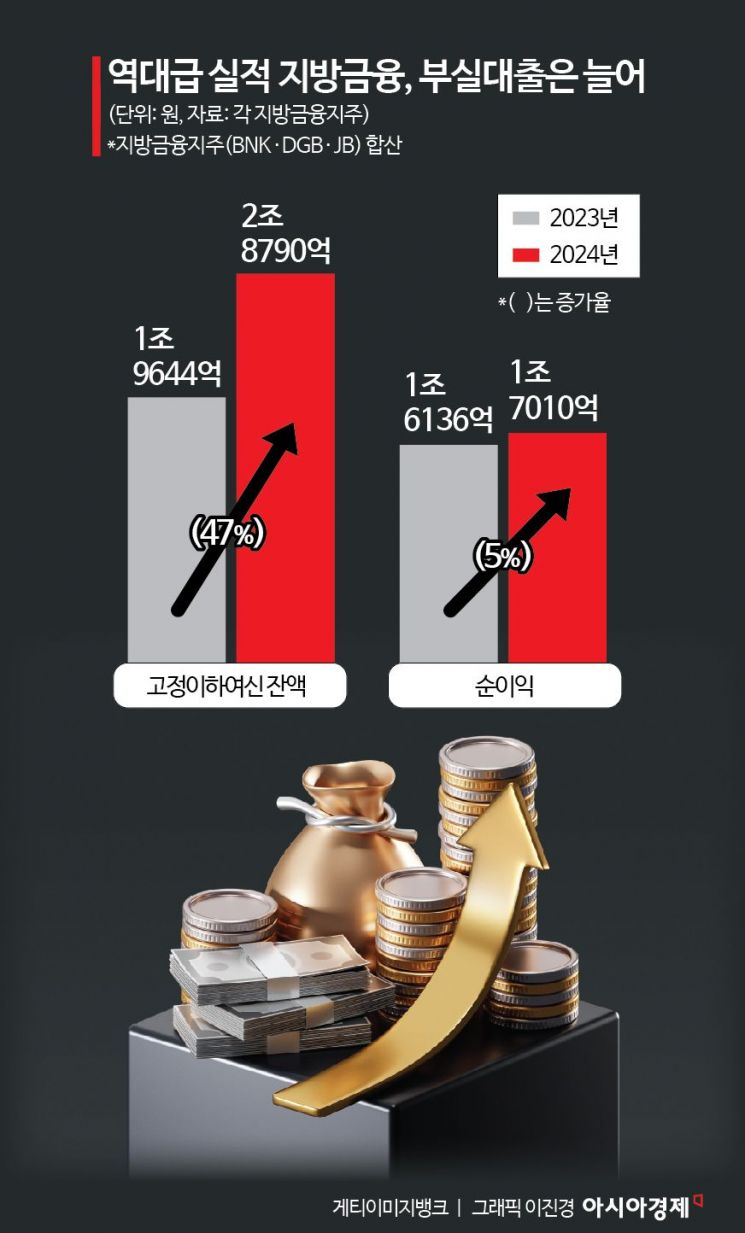
According to the financial sector on the 11th, the combined net profit of regional financial holding companies last year was 1.701 trillion KRW, an increase of about 5.4% (87.4 billion KRW) from the previous year (1.6136 trillion KRW). Among them, BNK Financial Group and JB Financial Group achieved record-high performances. BNK Financial's cumulative net profit last year was 802.7 billion KRW, up 25.5% from the previous year. JB Financial also achieved a net profit of 677.5 billion KRW, an increase of 15.6%. DGB Financial Group's net profit recorded 220.8 billion KRW, down 43.1% from the previous year.
Despite the record-breaking performance, asset soundness worsened. The combined balance of non-performing loans classified as "fixed and below" for regional financial holding companies last year was 2.879 trillion KRW. The ratio of fixed and below non-performing loans to total loans was 1.2%. The balance increased by 47% compared to 2023, and the ratio rose by 0.3 percentage points. This increase rate was steeper compared to the approximately 5% rise in net profit during the same period.
By holding company, BNK Financial showed the highest increase rate in non-performing loans. BNK Financial's fixed and below non-performing loan balance rose from 824.8 billion KRW to 1.3703 trillion KRW, showing a 66% increase. Following were DGB Financial with a 45% increase and JB Financial with an 11% increase. In terms of ratio, DGB Financial (1.62%) was the highest.
Loan receivables are classified into five categories based on soundness: normal, precautionary, fixed, doubtful recovery, and estimated loss. The closer to estimated loss, the longer the delinquency period or the more difficult the recovery. Fixed and below non-performing loans refer to loans classified from fixed to doubtful recovery and estimated loss, which are overdue for more than three months and difficult to recover. The larger the balance, the more non-performing loans there are. Since both the balance and ratio increased, it indicates that the soundness of regional financial holding companies has deteriorated.
Regional financial holding companies were passive in accumulating loan loss provisions to prepare for losses. Their combined loan loss provision balance was 3.2266 trillion KRW, about 12.6% higher than the previous year (2.8659 trillion KRW). BNK Financial's increase was only 4% compared to the previous year, lower than DGB Financial (33%) and JB Financial (7%). A BNK Financial official explained, "This is because a large amount of loan loss provisions was accumulated in 2023."
As a result, the ability to absorb expected losses from non-performing loans also declined. The coverage ratio of fixed and below non-performing loans, an indicator showing how much loan loss provisions are accumulated relative to fixed and below non-performing loans, decreased across the board. A coverage ratio of 100% means that even if all fixed and below non-performing loans result in losses, they can be fully absorbed. The most alarming "signal" was from DGB Financial, which dropped 9.2 percentage points from 110.6% to 101.4%. If DGB Financial's coverage ratio falls below 100%, it means DGB Financial cannot fully cover losses from non-performing loans. The largest drop was at BNK Financial, which fell sharply from 178% to 111%, a 67 percentage point decrease. BNK Financial achieved the best performance among regional financial companies but saw the largest increase in non-performing loans and a significant decline in loss absorption capacity.
Regarding the increase in non-performing loans, BNK Financial cited the fact that local companies mainly engage in manufacturing and that the loan portfolio is heavily weighted toward small and medium-sized enterprises (SMEs). Due to the regional economic downturn, these companies are unable to repay loans on time. As of last year, manufacturing accounted for 15.5% and 24.7% of the won-denominated loan portfolios of BNK Financial's affiliates Busan Bank and Gyeongnam Bank, respectively. For Gyeongnam Bank, manufacturing was the largest sector, while for Busan Bank, it was the second largest after real estate (20.5%). The proportion of SMEs in won-denominated loans was 58% and 61% for Busan Bank and Gyeongnam Bank, respectively.
The real estate PF provision factor was also significant. DGB Financial explained that the increase in asset soundness stage balances was due to related assets held by affiliates such as securities firms becoming non-performing. The PF provisions of iM Securities, a subsidiary of DGB Financial, reached 539.4 billion KRW over three years, with 295.1 billion KRW accumulated last year alone. A DGB Financial official said, "Real estate PF-related assets that were previously normal have shifted from normal to fixed, increasing the ratio of fixed and below non-performing loans."
© The Asia Business Daily(www.asiae.co.kr). All rights reserved.











