Emergency Joint Academic Conference by the Criminal Law Academic Community
The academic community has expressed opinions on the reallocation of investigative authority and amendments to legal provisions regarding the investigation by the High-ranking Officials' Crime Investigation Unit (HCIC) into President Yoon Seok-yeol's alleged charge of insurrection, which has become controversial. On the afternoon of the 7th at 3 PM, the criminal law academic community held an urgent joint academic conference titled ‘Hermeneutical Issues in Criminal Law’ in Room 302 of the Woochun Law Building at Seoul National University, Sillim-dong, Gwanak-gu, Seoul. This conference was co-hosted by the Korean Criminal Law Association (President Hwang Tae-jung), the Korean Comparative Criminal Law Association (President Choi Ho-jin), the Korean Criminal Policy Association (President Kim Han-gyun), the Korea Institute of Legal Policy (President Oh Young-geun), and the Korean Law Professors Association (President Choi Bong-kyung). The session was moderated by Professor Lee Joo-won (age 60, Judicial Research and Training Institute class 21) of Korea University Law School, and chaired by Professor Jeon Ji-yeon, Emeritus Professor at Yonsei University Law School.
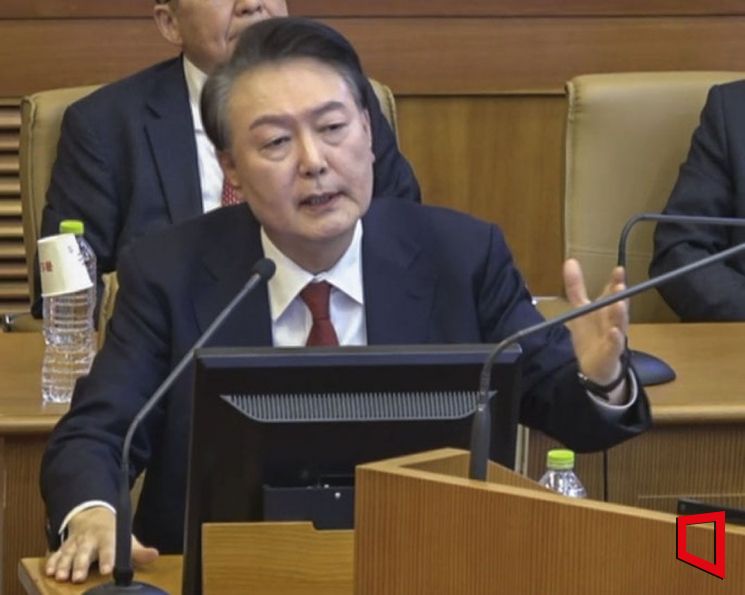 President Yoon Suk-yeol is speaking after listening to the testimony of Kwak Jong-geun, former Commander of the Army Special Warfare Command, who appeared as a witness at the 6th hearing of President Yoon's impeachment trial held at the Constitutional Court in Jongno-gu, Seoul on February 6, 2025. Photo by the Constitutional Court
Is Investigation Possible Based on ‘Direct Relevance’?
Article 2, Clause 4, Subparagraph (d) of the Act on the Establishment and Operation of the HCIC (HCIC Act) defines ‘related crimes’ as ‘crimes directly related to the high-ranking official crimes recognized during the investigation of high-ranking official crimes and committed by the relevant high-ranking official.’ The HCIC judged that the charge of insurrection is a ‘high-ranking official crime’ directly related to President Yoon’s ‘abuse of authority’ crime recognized during the investigation process, and therefore has investigative authority, leading to the investigation and detention.
"Need to Reallocate HCIC’s Investigative Authority and Amend the Term ‘Direct Relevance’"
Professor Cho Ki-young of Jeonbuk National University Law School proposed, “It is necessary to delete the prosecutor’s authority to initiate investigations under the Prosecutors’ Office Act, reallocate the HCIC’s investigative authority in line with the purpose of the HCIC Act, and simultaneously amend ‘direct relevance’ to ‘relevance’ or ‘reasonable relevance.’”
Professor Cho introduced existing interpretations of ‘direct relevance,’ including the views that it means △ internal relevance, △ identity of the charges, and △ the need for individual and comprehensive review. He stated, “Both the HCIC Act and the Prosecutors’ Office Act use the same term ‘direct relevance,’ but the ‘direct relevance’ in the Prosecutors’ Office Act is a transitional legislative provision aimed at limiting the prosecutor’s authority to initiate investigations in a system where investigative and prosecutorial powers are separated, with the police conducting investigations and prosecutors handling prosecutions.” He added, “The interpretation of ‘direct relevance’ under the Prosecutors’ Office Act should prevent this concept from serving as a backdoor allowing prosecutors investigative authority over crimes for which they do not have jurisdiction.” He further argued, “According to the HCIC Act, the HCIC must ensure efficient and strict punishment of corruption and misconduct by high-ranking officials and serve as a check on the bloated and politicized prosecution. The scope of crimes subject to HCIC investigation should be defined in accordance with this founding purpose, and this should be considered in interpreting ‘direct relevance.’”
Professor Cho also pointed out that since both the HCIC Act and the Prosecutors’ Office Act, which allocate investigative authority, use the identical term ‘direct relevance,’ there are inherent limitations in reflecting the differing legislative intents of the two laws in interpretation. He said, “Interpreting the same term differently depending on the law is not a proper legal methodology. The fundamental problem is that the Prosecutors’ Office Act and the HCIC Act, which have completely opposite legislative intents regarding the allocation of investigative authority, use the same term.”
Professor Noh Soo-hwan (age 59, class 24) of Sungkyunkwan University Law School, who participated in the discussion, expressed the view that “The acts of the president indicted for insurrection during the December 3 emergency martial law include multiple abuses of authority by the president as essential acts, so whether the crimes of insurrection and abuse of authority are regarded as a single crime in an absorption relationship or as concurrent offenses, it is clear that there is direct relevance.”
"Correct Interpretation Needed Amid Rule of Law Crisis"
Oh Young-geun, President of the Korea Institute of Legal Policy, pointed out, “Over the past several decades, as the prosecution and police have clashed over investigative authority, many criminal issues have likely not been properly resolved, and the innocent public has had to bear the consequences.”
Kim Han-gyun, President of the Korean Criminal Policy Association, emphasized, “In the midst of confusing voices shouting ‘illegality of illegality of illegality,’ where it is difficult to discern truth and falsehood, criminal law interpretation must be correct and clear to distinguish illegality according to the law and restore democracy and the rule of law.”
Choi Ho-jin, President of the Korean Comparative Criminal Law Association, said, “Clearly clarifying how the law is interpreted and applied according to the constitutional spirit demonstrates that law is no longer merely a ‘legal technique’ but the standard that determines ‘justice’ in a rule-of-law society. Scholars bear a heavy responsibility.”
Reporter Ahn Hyun, Legal Newspaper
※This article was written using content provided by the Legal Newspaper.
※This article is based on content supplied by Law Times.
© The Asia Business Daily(www.asiae.co.kr). All rights reserved.












