Commercialization Accelerated with Novel Redox Mediator
Ajou University Research Team Develops BAC to Enhance Lithium-Oxygen Battery Efficiency and Stability
Ajou University announced on the 13th that an international joint research team, including Professor Seong-Eun Seo from the Department of Chemistry, has developed a novel redox mediator (BAC) to solve the charging/discharging efficiency and stability issues of the next-generation lithium-oxygen battery.
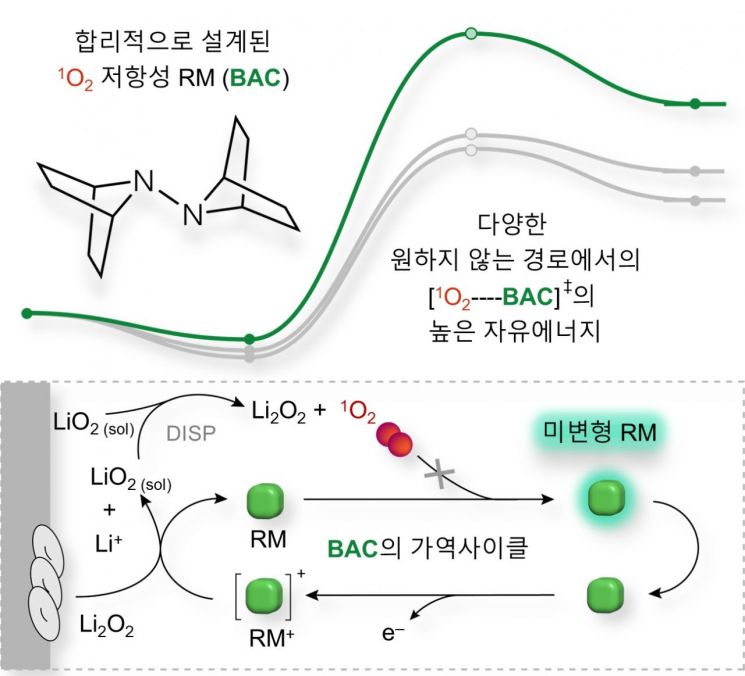 An illustration showing the structure of the redox mediator BAC developed by the joint research team at Ajou University and its high free energy reaction pathway with singlet oxygen. It demonstrates the reversible cycle in which BAC maintains stable performance against singlet oxygen within lithium-oxygen batteries.
 This study focused on overcoming the degradation of conventional mediators caused by reactive oxygen species (ROS) and the performance deterioration due to lithium peroxide accumulation.
The research team combined density functional theory (DFT) calculations with experimental approaches to design chemically stable BACs featuring two bicyclic dimer structures. These mediators reduce the high overpotential generated during the charging and discharging processes of lithium-oxygen batteries and promote the efficient decomposition of lithium peroxide, maximizing the battery's energy efficiency. As a result, it is expected to significantly contribute to extending battery life and improving stability.
The research findings were published in the January issue of Advanced Materials, attracting international academic attention. In addition to Professor Seong-Eun Seo, Professor Won-Jin Kwak from Ulsan National Institute of Science and Technology and Professor Shuming Chen from Oberlin College in the United States participated as co-corresponding authors. Furthermore, Ji-Won Hwang, a graduate student in the Department of Energy Systems at Ajou University (co-first author), Myung-Soo Choi, a researcher at the Next-Generation Energy Science Research Institute, and Ha-Eun Choi, a graduate student in the Department of Energy Systems, contributed as co-authors.
Currently, commercialized lithium-ion batteries are used in various fields such as smartphones, laptops, and electric vehicles; however, the need for next-generation battery development has emerged due to risks of ignition and energy capacity limitations. Lithium-oxygen batteries have attracted significant attention for being lightweight and having an energy density more than ten times higher, but side reactions occurring during repeated charging and discharging have been obstacles to commercialization.
The development of this novel redox mediator is expected to overcome these limitations, greatly improving the charging/discharging efficiency of lithium-oxygen batteries and enabling long-term stable high-power operation. Professor Seong-Eun Seo explained, “The mediator developed by our research team fundamentally solves existing problems, laying the foundation to overcome the commercialization barrier. This technology can also be applied to similar energy storage systems and catalytic technologies, creating ripple effects across the next-generation energy industry.”
This research achievement is evaluated to play an important role in strengthening the competitiveness of next-generation battery technologies, which are attracting attention from the government and industry. The research team plans to accelerate technology transfer and commercialization through additional verification, such as long-term cycling experiments of practical battery cells.
© The Asia Business Daily(www.asiae.co.kr). All rights reserved.












