High AI Exposure and High Complementarity Bring Productivity and Wage Gains
If Only Population Is Considered, Korea's GDP to Drop 16.5% by 2050
AI Adoption Reduces Decline to 5.9%
An analysis has emerged that doctors, financial experts, and university professors in Korea will greatly benefit from the introduction of artificial intelligence (AI). These occupations are highly exposed to AI but are difficult to replace due to their social and physical job attributes.
High AI Exposure and High Complementarity Lead to Increased Productivity and Wages, Resulting in Benefits
According to the 'AI and the Korean Economy' study jointly conducted by the Bank of Korea and the International Monetary Fund (IMF) on the 10th, occupations with 'high exposure and high complementarity' are more likely to enjoy productivity improvements and wage increases through AI adoption. This includes doctors, Korean medicine doctors, company CEOs and senior executives, financial experts, university professors, and customer service managers.
Early research on the impact of AI adoption viewed occupations with higher AI exposure as having a greater risk of replacement. However, the Bank of Korea explained that in this study with the IMF, AI complementarity was introduced for a more in-depth analysis. AI exposure indicates the extent to which tasks performed by a specific occupation can be replaced by AI. AI complementarity shows the degree to which an occupation is protected from AI replacement risk due to its social and physical attributes.
When adjusting AI exposure by complementarity, it was confirmed that the exposure of medical care professionals, previously considered highly exposed, decreased. Occupations previously classified as having low exposure, such as construction and mining machine operators, transportation service workers, construction structure workers, electricians, plumbers, police/firefighters and correctional officers, ship crew and related workers, construction workers, and sports and recreation experts, also appeared as low-exposure occupations.
Oh Sam-il, team leader of the Employment Research Team at the Bank of Korea's Research Department, said, "Considering the critical nature of decision-making, certain tasks are likely to remain under human supervision rather than relying entirely on AI in our society." He added, "Initially, research focused on exposure to identify who would be most adversely affected by AI adoption. It was expected that cognitive jobs, mainly high-income and highly educated ones, would be replaced. However, this study incorporated complementarity for occupations such as judges and surgeons, which, despite high AI exposure, are likely to be performed by humans due to their social and physical attributes."
On the other hand, occupations with 'high exposure and low complementarity' are more likely to have their tasks replaced by AI. This can lead to lower wages and job loss risks. Office jobs are representative examples. This group includes accounting and clerical staff, telecommunications sales workers, and computer system experts.
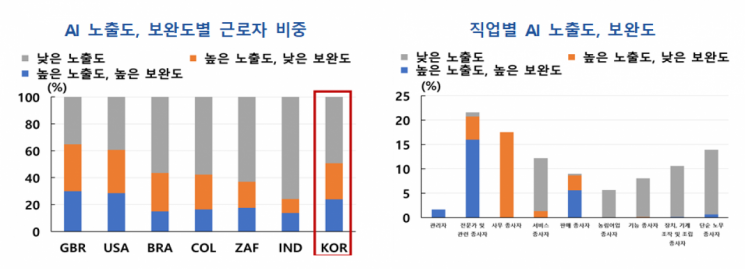
Occupations exposed to job replacement risk due to AI account for 51%. Twenty-four percent of all workers belong to the 'high exposure, high complementarity' group that can benefit from AI productivity gains, while 27% belong to the 'high exposure, low complementarity' group, which faces a high likelihood of replacement or income reduction due to AI.
It is particularly explained that AI will be both a 'crisis and an opportunity' for women, youth, and high-skilled and high-income groups. As AI exposure and complementarity rise together, differentiation within these groups is also expected to intensify. Team leader Oh said, "AI adoption reduces labor demand while requiring new technical skills. In this situation, the rigidity and dual structure of the domestic labor market may make job transitions difficult for workers, especially posing significant challenges for the elderly."
He added, "It is important to facilitate transitions from occupations with high replacement risk to those with low risk. Looking at past data, the rate of moving from vulnerable jobs to beneficial ones is about 30%, and increasing this number will be the most important policy task."
Based on Population Alone, Korea's GDP Expected to Decline 16.5% by 2050... AI Adoption Reduces Decline to 5.9%
AI is emerging globally as a 'key driver of industrial innovation.' Particularly, Korea faces a significant opportunity in the high-spec semiconductor industry due to the AI boom, while also experiencing the fastest aging among advanced countries, making the impact of AI adoption substantial.
AI technology adoption is an important opportunity to increase Korea's economic growth potential and productivity. According to the Bank of Korea's model simulation results, AI adoption can increase productivity by 1.1?3.2% and gross domestic product (GDP) by 4.2?12.6%, depending on the scenario. This level can largely offset the growth slowdown caused by aging. Team leader Oh specifically analyzed, "In the third scenario, where AI complements labor and boosts overall productivity, total factor productivity increases by 3.2%, and GDP rises by 12.6%." When considering only labor supply and excluding other variables, Korea's GDP is expected to decline by 16.5% from 2023 to 2050, but under the third scenario, the decline narrows significantly to 5.9%.
The productivity improvement effect from AI adoption was notably observed in 'large corporations' and 'long-established companies.' This suggests that productivity gaps between companies may deepen after AI adoption. Team leader Oh pointed out, "Such imbalance increases the likelihood that small and medium-sized enterprises or startups will be excluded from AI adoption benefits, indicating a need for policy intervention."
Korea is evaluated as well-prepared for AI adoption, possessing superior digital infrastructure and innovation capabilities compared to advanced countries. The AI readiness index ranks 15th out of 165 countries, higher than major advanced nations. By sector, Korea scored relatively well in innovation and economic integration (3rd), regulation and ethics (18th), and digital infrastructure (18th). However, there is considerable room for improvement in human capital utilization and labor market policies (24th). Team leader Oh said, "Tailored policies are needed to enhance labor market flexibility through education and retraining programs while strengthening social safety nets for vulnerable groups."
© The Asia Business Daily(www.asiae.co.kr). All rights reserved.













