Sharing Achievements of Regional and Youth Growth Together
Dongseo University (President Jang Je-guk) recently held the '2024 Work-Learning Dual System Performance Sharing Meeting' at the Park Hyatt Busan, expressing gratitude to companies and students who contributed to regional development and the resolution of youth unemployment through industry-academia cooperation.
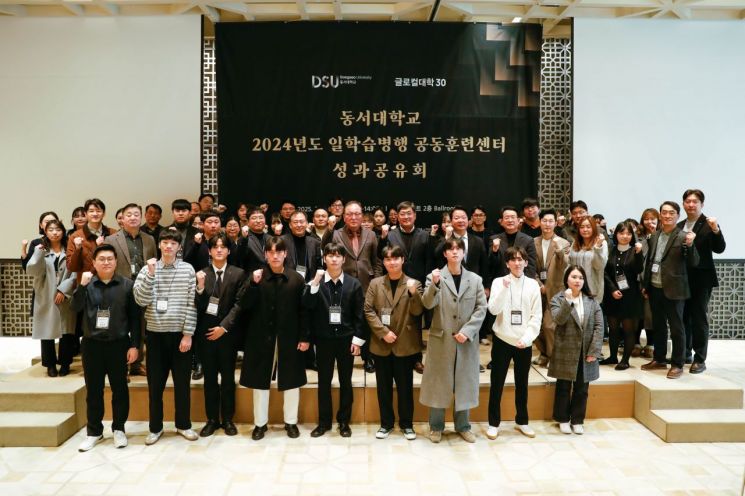 Dongseo University held the '2024 Work-Learning Dual System Project Performance Sharing Meeting.' Photo by Dongseo University
The event was attended by about 90 guests, including representatives from participating companies in 2024 and new companies for 2025, outstanding participants, and university faculty and staff.
Dongseo University awarded plaques of appreciation to a total of eight companies?KTE, BNK System, C-Lab, Hotel Lotte Signiel Busan, Samwon FA, Angel, Kyungsung Industry, and Corens?that actively participated in the Work-Learning Dual System project and provided students with high-quality on-site training opportunities. Additionally, nine outstanding student participants were selected and awarded certificates and scholarships.
The Work-Learning Dual System is a new industry-academia cooperation education model that provides field-centered training between universities and companies, sponsored by the Ministry of Employment and Labor and the Human Resources Development Service of Korea.
Currently, Dongseo University operates two projects: the IPP-type Work-Learning Dual System and the Advanced Industry Academy. Throughout 2024, 47 enrolled students from 25 companies have improved their practical skills.
Jung Do-woon, Joint Training Center Director of the Work-Learning Dual System at Dongseo University, stated, “As youth outmigration accelerates, Dongseo University will maximize the synergistic effects of coexistence with companies by fostering talent across all industrial sectors and advanced fields in the region through specialized education, creative employment clubs, and professional NCS competency unit-based education. Furthermore, we will promote the expansion of the Work-Learning Dual System and regional development through continuous industry-academia cooperation with local companies, and we plan to create new educational models for the qualitative advancement of the Work-Learning Dual System in the future.”
© The Asia Business Daily(www.asiae.co.kr). All rights reserved.












