Quota Negotiations During Trump's First Term
Export Volume May Decrease Further
Consideration of Investment in U.S. Production Facilities
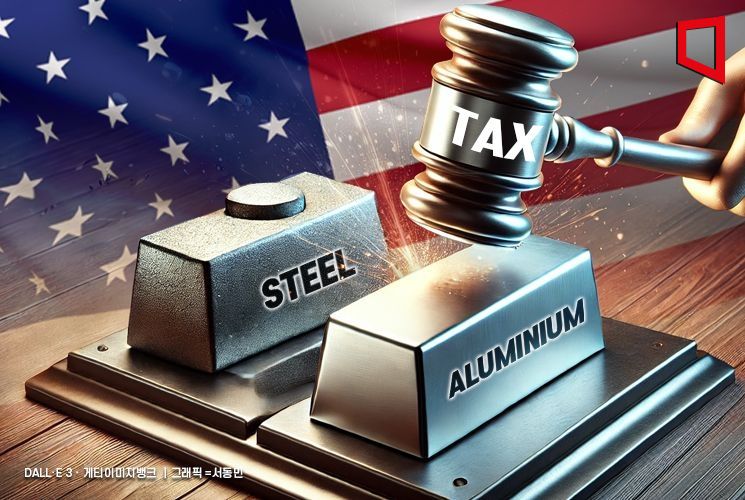
U.S. President Donald Trump has announced that he will impose a 25% tariff on all steel and aluminum products entering the United States on the 11th, prompting the domestic related industry to closely monitor the situation. Although there are immediate concerns about negative impacts such as export price increases and volume reductions, voices are emerging that it is necessary to understand the detailed contents of related policies, including additional tariffs or quota systems limiting export volumes, and respond accordingly.
According to the industry on the 10th, the three major domestic steel companies (POSCO, Hyundai Steel, Dongkuk Steel) are on high alert regarding the tariff measures announced by the Trump administration in the U.S. and are considering ways to minimize management uncertainties as the measures become a reality. An industry official said, "We are continuously monitoring trade policies and striving to accurately understand the details." However, the consensus in the industry so far is that short-term damage is inevitable.
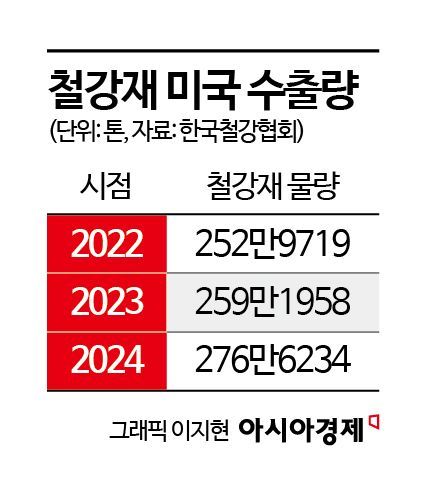
Previously, President Trump applied Section 232 of the Trade Expansion Act during his first administration in 2018 to impose a 25% tariff on imported steel. The rationale was that the U.S. steel industry, essential for manufacturing automobiles, weapons, and other products, was being encroached upon by other countries, posing a threat to national security. At that time, South Korea, which was in the midst of renegotiating the Korea-U.S. Free Trade Agreement (FTA), hurriedly entered steel negotiations. Ultimately, South Korea was granted a tariff exemption but was subjected to a quota system limiting annual exports to the U.S. to approximately 2.63 million tons.
In this context, if the universal steel tariff is imposed as President Trump has announced, the volume of exports to the U.S. is likely to decrease further. Consequently, export damage is expected mainly in high value-added products such as automotive steel sheets, which have higher prices. Another industry official said, "Our steel industry is already in a poor condition, so short-term negative impacts are unavoidable," adding, "In the long term, we need to explore whether South Korea can be used as leverage between China and the U.S. and devise niche strategies."
There is also a possibility that U.S. steel tariffs will intensify China's low-priced steel export offensive. China, suffering from sluggish domestic demand, is resolving its excess steel production through exports. If the U.S. imposes tariffs, low-priced Chinese steel is likely to flood global markets such as Asia and Europe instead of the U.S. This would exacerbate the global steel oversupply, making it difficult for Korean steel companies to avoid price declines and profitability deterioration in a chain reaction.
Some in the industry are already calling for a direct breakthrough by actively investing in local production facilities. Recently, Hyundai Steel has been considering a large-scale investment to build a new steel mill in the U.S. to produce automotive steel sheets, which aligns with this context. There are also calls for the Korean steel industry to develop eco-friendly and high value-added products and to more aggressively target the global market based on technological competitiveness.
However, since detailed policy information has not yet been announced, cautious views that it is necessary to wait and see also coexist. An industry official said, "Uncertainty regarding tariffs poses a significant risk to domestic companies," adding, "We need to closely monitor U.S. policy trends and seek response measures."
The fact that country-specific negotiations took place after the tariff announcement during Trump's first administration adds weight to this cautious stance. Han Areum, senior researcher at the Korea International Trade Association, said, "During the first term, quotas were negotiated, and a kind of volume-based tariff exemption was obtained," adding, "Although President Trump is taking a tough stance, it is necessary to examine whether there is room for country-specific negotiations once the specific details are announced."
© The Asia Business Daily(www.asiae.co.kr). All rights reserved.













