One in Four Aircraft Depart or Arrive Late
Air Seoul Has the Highest International Flight Delay Rate
Last year, one out of every four aircraft operated by domestic airlines departed or arrived at least 15 minutes later than the scheduled time. There are calls for the industry to make improvement efforts and for authorities to enforce thorough management and supervision to address the chronic aircraft delays.
On the 9th, according to data submitted by the Ministry of Land, Infrastructure and Transport and the aviation industry, provided by Ahn Tae-jun, a member of the National Assembly's Land, Infrastructure and Transport Committee from the Democratic Party of Korea, the average delay rate for domestic and international flights of 10 domestic airlines last year was 25.7%.
The Ministry of Land, Infrastructure and Transport counts a flight as delayed if it departs or arrives at the gate more than 15 minutes later than the planned operating schedule (the scheduled time indicated on the ticket). Based on this criterion, out of 678,489 flights last year, 174,078 were recorded as delayed. For domestic flights, 82,214 out of 370,306 flights (22.2%) were delayed, and for international flights, 91,864 out of 308,183 flights (29.8%) were delayed.
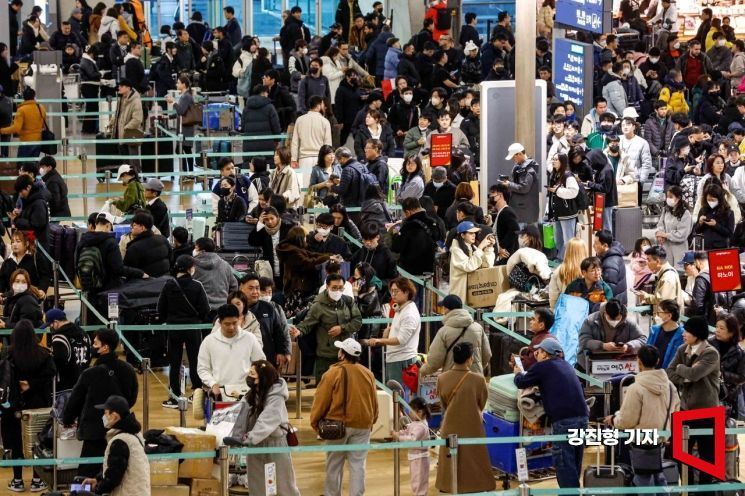 On the 24th, travelers visiting Incheon International Airport Terminal 1 were lining up to check in.
The annual delay rate last year also increased by 2.1 percentage points from the previous year to 23.6%. While the domestic flight delay rate decreased by 1.5 percentage points, the international flight delay rate rose by 6.5 percentage points, driving up the overall delay rate. A Ministry of Land, Infrastructure and Transport official explained, "The increase in international flights in 2024 has led to severe airport congestion, and frequent turbulence has caused some restrictions on international air routes."
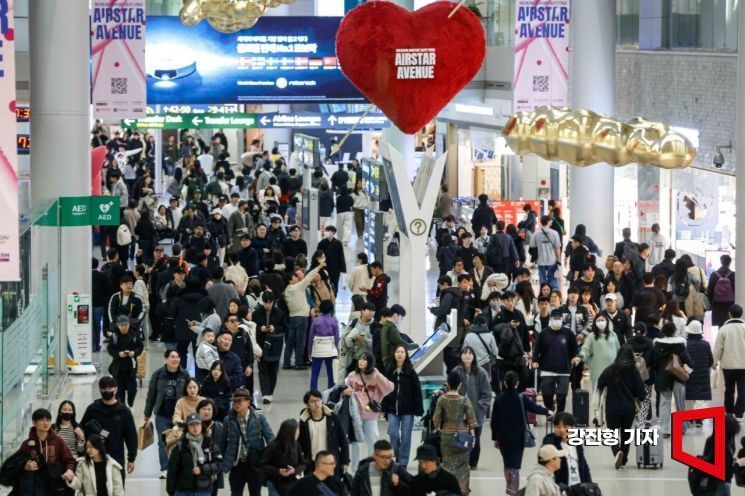 On the 24th, the duty-free area of Terminal 1 at Incheon International Airport was bustling with travelers.
The airline with the highest delay rate last year for international flights was Air Seoul. Out of 9,644 flights, 4,492 flights (46.6%) were delayed in departure or arrival. Eastar Jet followed with 38% (4,374 out of 11,507 flights), and Jin Air with 35.4% (11,370 out of 32,115 flights).
Conversely, the airline with the lowest international flight delay rate was Air Busan, with only 3,866 out of 22,344 flights (17.3%) delayed.
For domestic flights, T'way Air had the highest delay rate at 31.3%, with 13,635 out of 43,628 flights delayed. The second highest was Air Seoul with a 31% delay rate (1,330 out of 4,296 flights).
Asiana Airlines had the lowest delay rate at 17.2%, with 9,388 out of 54,464 flights delayed.
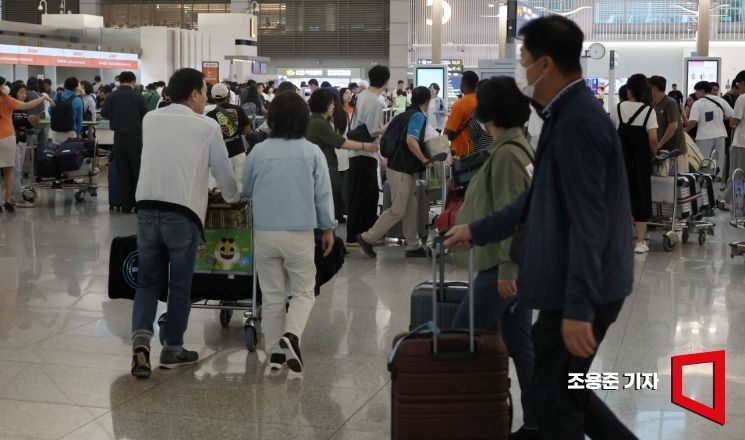 Last September, the departure hall of Incheon International Airport Terminal 1 was bustling with crowds heading overseas during the holiday period.
Assemblyman Ahn Tae-jun said, "Despite the increasing demand for air travel, efforts must be made to keep the promise of punctuality to passengers. If delays occur due to necessary aircraft maintenance, more thorough inspections must be conducted to prevent the recurrence of the same issues."
Meanwhile, last year, the total number of flights delayed due to 'maintenance' reasons among domestic airlines was 4,648 (combined domestic and international flights). The delay rate was 0.7%, a 0.1% increase from the previous year (0.6%). The annual maintenance-related delay rate was highest for Air Premia at 2.7% (68 out of 2,479 flights). This was followed by T'way Air at 1.1% (900 out of 79,675 flights), Air Busan at 0.91% (576 out of 63,178 flights), and Jeju Air at 0.89% (937 out of 105,298 flights).
© The Asia Business Daily(www.asiae.co.kr). All rights reserved.














