Professor Seunghyup Yoo's KAIST Team:
"Expectations for Early Disease Diagnosis and Improvement of Rebreathing Side Effects"
A 'real-time sleep apnea diagnostic sensor' that measures carbon dioxide concentration by attaching inside a mask has been developed.
Carbon dioxide is a major respiratory metabolic product, and continuous monitoring of carbon dioxide concentration serves as an important indicator for early detection and diagnosis of respiratory and circulatory diseases. It can also be widely used for monitoring individual exercise status.
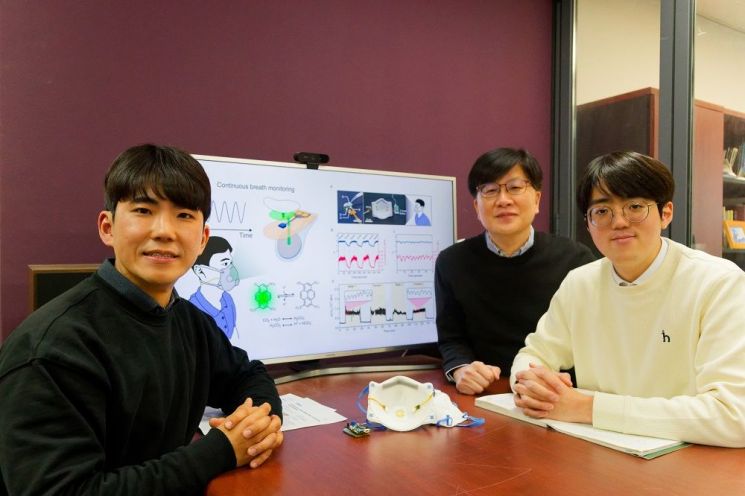 From the left, Dongho Choi, Ph.D. candidate, Department of Electrical Engineering, KAIST; Seunghyup Yoo, Professor; Minjae Kim, undergraduate student, Department of Materials Science and Engineering. Provided by KAIST
On the 10th, Professor Seunghyup Yoo's research team from the Department of Electrical Engineering at KAIST announced the development of a low-power, high-speed wearable carbon dioxide sensor capable of stable real-time respiratory monitoring.
Existing non-invasive carbon dioxide sensors were bulky and consumed a lot of power. Photochemical carbon dioxide sensors using fluorescent molecules could be miniaturized and lightweight, but had the disadvantage of difficulty in stable long-term use due to photodegradation of dye molecules.
The research team focused on the fact that the intensity of fluorescence emitted from fluorescent molecules in photochemical carbon dioxide sensors decreases according to the carbon dioxide concentration. Concentrating on effectively detecting changes in fluorescence, they developed a low-power carbon dioxide sensor composed of a light-emitting diode (LED) and an organic photodiode surrounding it.
Based on the previously high light-receiving efficiency, sensors that minimized the excitation light irradiated on fluorescent molecules consumed several milliwatts (mW), but the newly developed sensor is an ultra-low-power sensor consuming 171 microwatts (μW), which is several tens of times lower than existing sensors. It is flexible and lightweight, can be attached inside a mask to accurately measure carbon dioxide concentration, and can distinguish inhalation and exhalation in real time to monitor respiratory rate.
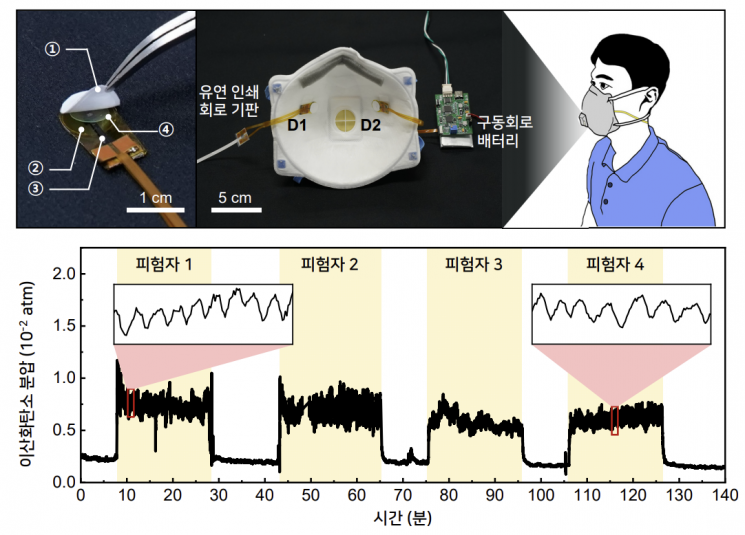 Wearable smart mask and real-time breathing monitoring. Photo by Professor Seunghyup Yoo's research team at KAIST.
The sensor efficiently reduces errors caused by photodegradation, a chronic problem of existing photochemical sensors, enabling stable continuous use for up to 9 hours (compared to within 20 minutes for existing technology), and allows multiple uses by replacing the carbon dioxide sensing fluorescent film.
Professor Seunghyup Yoo said, "The developed sensor has excellent characteristics such as low power consumption, high stability, and flexibility, making it widely applicable to wearable devices and usable for early diagnosis of various diseases such as hypercapnia, chronic obstructive pulmonary disease, and sleep apnea. In particular, it is expected to be used to improve side effects caused by rebreathing in environments requiring long-term mask wearing, such as dust generation sites or during seasonal changes."
The research, co-first authored by Minjae Kim, an undergraduate student in the Department of Materials Science and Engineering at KAIST, and Dongho Choi, a doctoral student in the Department of Electrical Engineering, was published online on the 22nd of last month in 'Device,' a sister journal of Cell.
© The Asia Business Daily(www.asiae.co.kr). All rights reserved.













