In a CNN Interview, Macron Criticizes the Reality Facing the EU
"Europe Should Aim for 20% of the World's Data Centers"
"Attracting Capital from the U.S. and Gulf Region Is Essential for Investment"
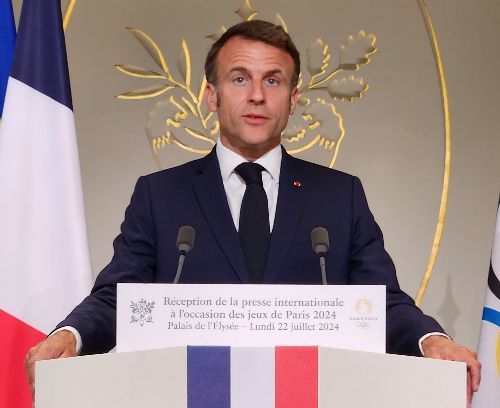 French President Emmanuel Macron is speaking at the Olympic foreign press reception held at the ?lys?e Palace in Paris on July 22 last year (local time). President Macron pointed out the serious lack of AI competitiveness in Europe during an interview with CNN in the United States on the 8th (local time). / Yonhap News
"Europe is falling behind in the artificial intelligence (AI) race."
Emmanuel Macron, President of France, who is co-hosting the AI summit this week in Paris with India, pointed out on the 8th (local time) that Europe’s lack of AI competitiveness is serious and that this situation could cause significant economic losses to the European Union (EU).
He cited the need for an AI strategy as "to close the gap with the United States and China." Macron also expressed concern that "Europe is at risk of becoming a mere consumer of AI," which could lead to losing the ability to control technological development and direction.
In fact, U.S. companies, centered around OpenAI, the developer of 'ChatGPT,' are leading the global AI dominance competition. The U.S. government has also nurtured and protected domestic technology through measures such as restricting semiconductor chip exports to China since the previous Biden administration to compete for technological supremacy. In China, despite U.S. restrictions, the recent emergence of the low-cost AI model DeepSeek has surprised the world.
The most urgent measures for AI competition are expanding investments across Europe and regulatory reforms favoring businesses. Looking at France alone, it is a country with a high self-sufficiency rate in nuclear-based energy, making it advantageous for building large-scale data centers. The Mont Val?rien military facility is planned to be used for improving next-generation aircraft carrier design and defense industry technology by utilizing AI technology. This will also be applied to the development of drone defense technology. However, the story changes when expanding the scope to the entire Europe. Europe holds only 3-5% of the world’s computing power, which is considered a disadvantage in the AI race.
President Macron emphasized, "Europe should aim to build 20% of the world’s data centers." He also stressed, "Attracting capital from the U.S. and the Gulf region (Arab countries) is essential," and reiterated that "Europe must invest more actively to secure AI competitiveness."
A regulatory reform roadmap for AI startups is also scheduled to be announced between February and March. President Macron said, "Unnecessary regulations must be eliminated and the current environment simplified," emphasizing that "Europe should create a business-friendly environment and keep pace with the U.S."
This awareness of the issue is also the background behind France’s initiative to hold the Paris AI summit on the 10th-11th (local time). In other words, it is one of Macron’s strategic moves to make France the center of global AI discussions and policy decisions. He also expressed hope that this AI summit will serve as an important "wake-up call" for Europe and that Europe will push for changes to regain leadership in the AI race.
Meanwhile, regarding former U.S. President Donald Trump’s use of tariffs as a bargaining chip, President Macron expressed dissatisfaction. He pointed out that the digital service export volumes of major U.S. tech companies such as Google and Apple are significant but were omitted from the calculations. According to the U.S. government, the U.S. trade deficit with the EU in 2024 was recorded at $235.6 billion, an increase of $26.9 billion. President Macron countered, saying, "It is unreasonable to exclude Europe’s digital service expenditures from the trade deficit calculations."
© The Asia Business Daily(www.asiae.co.kr). All rights reserved.












