Trade Security Management Institute Releases Report on Export Control Reinforcement
Japan and the Netherlands Announce Stronger Export Controls on Semiconductors
Expert: "Need to Strengthen South Korea's Position Within Supply Chain Structure"
As the United States strengthens export controls against China in response to the launch of China's generative artificial intelligence (AI) 'DeepSeek,' countries such as Japan and the Netherlands are also stepping up export control measures. Analysis suggests that the impact on South Korea in advanced technology sectors like semiconductors will be limited and may even present opportunities.
The Trade Security Management Institute announced on the 10th that it has consecutively published reports covering issues such as "The Netherlands Significantly Expands Independent Control Scope on Semiconductor Manufacturing Equipment" and "Japan Strengthens Export Controls on Emerging Technologies Including Semiconductors and Quantum Computers."
According to the reports, the Japanese government announced amendments to export controls on emerging technologies such as semiconductors and quantum computers on April 31. The amendment will undergo public consultation until May 1 and is expected to be implemented as early as May. With this measure, the Japanese government added export control measures for 22 types of semiconductor equipment, 2 types of AI, and 6 types of quantum computer-related equipment.
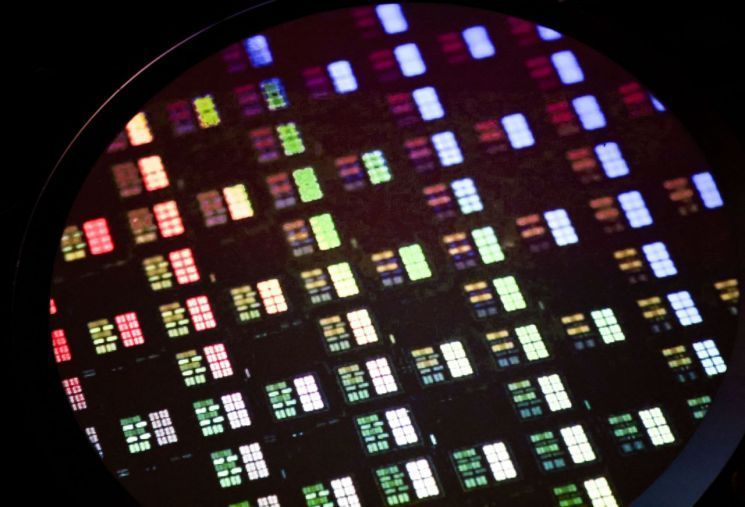
For semiconductor equipment, devices used in advanced semiconductor manufacturing processes such as lithography, etching, deposition, cleaning, and inspection have been added to the export control list or had their controls strengthened. In the AI sector, two new control targets were registered: integrated circuits for AI with bidirectional transmission speeds of 600GB/s or higher, and AI integrated circuit computers. Six new quantum computer operation devices, including cryogenic wafer (silicon wafer for semiconductor manufacturing) measurement equipment, cryogenic cooling equipment, and cryogenic low-noise amplifiers, were also added to the control list. For design and manufacturing technologies essential to semiconductor production, such as extreme ultraviolet (EUV) photoresists, a strengthened specific general license policy will be applied. Accordingly, even for exports to white-listed countries, general licenses will only apply if the transaction counterpart is pre-approved. However, for exports to South Korea, the relaxed general license policy will continue to apply as before.
The Japanese government also decided to strengthen catch-all controls that manage exports of items potentially usable for weapons. Previously, export controls applied only to items exported from Japan to weapon embargoed countries, but going forward, to block the possibility of indirect exports via 'Group A countries' to weapon embargoed countries, exports to Group A countries will also be controlled if notified by the Ministry of Economy, Trade and Industry. Group A countries correspond to the existing white-listed countries, including 27 nations such as the United States, Canada, Australia, the United Kingdom, and South Korea.
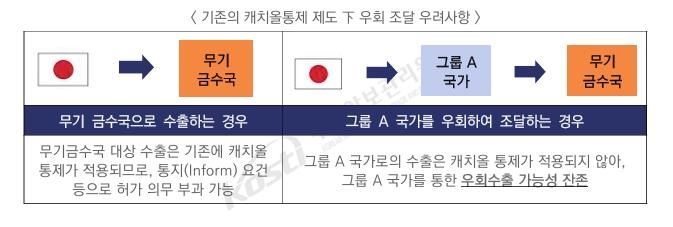 Strengthening of Japan's Catch-All Control System, Provided by the Trade Security Management Institute
Japan plans to expand its list of "Important Controlled Technologies" to prevent technology leakage by newly adding five items, including three types related to lithium-ion battery separators, electrolytes, and binders, as well as titanium sponge and giant magnetoresistance sensors, increasing the total controlled technologies to 15.
Earlier, on March 15, the Netherlands announced amendments to its independent export control measures on advanced semiconductor manufacturing equipment, scheduled to take effect in April. In response to the U.S. strengthening semiconductor export controls last December, the Netherlands will tighten controls on equipment essential for producing high-bandwidth memory (HBM), such as silicon through-via (TSV) etching equipment and imprint lithography equipment capable of advanced semiconductor patterning. Most of these are U.S. independently controlled items, including inline inspection equipment and overlay metrology equipment mainly handled by ASML, the world's largest semiconductor equipment manufacturer based in the Netherlands.
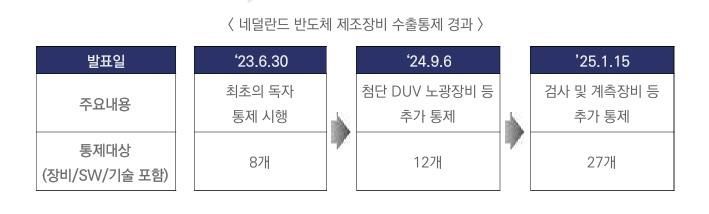 Netherlands Semiconductor Manufacturing Equipment Export Control Progress, Provided by Trade Security Management Institute
The Netherlands first implemented independent controls on eight types of semiconductor equipment in June 2023 and expanded the control list to 12 types, including advanced deep ultraviolet (DUV) lithography equipment, in September last year. With this latest measure, the number of controlled items will increase to 27. The report analyzed that "the Netherlands is actively responding to major countries' semiconductor manufacturing equipment controls by adopting control scopes and technical specifications similar to those of the United States."
Western countries' export controls are being implemented under a de-China policy aimed at curbing China's semiconductor and technology rise. South Korean companies and the government are closely monitoring how this trend will affect South Korea's exports and industries.
However, experts analyze that the impact of protectionism on South Korea will be limited if confined to the semiconductor industry. Kyunghee Kwon, a research fellow at the Korea Institute for Industrial Economics & Trade, said, "In the process of the U.S. rebuilding its de-China supply chain, there appears to be no damage to South Korea's semiconductor industry; rather, there is a need to strengthen its position within the supply chain structure." He added, "The reduced dependence on Taiwan in advanced semiconductor processes could also be an opportunity for South Korea." He further noted, "As the U.S. strengthens trade tariff policies, production bases in Vietnam and India, where South Korea has facilities, may come under scrutiny, so efforts to obtain exceptions seem necessary."
© The Asia Business Daily(www.asiae.co.kr). All rights reserved.














