Preparation of Urban Management Guidelines Considering Surrounding Land Use
Urban Planning Project for Coexistence of Cultural Heritage and Development to Begin Next Month
Active Review of View Corridors and Utilization to Enable Improvements While Preserving the Landscape
A plan is being prepared to develop the densely concentrated cultural heritage sites in downtown Seoul more efficiently. It is a management measure that can develop the surrounding areas while enhancing the landscape without damaging the cultural heritage.
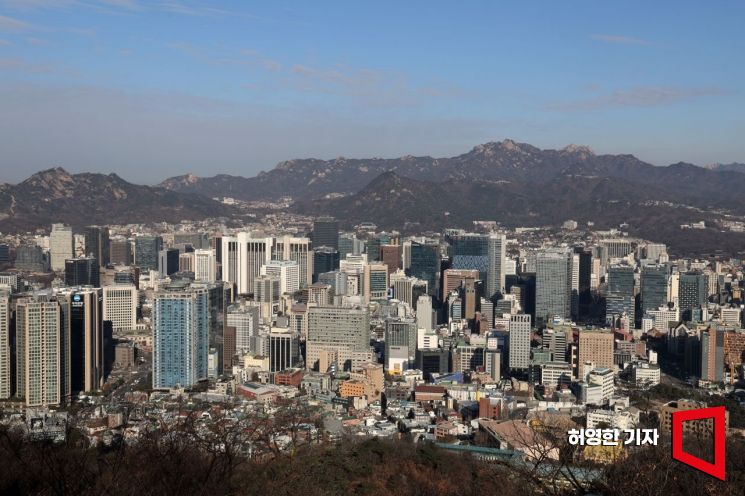
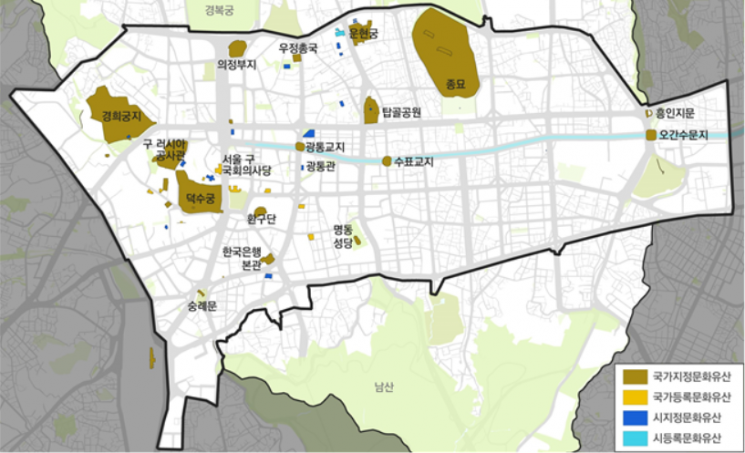
On the 10th, the Seoul Metropolitan Government announced that it will start a project next month to establish new urban management guidelines. Through this project, it aims to break away from the uniform regulatory approach around cultural heritage sites and present solutions based on urban management plans that reflect various urban elements. At the ‘Urban Space Policy Conference’ held in July last year, it was pointed out that while cultural heritage sites in the city center are densely concentrated and located in rapidly changing environments, they have not been continuously harmonized with the surrounding environment. Subsequently, the opinion was presented that urban planning tailored to each cultural heritage site could be a solution.
The angular regulation around cultural heritage sites has been operated as a management principle limiting the height of buildings around cultural heritage sites for over 40 years since it was first introduced in 1981. The angular regulation sets a 27-degree angle based on the boundary of the cultural heritage site and restricts the number of building floors only within the allowable range of this angle. This regulation was established to prevent the destruction of cultural assets due to indiscriminate development. However, the flat and uniform regulation centered on cultural heritage sites has continuously raised the need for improvement due to aging surrounding areas and infringement on citizens’ property rights.
Based on the guidelines to be prepared after this project, the city will select pilot targets among urban renewal redevelopment zones. Then, it will prepare guidelines that suggest the possible scope of construction, such as securing open spaces for effective view corridors and setting building heights. Afterward, it will proceed with changing the allowable standards through consultations with relevant institutions.
Jo Nam-jun, head of the Urban Space Headquarters of Seoul City, said, "This project will be an opportunity to prepare effective improvement measures for regulatory reform in line with the transition to a national heritage system," adding, "While envisioning a future-oriented urban landscape, we aim to realize a city culture centered on cultural heritage and citizens in harmony."
© The Asia Business Daily(www.asiae.co.kr). All rights reserved.













