The Greek government declared a state of emergency on the 6th (local time) as earthquakes continued unabated on Santorini Island, a world-renowned tourist destination in Greece.
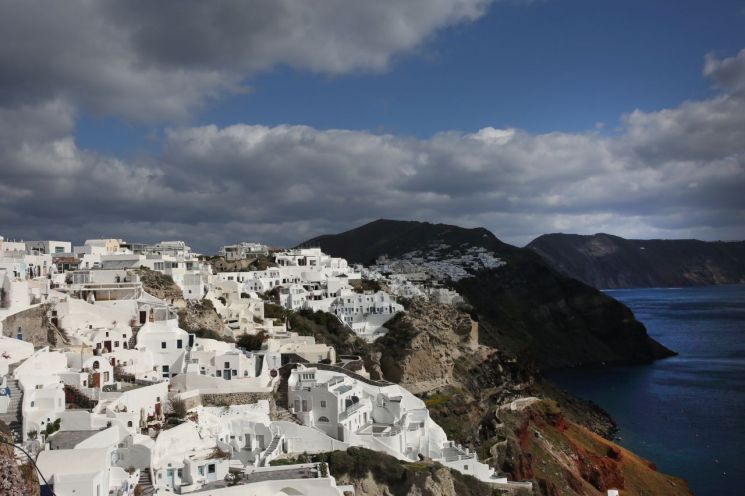 On the 5th (local time), an earthquake occurred near Santorini Island, Greece, prompting the Greek government to recommend restricted access. This followed more than 10 earthquakes exceeding magnitude 4.0 since the 4th. Photo by EPA Yonhap News
According to US CNN and other media, the Greek Civil Protection Department declared a state of emergency for Santorini Island on the same day. This measure is valid until March 3.
Since the end of last month, earthquakes have been occurring almost daily on Santorini Island. On the previous night, the strongest earthquake during this seismic activity was recorded at magnitude 5.2. As this was the first earthquake exceeding magnitude 5.0, increasing the risk of landslides and rockfalls, the Greek government decided to declare a state of emergency.
According to AFP news agency, aftershocks continue, with seven consecutive earthquakes of magnitude 4.0 or higher occurring on the same day.
Experts are unable to accurately predict when the seismic activity will end. They emphasize that the current situation is very unusual. Dr. Athanasios Ganas, director of the Athens Geodynamics Institute, a major earthquake research institution in Greece, said in an interview with public broadcaster ERT, "The earthquake intensity is gradually decreasing, but it has not yet stabilized." Dr. Vasilis Katastathis, deputy director of the institute, also explained, "We are about halfway through the current activity."
According to the institute, more than 6,000 earthquakes have occurred since February 26 in the waters near Santorini Island, Amorgos Island, Anafi Island, and Ios Island. In response, Greek government spokesperson Pavlos Marinakis stated, "We are mobilizing all national response systems to prepare for any situation."
So far, it is estimated that more than 11,000 residents of Santorini Island have left the island by boat and plane. Santorini Island is a world-famous attraction visited by 3.4 million tourists annually, but currently, tourist visits have come to a complete halt.
The Greek government is providing additional ferry and flight services to assist evacuation. The previous day, evacuation was delayed due to a temporary suspension of ferry operations caused by bad weather, causing confusion. Fortunately, ferry operations resumed from that day.
Santorini Island is located on the boundary between the African Plate and the Eurasian Plate, making earthquakes frequent, but experts analyze that continuous seismic activity like this is a very rare phenomenon. Although this earthquake occurred near the volcano that last erupted in 1950, experts explain, "The current tremors are not related to volcanic activity."
© The Asia Business Daily(www.asiae.co.kr). All rights reserved.












