Additional Sacrificed Dog Found at Wolseong in Gyeongju
"Bone Structure Analysis Shows Death Was Not Natural"
Concrete evidence shedding light on the rituals practiced by the people of Saro-guk (斯盧國) 1,700 years ago has been discovered.
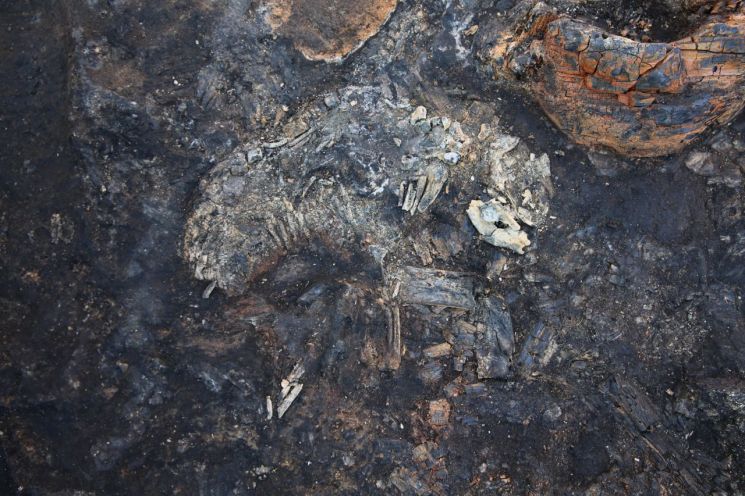
The Cultural Heritage Administration announced on the 6th that, following the discovery of animal bones presumed to be from a dog at the edge of a village southwest of Wolseong in Gyeongju last October, additional sacrificed dog remains have been confirmed. Wolseong was the capital city where the Silla palace was located. Since 2014, the Cultural Heritage Administration has been conducting excavation surveys of key Silla royal capital (王京) sites, including this area.
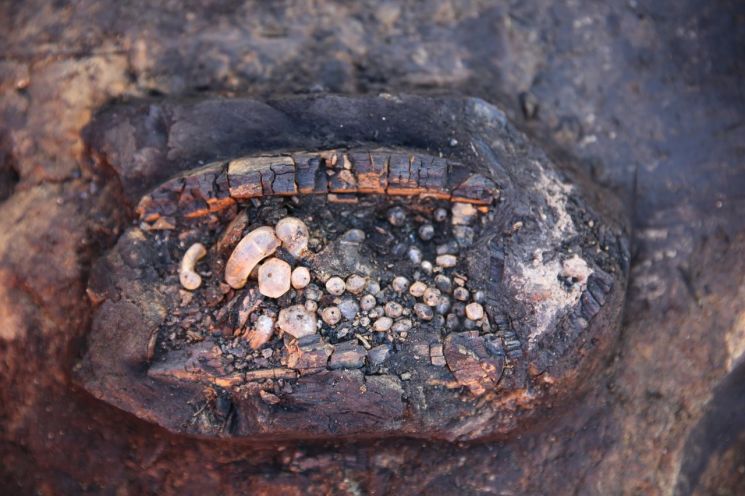
The newly discovered dog measured approximately 46 cm, smaller than the previously found dog which was 60 cm. The site where the remains were found was a circular structure with a diameter of 6 meters. Alongside the remains, lacquered wooden boxes, considered luxury items at the time, necklaces, a sword with a round ring, and twelve shark teeth were unearthed. Many of these artifacts have been dated to around the 3rd century. At that time, the Saro-guk, the precursor to Silla, existed in the Gyeongju area. It was one of the twelve Jinhan states, and scholars believe it lasted until the mid-4th century.
The Cultural Heritage Administration stated, "Considering the condition of the excavated artifacts and the surrounding circumstances, it is likely that after the ritual was performed, the area was burned." The two dogs were probably offerings, as they were found symmetrically on the left and right sides.
Kim Heon-seok, a curator at the National Gyeongju Cultural Heritage Research Institute, explained, "Analysis of the bone shapes indicates that the deaths were not natural. The cervical vertebrae were twisted due to strong pressure, and the leg bones were neatly arranged." He added, "Given the symmetrical placement of the two dogs, it is likely they were offered as sacrifices."
This is not the first time ritual traces have been found at Wolseong. Previously, bones of a man and woman estimated to be in their 50s were discovered beneath the fortress walls. Scholars interpret this as evidence of human sacrifice (人身供犧, insingonghui) intended to ensure the fortress’s strength. Choi Eung-cheon, head of the Cultural Heritage Administration, explained, "At Wolseong, rituals were conducted when settlements were established or fortress walls were constructed, transforming the site into a royal fortress. These ceremonies embodied the hearts and minds of the Silla people."
© The Asia Business Daily(www.asiae.co.kr). All rights reserved.













