2.0448 Trillion Won in Unpaid Wages Last Year, Up 14.6%
Economic Downturn in Construction and Large-Scale Collective Arrears Worsen Situation
1.6697 Trillion Won in Wage Arrears Cleared Last Year
Ministry of Employment and Labor to Strengthen Forced Investigations, Including Arrests, This Year
Minister Kim Moonsoo: "We Will Hold Responsible Parties Accountable to the End"
Last year, the amount of unpaid wages exceeded 2 trillion won, marking the largest scale ever recorded. This was due to sluggish economic conditions in industries such as construction, as well as large-scale collective wage arrears in some companies like Daewoo Winia and Qoo10. The government plans to strengthen forced investigations and criminal sanctions to prevent malicious wage arrears in the future. Efforts will also be made to prepare for the Habitual Wage Arrears Eradication Act, which will be implemented in October.
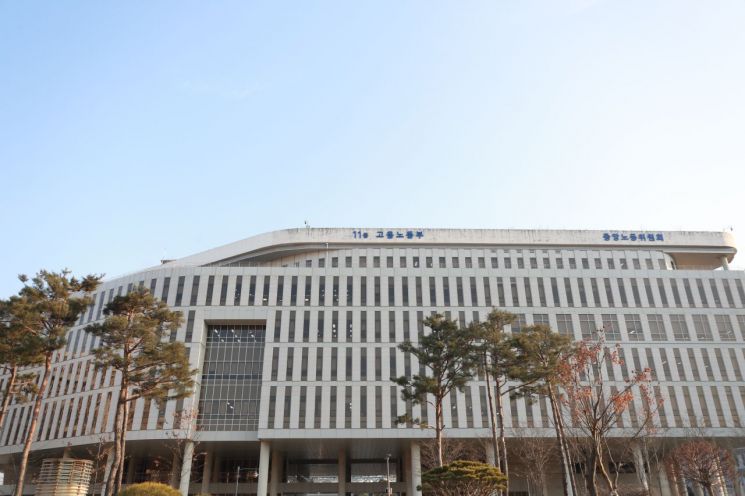
Kim Moon-soo, Minister of Employment and Labor, urgently convened the first "National Agency Heads Meeting" of the year on the 6th at the Seoul Regional Employment and Labor Office to discuss major labor issues such as reducing wage arrears and ordinary wages immediately after the Lunar New Year holiday. The meeting was attended by Kim Min-seok, Vice Minister of Employment and Labor, along with key directors and heads of regional employment and labor offices nationwide.
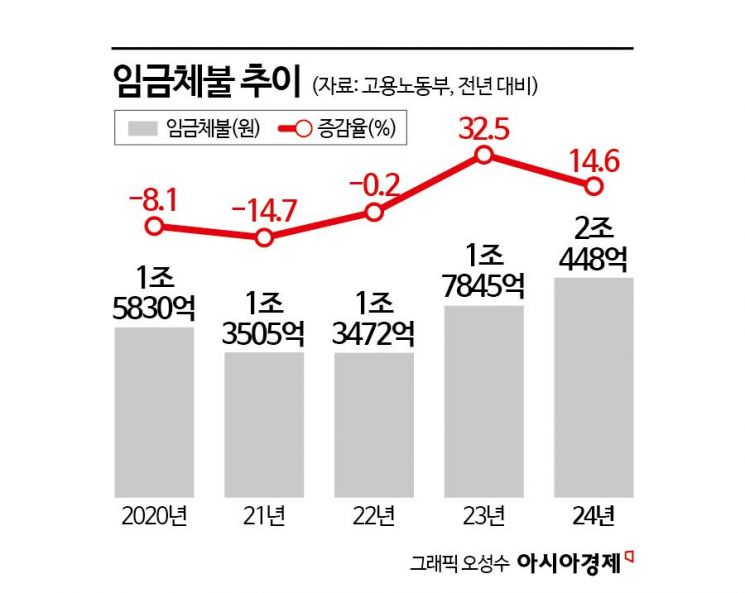
The Ministry of Employment and Labor announced that last year's wage arrears totaled 2.0448 trillion won, a 14.6% increase compared to the previous year. Although the growth rate was lower than the previous year's increase of 32.5%, it surpassed 2 trillion won for the first time, setting a record high. The number of workers affected by wage arrears was 283,121, a 2.8% increase from the previous year.
The economic downturn in industries such as construction, along with large-scale collective arrears in some companies like Daewoo Winia (119.7 billion won), Timef (Timon and Wemakeprice), and Qoo10 (32 billion won), which is related to the Timef incident, had an impact. The increase in total wages due to economic growth and a complacent social perception also contributed to the rise in wage arrears.
By industry, wage arrears in construction increased by 9.6% from the previous year to 478 billion won, accounting for a significant portion. Additionally, wholesale, retail, food service, and accommodation industries (264.7 billion won) increased by 16.7%, and transportation, warehousing, and telecommunications (247.8 billion won) rose by 57.0%.
As the severity of wage arrears increased last year, the Ministry of Employment and Labor took active measures. In June last year, the regulations on labor inspectors' duties were revised to activate forced investigations, and measures such as disclosing the names of high-amount and habitual wage arrears offenders and imposing credit sanctions were implemented while strengthening labor inspections. The Habitual Wage Arrears Eradication Act, which amends the Labor Standards Act, also passed the National Assembly.
Thanks to these efforts, the amount of wage arrears cleared last year reached 1.6697 trillion won, the largest clearance amount ever recorded. The clearance rate rose by 2.6 percentage points from the previous year to 81.7%. The current unsettled arrears amount to 375.1 billion won, and the Ministry plans to further strengthen wage arrears management going forward.
The Ministry of Employment and Labor plans to implement a "Wage Arrears Intensive Management Plan" with all regional employment and labor offices. In this process, malicious employers who withhold wages despite having the ability to pay or hide assets will face strengthened forced investigations, including arrest and detention regardless of the amount of arrears.
Efforts will also be made to strengthen criminal sanctions, such as requesting the Sentencing Commission to increase penalties for wage arrears crimes. For the Habitual Wage Arrears Eradication Act, which will be enforced in October, new grounds will be established to prohibit the departure of employers whose names are disclosed, and grounds for sanctions during recruitment will be prepared. To prevent the withholding of retirement allowances, which account for 40% of unpaid wages, a plan to gradually mandate retirement pensions according to workplace size will also be pursued.
Minister Kim emphasized, "Receiving wages properly, on time, and in full for the work done is the 'basic of basics' and the 'common sense of common sense' that needs no explanation." He added, "wage arrears are a serious crime against people's livelihood." He also stated, "The Ministry of Employment and Labor will maintain a strict stance in responding to wage arrears and will hold responsible parties accountable to the end according to law and principles."
© The Asia Business Daily(www.asiae.co.kr). All rights reserved.













