"Pursuing Cooperation Measures with Like-Minded Countries"
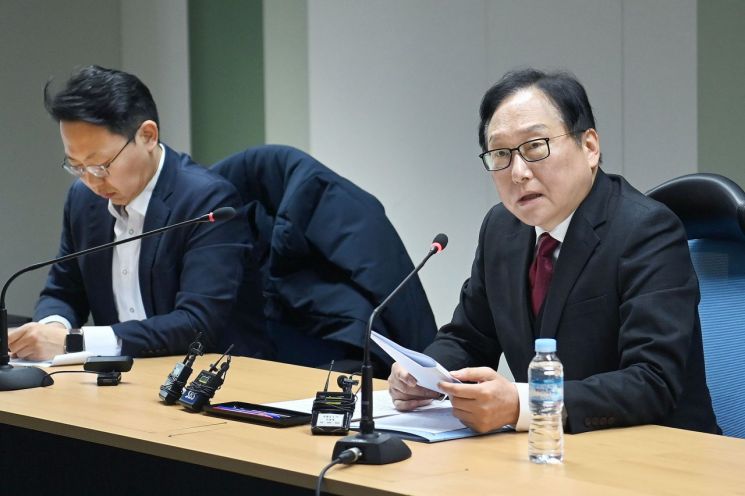 Jung In-kyo, Director General for Trade Negotiations (right), is giving opening remarks at the "Emergency Review Meeting on Major Countries' Responses to U.S. Tariff Measures" held at the Korea Chamber of Commerce and Industry on the morning of the 5th. Photo by Ministry of Trade, Industry and Energy
As the tariff war triggered by Trump escalates tensions between the US and China, South Korea, which has a high export dependence on both countries, is also expected to face inevitable economic damage. In particular, South Korea's exports of intermediate goods such as semiconductors, displays, and wireless communication components to China are likely to be directly hit. Our trade authorities are activating an emergency response system and seeking ways to minimize the damage.
On the morning of the 5th, Jung In-kyo, Head of Trade Negotiations at the Ministry of Trade, Industry and Energy, stated at an urgent video inspection meeting held at the Korea Chamber of Commerce and Industry in Seoul, attended by trade officers from major countries and KOTRA trade centers, "Although tariff measures targeting Canada and Mexico have been postponed, the possibility of future imposition cannot be ruled out," adding, "Trade authorities will cooperate with local missions to monitor trends 24/7 and immediately operate a 'Help Desk' within KOTRA trade centers to support difficulties faced by our companies."
He emphasized, "Given the extraordinary situation, trade officers and KOTRA must work closely to prepare support measures that reflect voices from the field." The government plans to hold additional response meetings including other major countries such as the European Union (EU) and actively pursue cooperation with countries holding similar positions.
Trade officers and KOTRA trade center heads attending the meeting also shared the status of responses by host country governments and companies operating there, as well as industry requests, and agreed to establish a local response system.
This meeting was held to respond to the Trump administration's move to strengthen protectionism. Although the US has postponed tariffs on Canada and Mexico for one month, it continues the global 'tariff war' by imposing an additional 10% tariff on all Chinese products.
Starting from the 10th, China plans to impose retaliatory tariffs of 10-15% on US agricultural machinery, coal, liquefied natural gas (LNG), and others. Additionally, China has launched an antitrust investigation against the US big tech company Google and announced new export control measures such as switching rare metal exports to the US to a licensing system.
Our government is focusing on analyzing the impact of the US-China trade conflict on our companies and preparing support measures. The industry expects that if tariff increases shrink the US IT and home appliance markets, production in China will decrease, which in turn could lead to a reduction in South Korea's exports of intermediate goods such as semiconductors, displays, and wireless communication components. According to the Korea International Trade Association, 85.86% of South Korea's exports to China in 2023 ($133 billion) were intermediate goods including memory semiconductors, displays, and wireless communication components. Therefore, if the US-China trade war intensifies, South Korea's exports to China are likely to decline sharply.
An official from the Ministry of Trade, Industry and Energy said, "If the US-China trade conflict prolongs, instability in the global supply chain will increase and damage to our companies may expand," adding, "The government will prepare various support measures to minimize damage to companies and strengthen cooperation with the international community."
© The Asia Business Daily(www.asiae.co.kr). All rights reserved.












