Main Symptoms and Causes of Reflux Esophagitis
Easily Mistaken for Heart or Respiratory Diseases Due to Chest Pain and Chronic Cough
The number of patients receiving treatment for reflux esophagitis (gastroesophageal reflux disease) is steadily increasing.
According to statistics from the Health Insurance Review and Assessment Service, the number of patients increased by 35% over 10 years, from about 2.4 million in 2013 to about 3.23 million in 2023.
In particular, reflux esophagitis has diverse symptoms including chest pain, making it easy to be mistaken for other diseases. Since it is a chronic disease with frequent recurrence, accurate diagnosis along with continuous treatment and management are necessary.
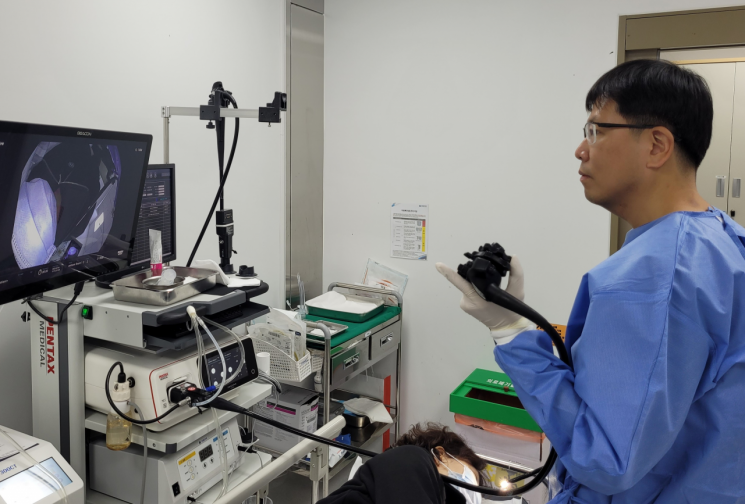 Director Kim Kyung-han (Gastroenterology) at Centum General Hospital is performing an endoscopy examination. Photo by Centum General Hospital
▲Main Symptoms
In the case of Mr. A (in his 50s), he recently experienced sudden chest pain. After having dinner, while resting on the sofa, he felt chest pain and burning. Worried it might be heart disease, he visited a hospital, where he was diagnosed with reflux esophagitis.
Dr. Kim Kyunghan, Head of the Endoscopy Center at Centum General Hospital’s Department of Gastroenterology, explained this disease as “When food or stomach acid in the stomach refluxes into the esophagus, it irritates the esophageal mucosa and causes various symptoms such as chest pain or burning.”
Between the stomach and esophagus in the human body, there is a “lower esophageal sphincter” that prevents food that has gone down into the stomach from coming back up into the esophagus. If its function declines or there are structural problems such as a hiatal hernia (a hole through which the esophagus passes), stomach acid and other contents can reflux.
Symptoms can vary depending on the patient. The representative symptoms are chest pain and burning (palpitations). In severe cases, stomach acid can reflux up to the pharynx and larynx, causing chronic cough, foreign body sensation in the throat, hoarseness, and other symptoms.
Below is a Q&A with Dr. Kim Kyunghan, Head of the Endoscopy Center at the Department of Gastroenterology.
▲Questions and Answers about Reflux Esophagitis
① Symptoms are diverse and can be mistaken for heart or respiratory diseases?
“Because the symptoms arise from acid reflux, they vary depending on the area irritated. If the lower or middle part of the esophagus is irritated, chest pain occurs, which can be mistaken for heart disease. If the larynx is irritated, coughing may occur, which can be mistaken for respiratory disease. Therefore, for those receiving an initial diagnosis or those whose symptoms persist despite treatment, it is advisable to undergo examinations and consultations again at a general hospital capable of differentiating various diseases.”
② Is it a disease that requires continuous management rather than a complete cure?
“Many patients report that while taking medication for reflux esophagitis, they do not experience discomfort, but symptoms recur repeatedly after stopping the medication over several years. It is important to recognize that this disease is a chronic condition that cannot be completely cured but must be managed.
In fact, one study followed patients with reflux esophagitis whose symptoms had completely resolved (remission or disappearance) for six months, and found that the recurrence rate was about 75?90% depending on the type. Therefore, most reflux esophagitis cases require maintenance therapy as a chronic disease.”
③ Then, is it okay to take esophagitis medication for a long time?
“Since it is a chronic disease, there are concerns about complications from long-term medication use. Usually, when maintenance therapy is performed with the main medication for reflux esophagitis, ‘proton pump inhibitors,’ it is recommended to reduce to the minimum dose that can suppress recurrence. This reduces the potential risk of side effects from long-term use of proton pump inhibitors. Recently, many reports have shown that the side effects of maintenance therapy for reflux esophagitis are not as significant as previously thought, so if the minimum effective dose is used properly, it generally does not cause major problems.”
▲Treatment and Management
If this disease is left untreated, it can lead to serious complications. Damage to the esophageal mucosa can cause esophageal ulcers and strictures, and in rare cases, esophageal cancer. It can also cause or worsen chronic laryngitis and asthma exacerbations.
Reflux esophagitis can be directly assessed for severity and extent through gastroscopy, and the presence of associated complications can also be checked.
Dr. Kim at Centum General Hospital emphasized, “Although it is difficult to completely cure reflux esophagitis, appropriate treatment and continuous management can relieve symptoms, maintain quality of life, and prevent complications.”
Treatment primarily involves medication that suppresses stomach acid secretion and reduces gastroesophageal reflux. It is important to note that symptoms may recur if medication is stopped after initial treatment. Long-term medication should be maintained, and decisions about discontinuation should be made in consultation with a physician based on symptom status.
Dr. Kim Kyunghan advised, “Lifestyle modification is especially important for reflux esophagitis. Irregular eating habits, overeating, late-night meals, lying down immediately after eating, excessive consumption of spicy and salty foods, smoking, and excessive alcohol intake all worsen this disease, so it is best to avoid these.”
© The Asia Business Daily(www.asiae.co.kr). All rights reserved.












