U.S. Imposes Additional 10% Tariff on China Starting the 4th
China Responds Immediately... 15% Tariff on LNG, 10% on Automobiles
Tariffs Seen as 'Negotiation Leverage,' Market Remains Cautious... Dollar and Treasury Prices Fall
Some Warn Market Is Underestimating Tariff Threats
The three major indices of the U.S. New York Stock Exchange showed mixed movements around the flat line on the 4th (local time). Despite concerns that the second U.S.-China trade war might reignite, investors are calmly observing the market while closely monitoring future developments.
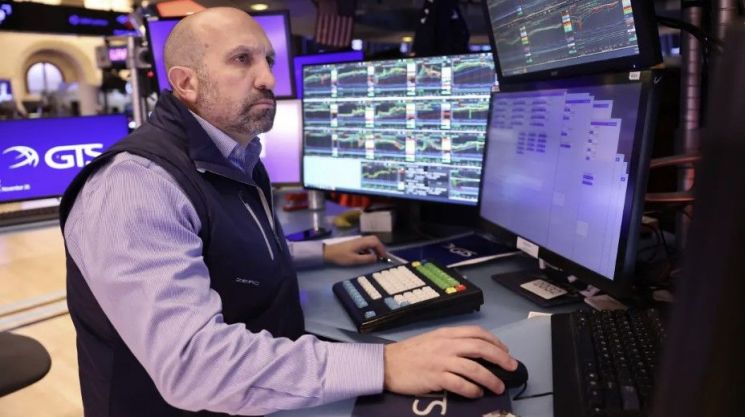
As of 9:43 a.m. in the New York stock market on the day, the Dow Jones Industrial Average (Dow), which focuses on blue-chip stocks, was trading at 44,386.05, down 0.08% from the previous day. The S&P 500, centered on large-cap stocks, rose 0.16% to 6,004.12, and the Nasdaq, focused on tech stocks, increased 0.52% to 19,493.11.
Starting at midnight on the 4th, the U.S. imposed an additional 10% tariff on all imports from China on top of existing tariffs. This followed the executive order signed by President Trump on the 1st. However, the 25% universal tariff measures previously announced for Canada and Mexico were postponed for one month.
China immediately retaliated. It announced tariffs of 15% on U.S. coal and liquefied natural gas (LNG), and 10% on crude oil, agricultural machinery, and automobiles. It also launched an antitrust investigation into U.S. big tech company Google. Nevertheless, President Trump stated that he would speak with Chinese President Xi Jinping before the tariffs take full effect, leaving room for negotiation.
Despite the possibility of a renewed second U.S.-China trade war, the market has responded relatively calmly.
Ross Mayfield, an investment strategist at Baird, said, "We are in a bull market supported by strong consumer spending and corporate earnings growth, so downturns can be seen as buying opportunities. Investors should prepare for increased market volatility due to trade uncertainties, but overall investment fundamentals remain quite solid."
Some analysts warn that the market may be underestimating President Trump's tariff policies, viewing his tariff threats merely as "negotiation leverage."
Andrei Tueny, Head of Trading at Saxo Bank France, advised, "The tariff issue will not disappear as quickly as expected. While earnings provide some momentum, there is a bigger game at play, and we are only at the beginning, so buying should be approached cautiously."
This week, major events including big tech earnings reports are scheduled. After the market closes on this day, Alphabet, Google's parent company, and semiconductor firm AMD will release their earnings. Amazon will announce its results on the 6th. The U.S. Department of Labor's January employment report, which provides insight into the labor market, will be released on the 7th. The market expects nonfarm payrolls to have increased by 154,000 last month, a significant decrease from the previous month's 256,000. The unemployment rate is forecasted to remain steady at 4.1%.
As the market remains largely unfazed by President Trump's tariff threats, safe-haven assets such as the dollar and government bonds are declining.
The dollar index, which measures the value of the U.S. dollar against six major currencies, fell 0.59% from the previous trading day to 108.24. Bond yields, which move inversely to bond prices, are weakening. The yield on the U.S. 10-year Treasury note, a global benchmark for bond yields, rose 2 basis points (1bp=0.01%) to 4.56% from the previous trading day. The yield on the U.S. 2-year Treasury note, sensitive to monetary policy, remained around 4.25%, unchanged from the previous day.
By individual stocks, Palantir, a U.S.-based AI-driven data analytics software company, surged 26.01% after issuing earnings forecasts that exceeded expectations. PepsiCo fell 2.07% after reporting sales and full-year earnings forecasts below expectations.
© The Asia Business Daily(www.asiae.co.kr). All rights reserved.












