Key Player in the Global AI Alliance: Samsung Foundry in the Spotlight
Lee Jae-yong, Sam Altman, and Masayoshi Son Meet
Emerging as a Core 'Stargate' Partner
Expanding Role in Crucial Semiconductor Sectors
Hopes for Regaining Leadership in Foundry
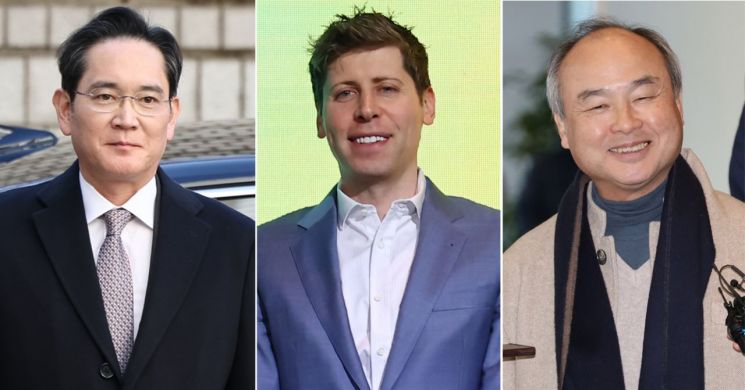
As Samsung Electronics emerges as a key partner in the global artificial intelligence (AI) infrastructure project ‘Stargate,’ its foundry (semiconductor contract manufacturing) business is gaining renewed attention. On the 4th, Samsung Electronics Chairman Lee Jae-yong held a strategic meeting with SoftBank Chairman Masayoshi Son, OpenAI CEO Sam Altman, and Arm CEO Rene Haas. With chips becoming central to the AI alliance, there are expectations that Samsung Electronics’ role in the semiconductor sector will grow.
According to industry sources on the 5th, the main agenda of the four-party meeting held on the 4th at Samsung Electronics’ Seocho office in Seoul was strategic cooperation in AI and semiconductor fields. The meeting was arranged to discuss collaboration on the ‘Stargate’ project, a strong AI infrastructure enhancement policy promoted by the Trump administration, with the four parties seeking ways to play a central role in the global AI ecosystem.
This project includes AI chip design, large-scale data center construction, and expansion of high-performance computing infrastructure. Among these, securing advanced semiconductors is an essential factor determining the project’s success. Each company participating in the Korea-US-Japan AI meeting is expected to leverage its strengths to build complementary cooperation. OpenAI focuses on AI technology development and utilization, while Arm provides semiconductor intellectual property (IP) to optimize chip performance.
With Arm responsible for semiconductor design, Samsung Electronics will supply high-performance memory semiconductors necessary for AI semiconductors and data center construction based on advanced processes. Samsung plans to contribute to building the global AI ecosystem by manufacturing high-performance AI semiconductors, providing advanced process technology, expanding large-scale semiconductor production capabilities, and supporting AI infrastructure optimization.
Within the semiconductor industry, there is speculation that Chairman Lee, freed from judicial constraints, may directly engage in strengthening the foundry business. Inside and outside Samsung Electronics, the foundry business is closely linked to Lee’s management philosophy, to the extent that it is said, “If the success of memory semiconductors is the legacy of former Chairman Lee Kun-hee, then the foundry is Chairman Lee’s work.” Particularly, Samsung’s foundry has yet to overcome its disadvantage compared to Taiwan’s TSMC. Last year, Samsung Electronics’ foundry market share fell to 9.3%, widening the gap with TSMC’s 64.9%.
Therefore, attention is focused on whether Samsung Electronics will regain leadership in the foundry sector through this meeting. Cooperation with OpenAI and Arm via the ‘Stargate’ project is expected to help Samsung explore new possibilities in the AI semiconductor market. Chairman Lee has shown a vision to develop Samsung Electronics’ foundry business as a central infrastructure supplier in the AI era and to lead future markets by combining it with the technological capabilities of OpenAI and Arm.
The industry also attaches significance to the fact that Chairman Lee gathered global AI magnates at Samsung Electronics’ Seocho office. Initially, Samsung Electronics planned for Vice Chairman Jeon Young-hyun, head of semiconductors, to meet CEO Altman instead of Chairman Lee, but with Lee’s judicial risks resolved, Chairman Son joined the meeting urgently. Furthermore, Chairman Lee is open to potential financial investments as a strategic partner in the ‘Stargate’ project, increasing the likelihood of Samsung Electronics’ deeper involvement in AI infrastructure development. SoftBank is also expected to strengthen the cooperation foundation through financial support and global network expansion.
Chairman Son said, “If Samsung Electronics’ semiconductor technology and Arm’s design capabilities combine, it could create great synergy in building AI infrastructure.” Industry insiders predict, “Samsung Electronics being selected as the core foundry partner for the ‘Stargate’ project could lead to securing leadership in the global AI ecosystem.”
However, Samsung Electronics also faces significant challenges. Risks include decreased semiconductor demand due to the global economic downturn, competition gaps in technology development speed, and the complexity of semiconductor supply chains. Accordingly, Samsung is expected to pursue strategies to minimize these risks through technological innovation, securing supply chain stability, and strengthening global partnerships.
Meanwhile, Samsung Electronics reclaimed the top spot in the global semiconductor market last year, surpassing Intel, thanks to rising memory semiconductor prices. It solidified its industry leadership with total sales of $66.5 billion and stood at the center of semiconductor market recovery. According to Gartner, global semiconductor sales in 2024 are projected to increase by 18.1% year-on-year to $626 billion, and further rise to $705 billion in 2025. Particularly, data center semiconductor sales surged 73% to $112 billion due to increased demand for data center graphics processing units (GPUs) and AI processors.
© The Asia Business Daily(www.asiae.co.kr). All rights reserved.












