National Assembly Begins Discussions for 'Korean-style IRA' Legislation
Industry: "Tax Credits Should Be Available Even During Downturns"
Government: "Cash Refunds Are Subsidy Expenditures... Premature at This Time"
The National Assembly has put the 'Battery Direct Refund System' on the discussion table in response to industry demands for urgent measures to revive the domestic secondary battery and battery industry. The proposal is to provide the deduction amount in cash to support the battery industry struggling amid the electric vehicle chasm (Chasm: temporary demand stagnation). Compared to the current system, which preserves investment in research and development costs or facility installation as a corporate tax reduction, this allows for immediate support.
Shin Young-dae, a member of the Democratic Party and representative of the National Assembly Secondary Battery Forum, hosted the 'Discussion on the Introduction of the Secondary Battery Direct Refund System' at the National Assembly on the 4th. He said, "If we do not prepare in advance for battery (technology development) at this point, I am concerned whether we can maintain technological superiority in this field in the future," adding, "National support is necessary." He also noted, "On the other hand, since national tax revenue is under difficult conditions, we need to find realistic measures to harmonize these aspects."
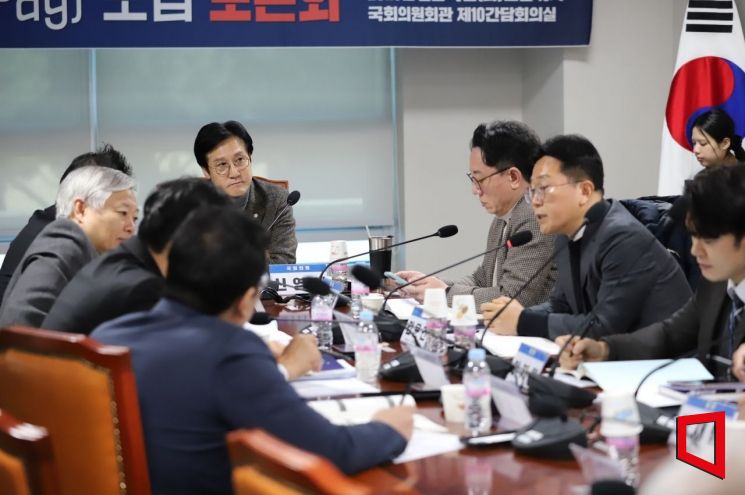 Shin Young-dae, a member of the Democratic Party of Korea, and government and industry discussants are attending the "Discussion on the Introduction of Direct Refund System for Secondary Batteries" held at the National Assembly on the 4th. Photo by the office of National Assembly member Shin Young-dae
Kim Seung-tae, head of policy support at the Korea Battery Association, who attended the discussion, emphasized the necessity of introducing the direct refund system. Kim pointed out, "The current tax credit bill deducts the calculated credit amount from corporate tax, so if there is no profit, the benefit cannot be received," adding, "The actual support effect is very insufficient." He continued, "Facility investment over the next few years is expected to determine the future battery market landscape," and said, "A proactive approach (direct refund system) is necessary to strategically foster the battery industry."
Park Ji-woong, a lawyer at Yulchon LLC, introduced both supporting and opposing views at the discussion. According to Park, proponents of the direct refund system argue that even companies operating at a loss can receive tax credit benefits, which is expected to activate investment. On the other hand, opponents believe that since the current system allows for carryforward deductions, loss-making companies are not excluded from tax benefits without additional legislation.
The Ministry of Economy and Finance (MOEF), which manages national tax revenue, raised concerns about the 'tax revenue burden.' Kim Moon-geon, head of the Tax Incentive System Division at MOEF, criticized, "At a time when economic difficulties are intensifying, the introduction of the direct refund system seems premature," adding, "There are concerns that it could bypass the government's budget formulation authority." He emphasized that additional national consensus is necessary.
© The Asia Business Daily(www.asiae.co.kr). All rights reserved.












