Professor Minseop Heo's Team at UNIST Proposes Terahertz Wave Generation Method Using Plasma
Energy Conversion Efficiency Increased Tenfold ... Published in Physical Review Letters
An international collaborative research team has proposed a new method to generate terahertz waves, electromagnetic waves known as the dream resource.
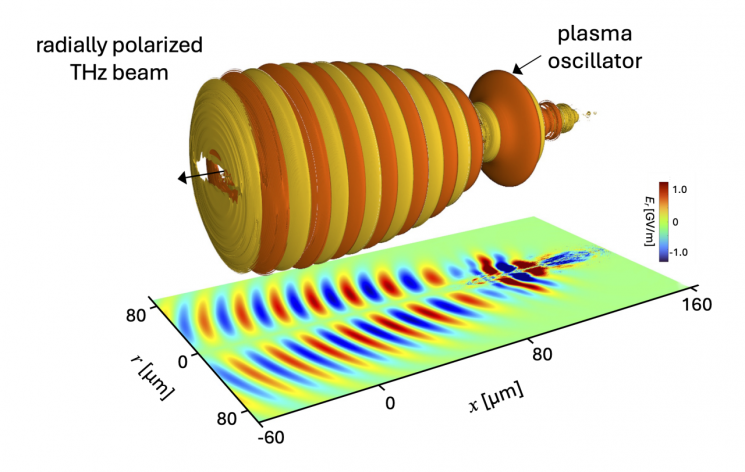
The research team led by Professor Minseop Heo from the Department of Physics at UNIST, Professor Hee-Yong Seok from GIST, and Professor Jaroszynski from the University of Strathclyde in the UK theoretically devised a method to generate terahertz waves by irradiating plasma with powerful laser pulses and verified it through computer simulations.
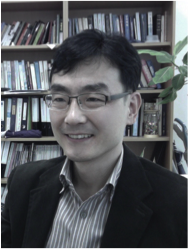 Professor Heo Minseop.
The results of this study were published on the 3rd of last month in the prestigious physics journal Physical Review Letters.
Terahertz waves are electromagnetic waves that oscillate at a frequency of tera (tera, 10^12), which is 1000 times giga (giga, 10^9), per second. Their short wavelength allows easy penetration, and the energy of a single photon is low, causing minimal damage to samples.
This is why they are gaining attention in medical diagnostics, security screening, and semiconductor device defect detection. They are also expected to play an important role as a frequency resource in next-generation ultra-high-speed communications.
The main reason such useful electromagnetic waves have only recently begun to attract attention is the difficulty in generating terahertz waves. The currently known method to extract high-intensity, high-output terahertz waves involves supplying energy with lasers to crystalline materials such as lithium niobate to induce resonance. However, increasing the laser intensity to boost output has the limitation that the crystalline material melts.
The research team focused on plasma. Since plasma is a state of matter where electrons and ions are already dissociated, or "melted," increasing the laser intensity does not cause problems. However, plasma is a difficult material to handle, making it challenging to control the interaction between plasma and lasers. This was resolved by gradually increasing the plasma density and simultaneously using two lasers.
According to computer simulation results, the proposed terahertz generation method allows easy frequency modulation, has ten times higher energy conversion efficiency from laser to terahertz waves compared to existing methods, and exhibits superior intensity and directionality.
The joint research team explained, "This study will aid the development of ultra-high-speed terahertz communication devices, biological cancer diagnostics, nonlinear material property research in the ultra-strong terahertz region, and ultra-compact particle accelerators using terahertz waves that can realize existing large particle accelerators in small room sizes."
 Dr. Manoz Kumar (first author).
 Researcher Lee Jae-ho.
 Researcher Park Dohyun.
This research was led by Dr. Manoj Kumar from the Department of Physics at UNIST as the first author, with researchers Jaeho Lee and Dohyun Park as co-authors.
The research was supported by the National Research Foundation of Korea and the Korea Institute for Advancement of Technology.
© The Asia Business Daily(www.asiae.co.kr). All rights reserved.












