Tariffs on Canada, Mexico, and China to Rise from the 4th
Retaliatory Tariffs Announced... Inflation Fears from Supply Shock
Automakers with Mexican Factories, Including GM and Ford, See Stock Declines
Safe-Haven Asset Preference Grows... Dollar and Treasury Prices Increase
The three major indices of the U.S. New York stock market all declined on the 3rd (local time). U.S. President Donald Trump launched a 'tariff bomb' on Canada, Mexico, and China, sharply worsening risk asset investment sentiment amid concerns over a global trade war. Market forecasts are spreading that the economy will slow due to supply shock-driven inflation. With the expansion of safe-haven asset preference, the value of the U.S. dollar and government bond prices are rising.
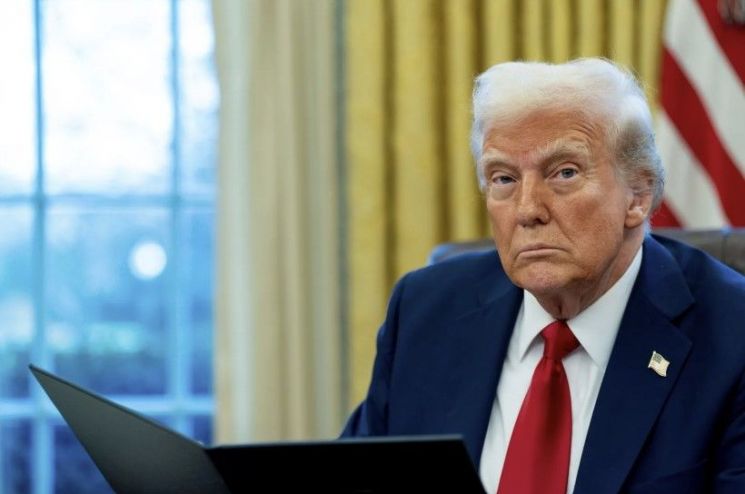
As of 9:51 a.m. in the New York stock market on that day, the Dow Jones Industrial Average (Dow), centered on blue-chip stocks, was trading at 43,999.55, down 1.22% from the previous day. The S&P 500, focused on large-cap stocks, was down 1.56% at 5,946.21, and the Nasdaq, centered on tech stocks, was slipping 1.95% to 19,244.85.
By stock, U.S. automakers with production bases in Mexico are sharply falling. General Motors (GM) is down 5.6%, and Ford is down 3.82%. Auto parts maker Aptiv and manufacturing companies such as Avery Dennison are down 8.8% and 2.38%, respectively. Engine manufacturer Cummins is also down 3.12%. Constellation Brands, which imports alcoholic beverages from Mexico, is down 4.25%, and Chipotle, a U.S. fast-food chain importing avocados from Mexico, is down 2.54%.
Earlier, on the 1st, President Trump signed an executive order based on the International Emergency Economic Powers Act (IEEPA) imposing a 25% tariff on all imports from Canada and Mexico, and an additional 10% tariff on all Chinese imports on top of existing tariffs. This executive order will take effect at midnight on the 4th. Mexico and Canada immediately announced retaliatory tariffs and countermeasures. China also announced plans to file a complaint with the World Trade Organization (WTO). The day before, President Trump indicated plans to expand the tariff war front by stating, "Tariffs will soon be imposed on European Union (EU) products as well."
Concerns are growing in the market that a global trade war has ignited. It is expected that the domino effect of retaliatory tariffs will spread, leading to supply chain disruptions, inflation, reduced consumption, and a vicious cycle of declining growth rates. Global accounting firm Ernst & Young estimated that if Mexico, Canada, and China impose retaliatory tariffs on the U.S., the U.S. GDP growth rate will decrease by 1.5 percentage points in 2025 and 2.1 percentage points in 2026.
Dominic Wilson, an economist at Goldman Sachs, said regarding this tariff increase, "Such policy changes risk amplifying concerns about future trade policy risks and potential retaliation," adding, "It could shake the market's confidence that the administration will not implement policies that lower growth or increase inflation."
Tobin Marcus, head of U.S. policy and political research at Wolfe Research, said, "The market may now have to take Trump's tariff agenda literally rather than seriously," and "If this new level of severity is suddenly reflected in (stock) prices, Monday (the 3rd) could be a tough day for the market."
However, some in the market cautiously suggest that negotiations might be concluded just before the tariff imposition deadline at midnight on the 4th. Goldman Sachs said the previous day, "Considering economic damage and conditions such as suppressing fentanyl inflows, the tariff imposition could be temporary," and "There is room for compromise at the last moment."
Investors are paying close attention to major events scheduled this week while assessing the impact of President Trump's tariff measures. Alphabet, Google's parent company, will report earnings on the 4th, and Amazon will report on the 6th. The U.S. Department of Labor's January employment report, which provides insight into the labor market, will be released on the 7th. The market expects nonfarm payrolls to have increased by 154,000 last month, a significant decrease from the previous month's 256,000. The unemployment rate is expected to remain steady at 4.1%.
With the expansion of safe-haven asset preference due to President Trump's tariff increase, the U.S. dollar and government bond prices are rising.
The dollar index, which measures the value of the U.S. dollar against six major currencies, is up 0.89% from the previous trading day at 109.17. Bond yields, which move inversely to bond prices, are weak. The U.S. 10-year Treasury yield, a global bond yield benchmark, fell 6 basis points (1 bp = 0.01%) from the previous trading day to 4.5%. The U.S. 2-year Treasury yield, sensitive to monetary policy, is moving around 4.24%, the same level as the previous day.
© The Asia Business Daily(www.asiae.co.kr). All rights reserved.












