Korea Economic Association Surveys Industry Opinions on Greenhouse Gas Reduction Targets
"Communication with Stakeholders... Setting Targets Considering Industrial Characteristics"
Eight out of ten companies (82.7%) expressed the opinion that the government should maintain the current level of industrial sector reduction targets when setting the '2035 Greenhouse Gas Reduction Target (NDC)' to be submitted to the United Nations (UN) this year.
The Korea Economic Association announced on the 3rd that this conclusion was reached as a result of a survey on industry opinions regarding the national greenhouse gas reduction targets, conducted by Monoresearch targeting the top 1,000 manufacturing companies based on sales.
The perceived feasibility of achieving the 2030 industrial sector greenhouse gas reduction target by the industry averaged 38.6%, indicating a 'low (21?40%)' level. The main factors making target achievement difficult were identified as ▲difficulty in transitioning to a low-carbon industrial structure (31.0%) ▲delays in improving energy efficiency (26.2%) ▲economic and production contraction (20.2%).
Regarding the appropriate level of the 2035 industrial sector greenhouse gas reduction target, eight out of ten companies (82.7%) expressed the opinion that the current level should be maintained. In particular, as supplementary points when setting the target, they requested ▲setting reasonable targets through communication with stakeholders (22.2%) ▲concretization of climate response budgets (22.2%). Additionally, there were opinions on ▲adjusting the carbon neutrality target timeline (16.9%) ▲adjusting reduction targets between sectors (15.9%).
The industry viewed that raising the greenhouse gas reduction targets leads to an increase in the intensity of climate policies, which affects economic growth rates and worsens industrial profitability. It was also pointed out as a problem that communication with companies bearing the actual burden of greenhouse gas reduction is not smooth. The government's 'Carbon Neutrality Basic Plan' announced in April last year was also evaluated as lacking sufficient communication with various stakeholders.
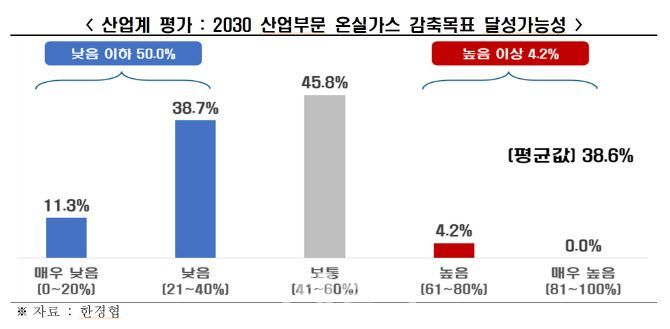 Achievability of the 2030 Industrial Sector Greenhouse Gas Reduction Target. Provided by the Korea Economic Association
The Korea Economic Association holds the position that the structural limitations of the domestic industry must be considered. Compared to major countries, Korea has a high proportion of manufacturing, which limits further improvement in emission intensity.
According to the government's 'Carbon Neutrality Technology Innovation Strategy Stepwise Implementation Plan (Roadmap),' the commercialization timing of low-carbon technologies in high-emission industries such as steel, chemical, cement, semiconductor, and display is between 2030 and 2040. Therefore, when setting reduction targets, evaluations regarding the commercialization timing of carbon reduction methods need to be reflected.
Among the risks arising in the process of transitioning to a low-carbon economy, the industry rated the risk of 'increase in greenhouse gas emission prices' highest at 56.4%. Energy-intensive industries cited the cost burden due to 'use of low-carbon energy sources' at 58.1%. The Korea Economic Association interpreted that since most energy-intensive industries have high external dependence and industrial linkage effects, efforts are needed to mitigate the negative impacts on the overall economy.
Lee Sang-ho, Head of the Economic and Industrial Headquarters at the Korea Economic Association, stated, "The burden on corporate management due to strengthened climate policies and transition risks is greatly increasing," adding, "It is necessary to set reasonable greenhouse gas reduction targets and strengthen carbon neutrality support policies so that companies can focus on their core business while responding to rapidly changing global climate policies."
© The Asia Business Daily(www.asiae.co.kr). All rights reserved.













