As the executive order signed by U.S. President Donald Trump on his first day in office primarily targets Mexico and Canada, it is being analyzed as a preliminary move for renegotiating the United States-Mexico-Canada Agreement (USMCA). The government is closely monitoring the impact on companies' exports and local production, stating that it is not yet a stage to be complacent. However, industry insiders predict that the possibility of an actual 25% tariff imposition is low.
A Ministry of Trade, Industry and Energy official said on the 23rd, after the 'Joint Public-Private Response Meeting on U.S. New Administration's Trade Policy toward Mexico,' "The executive order related to the U.S. first trade policy instructed major ministries to review and resolve issues by April 1. Although there was no mention of Korea, unlike Mexico, Canada, and China, there was also no statement excluding Korea, so we cannot be complacent. We will meet with U.S. officials to convey Korea's position as much as possible until the executive order is concretized."
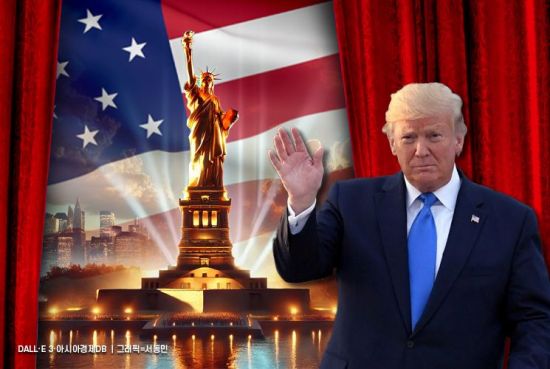
The most imminent issue currently is whether the U.S. will raise tariffs on its trading partners. President Trump has announced a 25% tariff increase on Mexico and Canada starting next month. This situation could cause difficulties for domestic companies operating locally in exporting. Industry representatives attending the meeting reportedly judged that the possibility of tariff increases is low. A government official who attended the meeting said, "KOTRA (Korea Trade-Investment Promotion Agency) on the ground believes that the Trump administration's tariff pressure on Mexico and Canada is a card for renegotiating the USMCA," adding, "Although the USMCA is scheduled for review in 2026, Trump wants to renegotiate sooner."
Another industry representative said, "The trade-related executive orders of Trump's first administration reflected protectionism and 'America First,' but some orders were not fully implemented or maintained due to legal issues, global supply chain impacts, and diplomatic tensions," and predicted, "Therefore, similar difficulties may arise when this executive order is actually implemented."
The government is not ruling out the possibility of U.S. tariff hikes and remains vigilant. A Ministry of Trade, Industry and Energy official said, "About 500 Korean companies are active in Mexico, mainly in the automobile, home appliance, and steel sectors. We are maintaining close communication between companies and the government through local KOTRA and commercial attach?s," adding, "There is a possibility that the U.S. will take specific measures after February 1, so we are closely monitoring the situation."
Even if the tariff hurdle is overcome, many issues remain to be resolved. President Trump's executive order includes in the trade sector ▲review of trade agreements ▲consideration of designating currency manipulators ▲feasibility study on establishing an external import agency ▲review of anti-dumping and countervailing duty regulations. In the China-related sector, it mentions ▲review of the first phase implementation of the U.S.-China trade agreement ▲expanded application of Section 301 ▲review of China's PNTR (Permanent Normal Trade Relations) status. In the energy sector, it includes ▲abolition of electric vehicle promotion policies ▲establishment of non-fuel mineral producer status.
Particularly, the repeal of electric vehicle subsidies under the Inflation Reduction Act (IRA) is expected to directly affect Korean companies. Hyundai Motor Group predicts that if the electric vehicle subsidies are abolished, electric vehicle sales in the U.S. market will decrease by 8.7 to 13.3%. It also forecasts that the overall U.S. electric vehicle market size will shrink by 27%, from 1,184,000 units annually to 867,000 units. Korean electric vehicle and battery companies that have built or plan to build manufacturing facilities in the U.S. will inevitably face disruptions in their investments and business plans.
Regarding this, a Ministry of Trade, Industry and Energy official said, "The executive order does not say subsidies will not be paid but specifies a suspension and a 90-day review period," adding, "The specific impact will depend on the review results." He continued, "We are actively explaining the investment effects of Korean companies in the U.S. and seeking ways to achieve a win-win situation." On the possibility of renegotiating the Korea-U.S. Free Trade Agreement (FTA), he said, "Currently, there is no clear indication of the U.S. side's intentions," and added, "We plan to keep all options open and respond thoroughly."
© The Asia Business Daily(www.asiae.co.kr). All rights reserved.












