Estimated 0.2%p Decrease Centered on Consumption and Domestic Demand
Fourth Quarter Last Year at 0.2%, Annual Growth Expected at 2.0-2.1%
The Bank of Korea forecasted that this year's real Gross Domestic Product (GDP) growth rate would be revised downward from the previous 1.9% to 1.6?1.7%. Due to unexpected martial law incidents and the Jeju Air passenger plane disaster, economic sentiment has significantly deteriorated, and the growth rate for the fourth quarter of last year is also expected to remain at 0.2%, below the previous forecast.
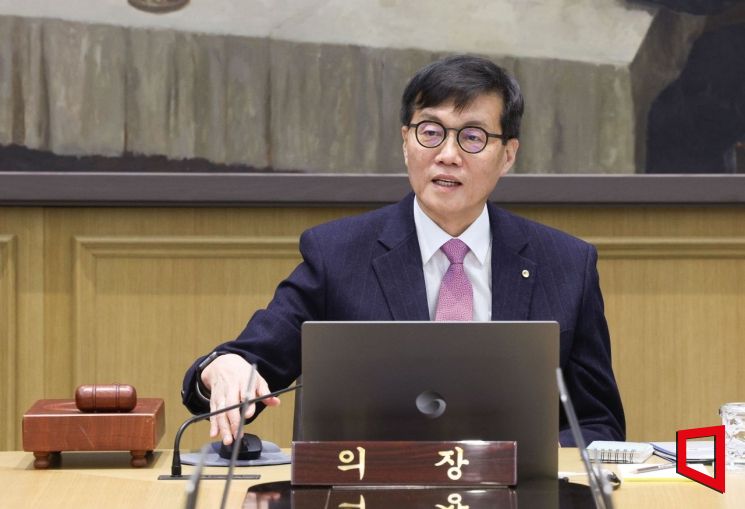 Bank of Korea Governor Lee Chang-yong is greeting members at the Monetary Policy Committee plenary meeting held at the Bank of Korea in Jung-gu, Seoul, on the morning of the 16th. 2025.01.16 Photo by Joint Press Corps
On the 20th, the Bank of Korea released a report titled 'Assessment of the Economy at the January Monetary Policy Committee Decision' on its blog, projecting that this year's economic growth rate in South Korea will be at the level of 1.6?1.7%.
It is unusual for the Bank of Korea, which typically announces economic outlook figures in February, May, August, and November and refrains from providing specific growth forecasts at other times, to release such a 'mid-term review' this month. The Bank explained, "Since the November forecast last year, we have assessed the impact of unexpected political risks on our economy and decided to share the results externally before the official February forecast to aid decision-making by domestic and international economic agents and to facilitate communication on monetary policy."
This Year's Economic Growth Rate Revised Downward to 1.6?1.7%
The Bank of Korea had forecasted a 1.9% economic growth rate for this year in its November outlook last year, but now judges that this forecast will be revised downward to 1.6?1.7%. The Bank stated, "Due to political uncertainty triggered by the emergency martial law incident in December last year and the resulting contraction in economic sentiment, this year's growth rate is estimated to be about 0.2 percentage points lower, mainly driven by consumption and domestic demand." The forecast assumes that the heightened political uncertainty at the end of the fourth quarter last year will persist into the first quarter of this year but gradually ease from the second quarter, with economic sentiment recovering to previous levels in the second half of the year.
The expectation that the fourth-quarter growth rate last year will fall short of initial forecasts is also seen as a factor lowering this year's growth outlook. Although the government's budget for this year was cut more than initially expected, which is analyzed to reduce the growth rate by 0.06 percentage points, the Bank assessed that early budget execution and other fiscal stimulus measures will offset this effect.
The Bank of Korea will announce its revised economic outlook on the 25th of next month. It believes that the growth forecast to be released then will be significantly influenced by ▲ the timing of the resolution of domestic political uncertainty, ▲ additional government stimulus measures, and ▲ the economic policies of the new U.S. administration. The Bank emphasized, "It is essential to prevent political uncertainty from escalating again and to ensure that economic policies operate consistently and normally, independent of politics, to secure external confidence in our economy and stabilize the sentiment of domestic economic agents."
Last Year's Growth Forecast Revised to 2.0?2.1% Due to Martial Law and Passenger Plane Disaster
The domestic growth rate for the fourth quarter of last year is expected to be 0.2% or lower, significantly below the initially anticipated 0.5% quarter-on-quarter growth. The annual growth forecast for last year was revised downward from the previous 2.2% year-on-year to 2.0?2.1%.
The Bank of Korea stated, "Following the unexpected martial law incident in early December last year and the Jeju Air passenger plane disaster, domestic political shocks persisted, severely damaging economic sentiment and causing contractions in domestic consumption and construction investment. As a result, the fourth-quarter growth rate likely fell substantially below the November forecast." It added, "Consumption, which had improved in the third quarter, weakened in the fourth quarter. Card spending growth rapidly slowed from the end of December, and sales of imported cars, which have a high proportion of high-priced models, also contracted further in December." Construction investment also worsened in the fourth quarter, with apartment sales in December reaching 21,000 units, 17.2% below the initially planned 25,000 units.
However, exports were evaluated to have generally met the November forecast, supported by solid demand for IT products based on robust artificial intelligence (AI) investment.
© The Asia Business Daily(www.asiae.co.kr). All rights reserved.