'Anti-China Hawk' Rubio Predicts Intensified Hegemonic Competition
Suggests Possible Chinese Invasion of Taiwan Within 5 Years
"America First Is Not Isolationism but Common Sense Realization"
Reveals Second-Term Foreign Policy Standards
Marco Rubio, the nominee for Secretary of State who will lead the foreign policy of the second Trump administration in the United States, on the 15th (local time) defined China as the 'greatest threat' and claimed that China became a global superpower through lies, deception, and theft at the expense of the United States. He predicted that the standard for the second Trump administration's foreign policy would be whether it makes the U.S. 'safer,' 'stronger,' and 'more prosperous.' Regarding North Korea, he criticized Chairman Kim Jong-un for using nuclear weapons as insurance to maintain power.
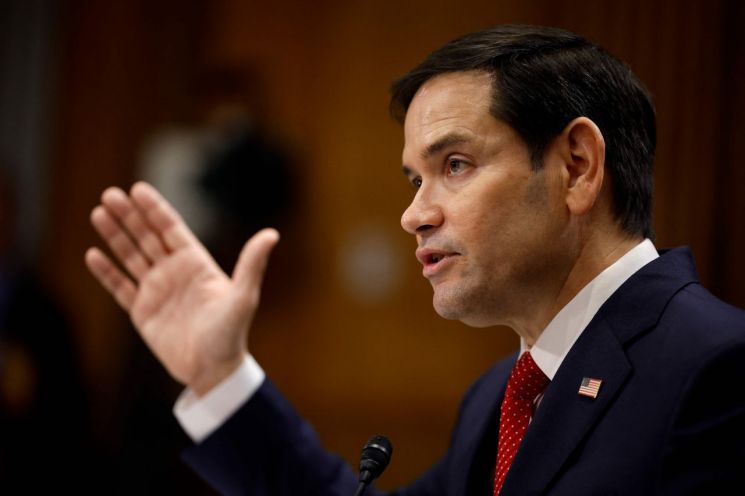 Marco Rubio, the nominee for U.S. Secretary of State, is attending the Senate Foreign Relations Committee confirmation hearing on the 15th (local time) and answering questions from lawmakers. Photo by Getty Images Yonhap News
'Anti-China Hawk' Rubio Predicts Intensified Hegemonic Competition... Suggests Possible Chinese Invasion of Taiwan Within 5 Years
Rubio appeared at the Senate Foreign Relations Committee confirmation hearing, which lasted about five hours, and stated, "The 21st century will be defined by what happens between the United States and China." He described China as "the most powerful and dangerous, and a near-peer adversary that the U.S. has ever faced." He added, "If we do not change the course of history, we will live in a world where many important things, from security to health, depend on China's permission," emphasizing that this is "unacceptable."
Rubio, a 'pro-Trump diplomat,' is a prominent anti-China hawk. He has consistently been involved in various anti-China sanction efforts in the U.S. Congress and has been on the Chinese government's entry ban list since 2020. This appointment, led by a hardline hawk, is seen as a sign that the U.S.-China hegemonic conflict will intensify further in the second Trump administration.
Regarding the disclosure of U.S. companies' investments in China, Rubio said, "At the very least, we need insight into whether American investment funds, whether institutional or individual, support activities that weaken the United States." On the possibility of a Chinese invasion of Taiwan, he suggested that "unless there is a dramatic change, we must accept the fact that we will have to respond to this issue before the end of this decade (January 2020 to December 2029)," implying that such a scenario could materialize within five years.
The New York Times (NYT) reported that Rubio was the most active in answering questions related to China during the hearing, noting, "The five-hour hearing proceeded amicably throughout, and both Republican and Democratic lawmakers agreed on the threats facing the United States." Rubio, who has long served on the Senate Foreign Relations Committee, is expected to be one of the fastest confirmed figures in the second Trump administration.
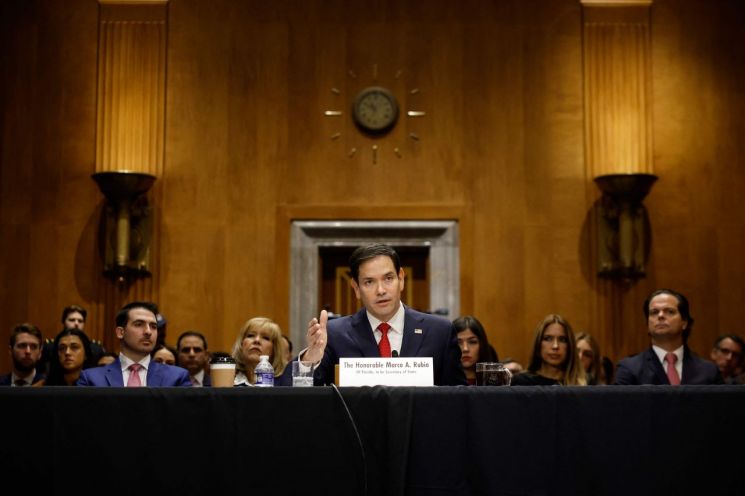 Marco Rubio, the nominee for U.S. Secretary of State, appeared before the Senate Foreign Relations Committee for a confirmation hearing on the 15th (local time), answering questions from the senators. Photo by Getty Images Yonhap News
"America First Is Not Isolationism but Common Sense Realization" Reveals Second-Term Foreign Policy Standards
Rubio, a close ally of President-elect Trump, also emphasized that the key phrase of the second Trump administration, 'America First,' is not isolationism. He defined prioritizing America's core national interests as "not isolationism but the realization of common sense." He explained that the foreign policy standards of the second Trump administration will be whether it makes the U.S. ▲ safer ▲ stronger ▲ more prosperous.
In addition to China, Rubio defined Russia, Iran, and North Korea as 'rogue states.' He criticized, "Dictators and rogue states in Moscow, Tehran, and Pyongyang are sowing chaos and instability," adding, "They fund radical terrorist groups and then hide behind the United Nations Security Council (UNSC) veto power and nuclear war threats." China and Russia, as permanent members of the UNSC, hold veto power over UN resolutions. He further stated that North Korean Chairman Kim Jong-un "uses nuclear weapons as insurance to maintain power," calling him "a dictator in his 40s who must find a way to maintain power for the rest of his life."
Regarding the North Atlantic Treaty Organization (NATO), Rubio described it as a "very important alliance." However, he agreed with President-elect Trump's view that "wealthy and advanced NATO partners should contribute more to their national defense and NATO partnership," urging these member countries to increase defense spending. On the Russia-Ukraine war, which took up a significant portion of the early hearing questions, he said, "The war must end," and that concessions from the involved parties are necessary. He mentioned that sanctions against Russia could be used as a bargaining chip but did not provide specific details.
Additionally, Rubio, who comes from a Cuban immigrant family, responded "without a doubt" when asked if Cuba should remain on the list of state sponsors of terrorism. This is interpreted as an intention to reverse the Biden administration's recent policy to remove Cuba from the terrorism sponsor list after taking office.
Meanwhile, Pam Bondi, the nominee for Attorney General, who appeared at the Senate Judiciary Committee confirmation hearing on the same day, expressed her intention to maintain political neutrality by stating, "The Department of Justice must act independently." However, she avoided giving a clear answer regarding the possibility of retaliatory investigations by President-elect Trump targeting his political opponents.
© The Asia Business Daily(www.asiae.co.kr). All rights reserved.













