Listening to Citizens' Suggestions and Responding Immediately at the Deregulation Debate
Forward-Looking Stance on Lifting the Land Transaction Permission Zone Near the GBC Area
"Real Estate Stabilizing Downward, Seoul City Actively Reviewing"
Mandatory Direct Construction by Prime Contractors Also to Be "Reconsidered, Resolve What Was Started"
Seoul Mayor Oh Se-hoon expressed his determination to lift various regulations, including the cancellation of the land transaction permission zone near the International Exchange Complex District. He also announced that the mandatory direct construction regulation for prime contractors on public projects ordered by the city would be reconsidered to alleviate difficulties faced by the construction industry.
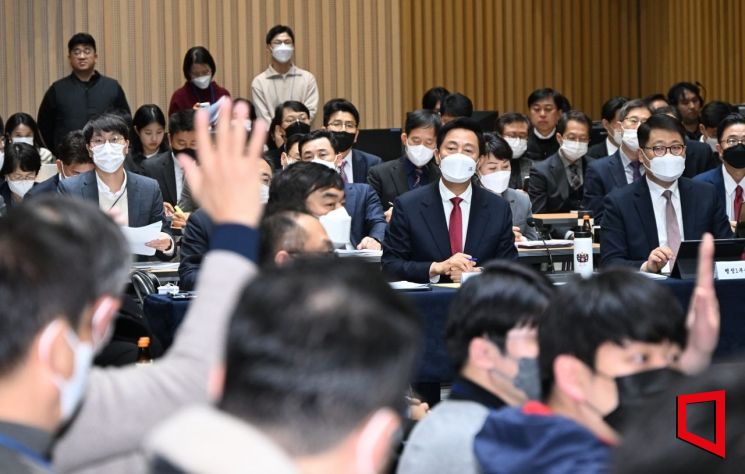
On the 14th, Mayor Oh said at the "Big Debate on Easing Regulations to Revive Livelihoods" held in the Seoul City Hall main conference room, "The land transaction permission zone system, which was chosen during a special period, is being actively considered for cancellation," adding, "I will organize my thoughts and announce them soon."
Will the Land Transaction Permission Zone Be Lifted After 5 Years? "Real Estate Now Stabilizing Downward"
Park, a licensed real estate agent who has worked in Dogok-dong for 22 years, said, "The land transaction permission zone was designated due to concerns that land transactions could surge with the designation of the GBC (Global Business Center) area, but five years have already passed," emphasizing, "Like a balloon effect, prices are soaring in areas outside the permission zone. The cancellation of the permission zone is a strong hope of the local community."
In response, Mayor Oh explained, "Since this land transaction permission zone system was introduced five years ago, many people have requested that it is an excessive regulation, questioning why they should be regulated when buying and selling their own property, expressing grievances," adding, "I wanted to lift the regulation, but due to the surge in real estate prices, lifting it could have poured fuel on the fire, so I could not boldly do so."
Mayor Oh believes that conditions have been created to consider lifting the land transaction permission zone as the real estate market stabilizes.
He said, "Experts believe that real estate prices, which surged last year, have entered a downward stabilization trend over the past two to three months. Recently, the number of transactions has decreased by about 30% monthly on average," adding, "We are also cautious about the possibility that real estate might continue to decline excessively, and because of this, Seoul City is actively reviewing the cancellation of the permission zone."
The land transaction permission system was introduced to prevent speculative transactions and maintain a stable market order. When designated as a land transaction permission zone, transactions of housing, commercial buildings, or land above a certain standard require approval from the mayor of the city, county, or district. Currently, 65.25㎢ in Seoul, mainly in development project areas, are designated as land transaction permission zones, accounting for 10.8% of Seoul’s total area (605.24㎢).
In June 2020, Seoul designated Jamsil-dong in Songpa-gu and the Samsung, Cheongdam, and Daechi-dong areas in Gangnam-gu as land transaction permission zones, extending the designation four times, with the current application period lasting until June 22 this year. Due to concerns about speculative demand inflow during the development of the International Exchange Complex District from COEX in Gangnam-gu to Jamsil Sports Complex in Songpa-gu, an area of 14.4㎢ was designated as a land transaction permission zone. Particularly, the area near the International Exchange Complex District was designated more extensively than other development project areas, sparking fairness controversies.
"Need to Ease Mandatory Direct Construction by Prime Contractors on Public Projects"… Mayor Oh Says "Resolve What You Have Started"
There have also been demands to abolish the regulation requiring prime contractors participating in public projects ordered by Seoul City to directly construct at least 50% of the work. Critics argue that there has been no empirical analysis of the regulation’s effect on quality and safety accident reduction, and that it reduces the volume of orders for local construction companies, hindering regional economic revitalization.
A citizen working at a construction policy research institute pointed out, "General contractors are legally designated to manage and coordinate plans, and specialized contractors are responsible for construction by field, maintaining a division of labor system. The policy expanding the mandatory direct construction by prime contractors is not an excessive regulation but an unreasonable one."
Mayor Oh responded, "This regulation was created by me personally, so I will request a review to resolve what I have started," adding, "When the construction industry is struggling as it is now, such regulations can feel like a heavy burden." He explained the purpose of the system, saying, "In the mid to long term, lowering the subcontracting ratio is necessary to minimize the problems, side effects, and disadvantages arising from illegal subcontracting," adding, "Because the direct construction ratio was raised without structural reform on a large scale, there is much resistance on the ground."
"Please Recognize the Current Floor Area Ratio of Moa Town" ? Flood of Demands for Real Estate Regulation Easing
There were also demands to include the current floor area ratio to improve the business feasibility of Moa Town. The current floor area ratio refers to the floor area ratio of a housing complex as recorded in the building register. Last year, Seoul revised the 2030 Urban Residential Environment Improvement Basic Plan and announced that complexes or areas built exceeding the permitted floor area ratio would have their current floor area ratio recognized as the standard floor area ratio. However, projects eligible for recognition of the current floor area ratio are limited to redevelopment projects subject to the Urban and Residential Environment Improvement Act, such as rapid integrated planning.
A citizen who identified themselves as a member of the Moa Town Promotion Committee in Eungbong-dong said, "Our area is a Type 1 General Residential Area with a current floor area ratio of about 196%, close to a Type 2 General Residential Area, but we are in an unreasonable situation where we must donate 50% of the increase in zoning," emphasizing, "For smooth project progress, Moa Town should also have its current floor area ratio recognized."
In response, Choi Jin-seok, Director of the Seoul City Housing Office, explained, "Unlike the Urban and Residential Environment Improvement Act, Moa Town under the Special Act on the Maintenance and Improvement of Vacant Houses and Small-scale Housing (Vacant House Act) currently does not have its current floor area ratio recognized, and we are proposing this to the Ministry of Land, Infrastructure and Transport."
Another citizen suggested that when small apartment complexes adjacent to large complexes pursue integrated redevelopment projects, incentives such as easing donation requirements or additional floor area ratio should be provided. They argued that policy support is needed for complexes of 300 to 400 households, unlike apartments with fewer than 200 households that receive some regulatory relief under the Special Act on Small-scale Housing Maintenance.
Mayor Oh said, "It is a proposal worthy of support, but it requires residents’ consensus. It would be best to communicate smoothly from the start so that the small complex is incorporated into the large complex," adding, "We will find ways to provide financial and administrative support to small complexes and help them progress quickly."
There was also an opinion to improve the system by shortening the restriction on pre-sale of apartments by construction companies under business suspension to one year. A citizen said, "Currently, if the construction entity or project owner is under business suspension, pre-sale is restricted for up to two years after the suspension period ends," adding, "It is a heavy burden on construction companies in a difficult economic situation to be restricted from pre-sale even after the business suspension ends, with sales timing regulated to after the use inspection."
Mayor Oh said, "If you provide specific cases, I will review them," but added, "In cases where poor construction causes casualties and business suspension measures are imposed, if the city shows flexibility, criticism may arise."
© The Asia Business Daily(www.asiae.co.kr). All rights reserved.











