Implications of Japan's Community-based Integrated Care and Korea's Community Care Policy
Graduate School of Social Welfare at Silla University (President Heo Nam-sik) held a winter academic conference and an industry-academia-research linked seminar to prepare alternatives for the entry into a super-aged society and the rapid increase in care demand.
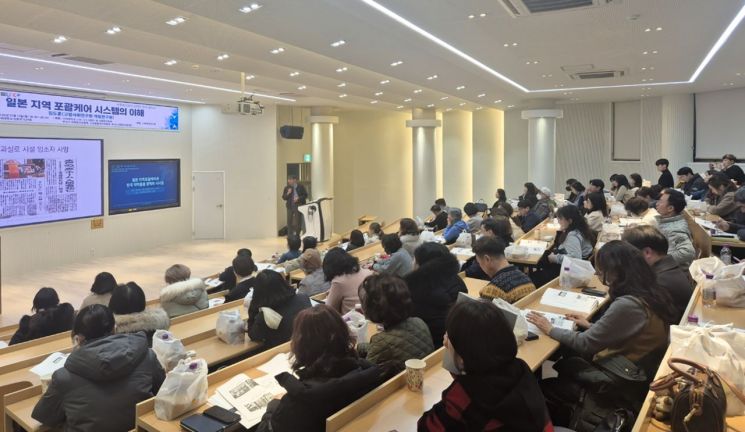 Winter Academic Conference on the Theme 'Implications of Japan's Community-Based Integrated Care and Korea's Community Care Policies' Hosted by Silla University Social Welfare Research Association. Photo by Silla University
The policy seminar titled "Implications of Japan's Community-based Integrated Care and Korea's Community Care Policy," held on the 13th at Silla University's Humanities Building, was jointly hosted by the Graduate School of Social Welfare at Silla University, the Social Welfare Research Association, the LINC 3.0 Project Group, the Busan Social Welfare Center Association, the Busan Senior Welfare Center Association, and the Busan Center for Comprehensive Support for the Elderly Living Alone.
On this day, Kim Do-hoon, a researcher at the Institute for Aging Society, emphasized in his presentation titled "Understanding Japan's Community-based Integrated Care System" that Japan supports elderly care robustly within neighborhoods through an integrated linkage of essential services such as medical care, caregiving, housing, prevention of care needs, and daily life support within a 30-minute radius, which corresponds to the middle school district area.
According to Researcher Kim, Japan considers 2025, when the baby boomer generation reaches the late elderly age of 75, as a critical turning point and is making policy efforts to enable the elderly to maintain dignity and live independently in their own communities rather than in facilities or hospitals.
The Community-based Integrated Care Support Centers operate in over 5,000 neighborhood living communities across Japan and serve as key facilities providing services such as preventive care management, comprehensive counseling and support, rights advocacy, and comprehensive and continuous care support. However, they also pose significant challenges, including enormous costs that can lead to municipal financial crises, disparities between regions, securing professional personnel, and cooperation among them.
Professor Cho Eui-su of Silla University pointed out in his presentation titled "Challenges of Japan's Community-based Integrated Care System and Korea's Integrated Community Care Support System" that with the enactment of the "Act on Integrated Support for Community Care including Medical and Nursing Care" in Korea in March 2024 and its implementation scheduled for next year, Japan's community-based integrated care system holds significant policy implications.
Professor Cho emphasized the urgent need to establish an integrated community care system in Korea, where rapid aging and a surge in late elderly populations are occurring, but there is a lack of an integrated control tower for local medical and care services, a high rate of social hospitalization, and difficulties in maintaining a stable elderly life in one’s own community.
Park Sun-hee, director of the Busan Center for Comprehensive Support for the Elderly Living Alone, who participated as a designated discussant, pointed out that while Japan’s community-based integrated care support projects can be operated centrally by basic local governments as insurers of health insurance and long-term care insurance, Korea’s management entities for medical, nursing, and care services are separated among city/county/district governments, the National Health Insurance Corporation, and private operators, making it difficult to establish a locally led integrated support system.
Participants on the day agreed that Busan, which has the highest aging rate among all special and metropolitan cities nationwide, needs to become a leading city in establishing an integrated support system for community care and demonstrate the highest successful capabilities in caregiving.
© The Asia Business Daily(www.asiae.co.kr). All rights reserved.












