Establishment of Gyeonggi Province's Basic Plan for Activating Livestock Manure Resource Circulation
8 Major Strategies and 14 Implementation Tasks in 3 Key Areas
A Total Budget of 171.2 Billion KRW to Be Invested Over 5 Years
Gyeonggi Province announced on the 14th that it has established the "Basic Plan for Activating Livestock Manure Resource Circulation (2025-2029)" to create high added value using livestock manure and realize eco-friendly agriculture.
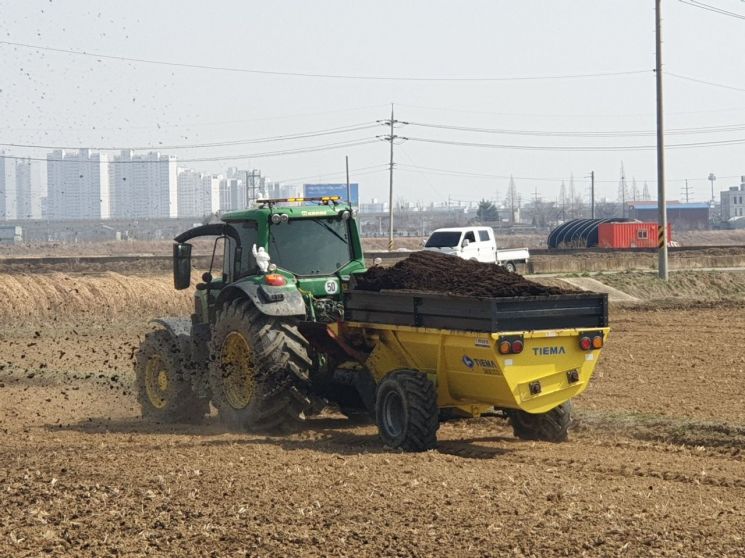
The livestock industry has faced various problems such as a lack of manure treatment facilities and odor complaints due to urbanization and industrialization, and difficulties in using livestock manure as fertilizer due to the decrease in farmland. To address these issues, Gyeonggi Province has prepared various support policies aimed at expanding eco-friendly scientific circular agriculture.
Eco-friendly scientific circular agriculture refers to a circular farming system where livestock manure produced at livestock farms is converted into high-quality compost and returned to farmland, and rice straw and agricultural by-products produced on farmland are reused as feed.
Looking at the main contents, the province presented 14 implementation tasks under 8 major strategies in 3 key areas with the vision of "activating livestock manure resource circulation": △activation of eco-friendly scientific circular agriculture △diversification of livestock manure resource circulation methods △positive perception of livestock manure. To achieve this, a total budget of 172.1 billion KRW will be invested over five years.
First, to activate eco-friendly scientific circular agriculture, support will be provided for the distribution of joint composting facilities by regional hubs, fostering and activating specialized compost distribution organizations, and producing high-quality compost.
To diversify livestock manure resource circulation methods, support will be given for energy conversion of livestock manure such as biogas and solid fuel production, transformation into high value-added industries like biochar, and linkage with other industries.
Furthermore, to promote a positive perception of livestock manure, collaboration with related organizations in livestock, agricultural policy, and agricultural technology will be strengthened, and support plans for resident coexistence will be prepared for communities where energy conversion facilities are installed. In addition, participatory educational programs for residents will be developed, and customized consulting to reduce livestock odor will be provided to farms.
Meanwhile, Gyeonggi Province was the first in the nation to support land tillage costs for fields where compost is spread starting in 2023, and manages compost and odor at livestock farms through the operation of livestock odor managers. Along with this, participatory odor reduction education was conducted to improve the negative perception of the general urban population.
As a result of these efforts, 12,000 tons of compost were returned to 1,040 hectares of farmland in 2024, and odor-related complaints decreased by 18% compared to the previous year.
Lee Kang-young, Director of the Livestock Animal Welfare Bureau of Gyeonggi Province, said, “With the establishment of the basic plan, we have begun to promote livestock manure resource circulation with a long-term perspective. This will contribute to the sustainable development of Gyeonggi Province’s agriculture and livestock industry.”
© The Asia Business Daily(www.asiae.co.kr). All rights reserved.












