The Constitutional Court, which is currently reviewing the impeachment trial of President Yoon Suk-yeol, has stated that the transmission of investigation records related to the 12·3 Martial Law Incident was carried out lawfully. The court also received and used relevant investigation records during the impeachment trial of former President Park Geun-hye in 2016.
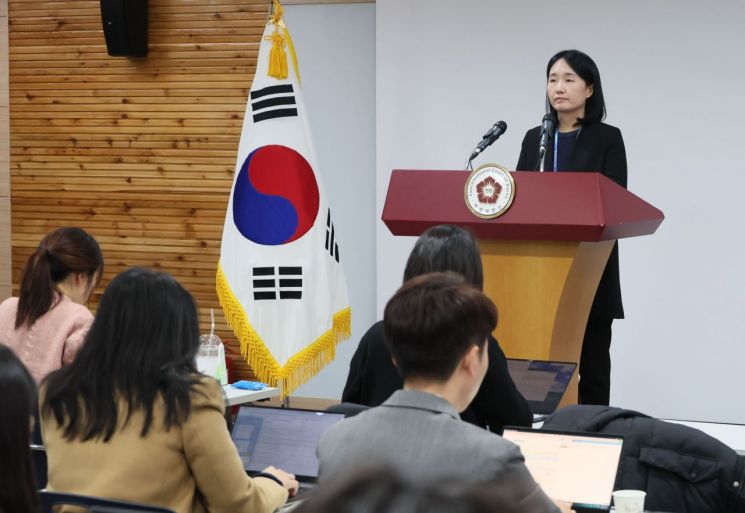 Cheon Jaehyun, spokesperson for the Constitutional Court, is briefing at the Constitutional Court annex in Jongno-gu, Seoul on the 13th. Photo by Yonhap News
On the 13th, Cheon Jaehyun, spokesperson for the Constitutional Court, held a daily briefing. When asked about President Yoon's side's claim that "receiving investigation records on insurrection charges violates the Constitutional Court Act," Cheon explained, "The request for certified copies of records is based on the Constitutional Court Act and the Constitutional Court Adjudication Rules," adding, "There is no issue of violating Article 32 of the Constitutional Court Act, as claimed by President Yoon's side." He further noted, "Similarly, during the impeachment of former President Park, an objection regarding the investigation records was also dismissed."
Previously, the Constitutional Court requested the Ministry of National Defense, the prosecution, and the police to send certain investigation records related to the 12·3 Martial Law Incident, and all three agencies complied. In response, President Yoon's side objected, citing Article 32 of the Constitutional Court Act, which states that 'the court cannot request records of cases where a trial, prosecution, or criminal investigation is ongoing.' They argued that, since there has been no legal judgment on the insurrection charges, the investigation records could be used against President Yoon in the impeachment trial.
The Constitutional Court explained that the transmission of these investigation records was lawful based on the relevant statutes. Article 10, Paragraph 1 of the Constitutional Court Act stipulates that 'the Court may establish rules regarding procedures for adjudication, internal discipline, and administrative affairs,' and Article 39, Paragraph 1 of the Constitutional Court Adjudication Rules allows for the request of document transmission. The court also pointed out that, in line with precedents from previous presidential impeachment trials, investigation records were received and used in deliberations, so there is no issue in this case.
The first official hearing for President Yoon's impeachment trial is scheduled for tomorrow. However, since President Yoon, the respondent, has announced that he will not attend, the first session is expected to conclude without any separate proceedings. According to the Constitutional Court Act, the trial can proceed without the parties present, so substantive arguments are expected to begin in earnest from the second hearing on January 16.
Meanwhile, it has been reported that President Yoon's side recently withdrew a competence dispute adjudication filed with the Constitutional Court regarding the first arrest warrant issued by the Corruption Investigation Office for High-ranking Officials (CIO). Spokesperson Cheon stated, "The withdrawal for the first arrest warrant, which was a competence dispute case between the President and the CIO chief, was received at around 8 a.m. on the 11th." It appears that President Yoon's side withdrew the injunction request and other actions regarding the warrant, which had already expired and was no longer effective.
© The Asia Business Daily(www.asiae.co.kr). All rights reserved.












