It has been revealed that the global stock market capitalization expanded by a staggering $13.6 trillion (approximately 21,650 trillion KRW) over the course of one year. The rally of U.S. companies, led by AI giant Nvidia, was prominent, with the S&P 500 index, the representative U.S. stock index, breaking its all-time high nearly 60 times just this year. This rally was also observed in more than half of the top 20 countries by growth rate, including Japan, the United Kingdom, and France, which recorded the highest year-end closing prices in 35 years.
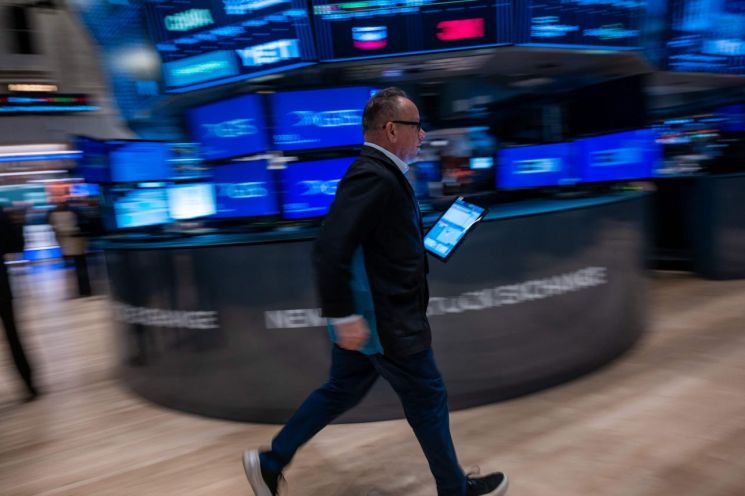
U.S. Hits New Highs Dozens of Times... Global Stock Market Rally
The Nihon Keizai Shimbun (Nikkei) reported on the 31st, citing financial information subsidiary QUICK and others, that the global stock market capitalization denominated in U.S. dollars increased by about $13.6 trillion from the end of last year to reach $121.8 trillion (approximately 17,926.5 quadrillion KRW).
The Morgan Stanley Capital International (MSCI) World Index (ACWI), which shows global stock price trends, recorded a 19.8% increase compared to the end of last year as of the 27th. Nikkei emphasized that this is the highest level since economic activities fully resumed after the pandemic in 2021.
The three major indices of the U.S. New York Stock Exchange all closed lower on the 30th (local time) due to year-end profit-taking sales, but the gains for the year so far are in double digits. The S&P 500 index, which has set new highs dozens of times, is expected to record a 20%+ increase for two consecutive years for the first time since the late 1990s. The tech-heavy Nasdaq index's gain is approaching 30%. The Nikkei 225, Japan’s representative stock index, also closed at 39,894.54 on the same day, marking a year-end closing price surpassing that of 1989 during the bubble economy period.
It is not just the U.S. and Japan. Among the top 20 countries by nominal GDP, including the United Kingdom, Germany, France, Brazil, and Indonesia, 13 countries saw their representative stock indices reach all-time highs this year. Nikkei noted, "In 2024, funds flowed into all assets," and "More than half of the stock markets among the top 20 countries set new highs." The Shanghai Composite Index in China, which had been sluggish until September, also recorded double-digit gains fueled by expectations of government stimulus measures. However, South Korea was left out of this trend and showed a sluggish performance.
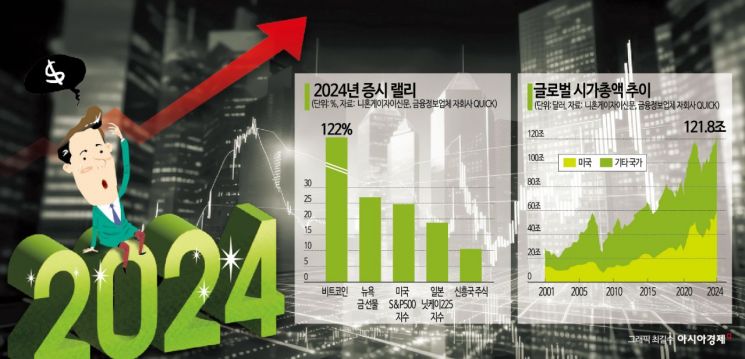
"U.S. Dominance Becomes Clearer" Accounts for 90% of This Year's Market Cap Increase
The driving force behind this year's global stock rally is primarily the strength of the U.S. economy. David Heillo, Vice Chairman of investment firm Harris Associates, evaluated, "The strength of household and corporate balance sheets and solid employment stood out." U.S. companies account for more than half of the global market capitalization. These companies accounted for nearly 90% of the market cap increase this year. Thanks to the relatively robust U.S. economy, the AI boom, and the Federal Reserve's interest rate cuts, global investment funds poured into the New York Stock Exchange.
Nikkei reported, "The stock price of Nvidia, the AI leader, rose 2.8 times, and its market capitalization exceeded $3 trillion," adding, "Among the top 1,000 companies worldwide by market cap, 418 are U.S. companies, the largest number included." The outlet analyzed, "Looking at asset movements throughout the year, U.S. dominance is becoming even clearer." It also added, "Central banks of major countries except Japan have entered an interest rate cut cycle, leading to inflows into gold and corporate bonds."
However, there are also forecasts that the U.S. economy may weaken after 2025. Concerns are rising that inflation could rebound due to high tariff policies by President-elect Donald Trump, who will take office in January next year. The launch of Trump's second term is a major variable that could shake not only the U.S. but also the global economy and policies. The market has also confirmed warning signals, such as the soaring U.S. 10-year Treasury yield, a long-term interest rate indicator.
U.S. economic media CNBC stated, "Trump's return raised expectations for deregulation, corporate tax cuts, and the U.S. economy, which greatly helped the stock market this year," but also diagnosed, "The market has recently lost some momentum." Jeremy Siegel, Professor Emeritus at the Wharton School of the University of Pennsylvania, appeared on CNBC's Squawk on the Street and predicted, "The market may temporarily pause next year," adding, "The S&P 500 index is increasingly likely to experience a correction defined by a 10% decline next year."
© The Asia Business Daily(www.asiae.co.kr). All rights reserved.













