Consumer Prices This Month Up 0.4%P from Previous Month
Rising Trends in Petroleum, Agricultural Products, and Processed Foods
Annual Consumer Prices Down 1.3%P to 2.3%
Fresh Food Up 9.8%, Highest in 14 Years
Consumer prices in December rose by 1.9%, maintaining a low 1% range for the fourth consecutive month. However, inflationary pressures increased compared to the previous month due to rising petroleum prices influenced by the exchange rate. The annual consumer price inflation rate for this year was 2.3%, the lowest in four years, although agricultural product prices surged sharply. The government expects next year's inflation rate to be lower than this year's, but anticipates stronger upward pressure next month compared to this month.
According to the 'December and Annual Consumer Price Trends' released by Statistics Korea on the 31st, the consumer price index for this month was 114.91 (2020=100), up 1.9% compared to the same month last year. The consumer price inflation rate has remained in the low 1% range for four consecutive months since September (1.6%). However, the rate of increase has somewhat expanded this month, following October (1.3%) and last month (1.5%).
This is because prices across the board?including services (2.1%), industrial products (1.4%), agricultural, livestock, and fishery products (2.6%), and electricity, gas, and water (3.0%)?rose compared to the same month last year. In particular, petroleum products, agricultural products, and processed foods had a significant impact. The inflation rate for petroleum products was 1.0%, an increase from -5.3% in the previous month. Agricultural products rose from 0.3% last month to 2.6% this month, and processed foods increased from 1.3% to 2.0%.
Gong Mi-sook, Director of Economic Trend Statistics at Statistics Korea, explained, "Petroleum prices turned upward due to the exchange rate effect, a base effect from last year's decline, and changes in fuel taxes. Agricultural products saw an expanded rise due to poor harvests and reduced shipments, while processed foods saw price increases in some items such as bread, coffee, biscuits, and bottled water."
Although the recently sharp rise in the exchange rate has not yet had a significant impact on prices, it is expected to be reflected additionally in future inflation. Director Gong said, "Petroleum prices seem to have been affected by the exchange rate this month, while other items may be reflected with a time lag."
The core consumer price index excluding food and energy, calculated using the OECD method, was 111.59 this month, up 1.8% compared to the same month last year. The domestic core consumer price index excluding agricultural products and petroleum products, which indicates the underlying trend of prices, was 113.46, up 1.8%. The living cost index, which reflects consumer perception more closely, rose 2.2% to 117.34, showing a relatively noticeable increase.
On an annual basis, the consumer price index for this year was 114.18, up 2.3% from the previous year, marking the lowest level in four years since 2020 (0.5%). After soaring to 5.1% in 2022, it dropped to 3.6% last year and remained in the 2% range this year. This was due to a reduced decline in petroleum prices and continued increases in agricultural product prices, while inflation rates for other items slowed compared to last year. This year, the food and energy excluded index rose 2.2%, the agricultural products and petroleum excluded index increased 2.1%, and the living cost index rose 2.7%.
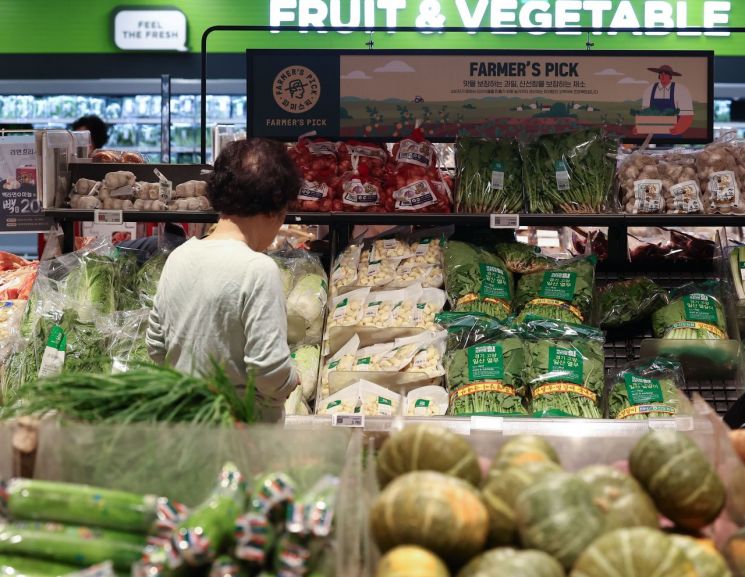
The fresh food index, which includes fruits and vegetables, rose 9.8%, marking the highest increase in 14 years since 2010 (21.3%). In particular, the fresh fruit price inflation rate this year was 17.1%, the highest in 20 years since 2004 (24.3%). Agricultural products recorded a 10.4% increase, the largest rise in 14 years since 2010 (13.5%).
The government expects next year's consumer price inflation rate to slow down compared to this year due to the easing of international oil price increases and stabilization of core inflation. However, next month is expected to see stronger upward pressure than this month due to the base effect of petroleum products and demand for Lunar New Year seasonal goods. The Ministry of Economy and Finance stated, "To establish price stability next year, we plan to continue policy efforts such as discount support for agricultural, livestock, and fishery products, energy and agricultural food voucher support, and tariff quota support for major food raw materials."
© The Asia Business Daily(www.asiae.co.kr). All rights reserved.












