Muan Airport Runway Extension Project Underway
Concerns Over "Bird Strike" Upon Completion
Migratory Birds Cross Runway Path
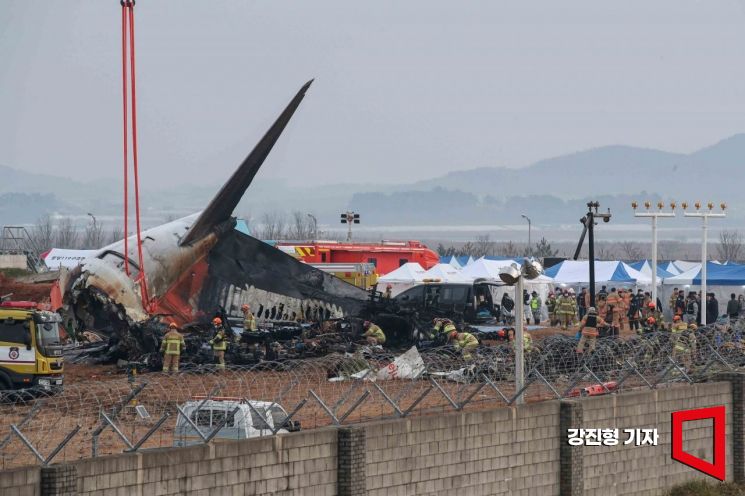 Firefighters are searching for fuel items at the site of the Jeju Air passenger plane collision and explosion accident that occurred on the 30th at Muan International Airport in Jeonnam. Photo by Kang Jin-hyung
Concerns have been continuously raised that the number of bird strikes could increase if the runway extension project at Muan International Airport in Jeollanam-do, where the Jeju Air passenger plane crash occurred, is completed. Since the runway extension is being carried out toward the coastal area, it is closer to migratory bird habitats, increasing the risk of accidents.
According to related government agencies on the 31st, Muan Airport has been undergoing construction to extend the runway from 2,800 meters to 3,160 meters since 2021. In this regard, the Busan Regional Aviation Administration received an environmental impact assessment report from an evaluation company in November 2021 but requested a more detailed review of the possibility of bird strikes, stating that supplementation was necessary. The request expressed concerns that “as the extended runway section becomes closer to the coastal area, the risk of bird-aircraft collisions during takeoff and landing is expected to increase compared to the current airport operations.” This means that if the runway is extended as planned in 2025, bird strikes similar to those in the Jeju Air accident could increase.
The supplementary environmental impact assessment report resubmitted in March 2022 also included the content that “the risk of bird strikes is expected to increase during the migration period of waterfowl.” It analyzed that as flights increase, birds that gather and winter in groups could collide with aircraft. In particular, greater white-fronted geese, bean geese, black scoters, mallards, and freshwater cormorants, which travel around the Muan Airport area during their habitat activities, were classified as having a higher risk of collision.
The number of migratory birds flying to Muan Airport to spend the winter has been increasing despite fluctuations. There are four migratory bird habitats within 13 km around Muan Airport: Hyeongyeong and Unnam in Muan-gun, Muan Reservoir, the coasts of Muan and Mokpo, and Amhaedo Island. The Muan tidal flat wetland protection area, covering 113.34 square kilometers, has also been established. As of this month, the total number of migratory birds in the area is 19,881. This is an increase of 9,024 birds (83.1%) from 10,857 in 2016. The number of birds in the Hyeongyeong and Unnam areas rose from 5,254 to 12,239, and along the Muan and Mokpo coasts, the number increased from 1,892 to 4,315.
An official from the Ministry of Environment explained, “The number of birds may increase due to the gradually warming climate of the Korean Peninsula and efforts to improve migratory bird habitats.”
The problem is that the flight paths of migratory birds in the area cross the Muan Airport runway. Waterfowl, including ducks that were the cause of the recent accident, as well as geese and waterfowl, all inhabit areas between Muan Reservoir and the coast. Muan Reservoir is located to the east of the runway, while the coast is to the west. To move between habitats, the birds must cross the runway. In particular, greater white-fronted geese and white-cheeked pintails were confirmed to cross right through the middle of the runway, and freshwater cormorants were found to use the flight paths of aircraft during takeoff and landing.
Due to these factors, the bird strike rate at Muan Airport is the highest nationwide except for Incheon International Airport. From 2019 to August this year, a total of 11,004 flights operated at Muan Airport, with 10 bird strike incidents occurring. The bird strike rate is 0.09%, which is higher than airports with much more flights such as Jeju Airport (0.013%) and Gimpo Airport (0.018%).
Measures proposed to reduce bird strikes in the future include sonic deterrents, alarms, lasers, LED lights, and drones. However, since the runway extension project has not been completed, additional mitigation measures have reportedly not been implemented.
© The Asia Business Daily(www.asiae.co.kr). All rights reserved.

![Clutching a Stolen Dior Bag, Saying "I Hate Being Poor but Real"... The Grotesque Con of a "Human Knockoff" [Slate]](https://cwcontent.asiae.co.kr/asiaresize/183/2026021902243444107_1771435474.jpg)














