The main cause of the Muan International Airport Jeju Air passenger plane disaster that occurred on the 29th is being pointed to as aircraft damage due to a 'bird strike.' However, experts agree that a large-scale disaster is unlikely to occur from a bird strike alone and emphasize the need for thorough analysis of the accident's cause.
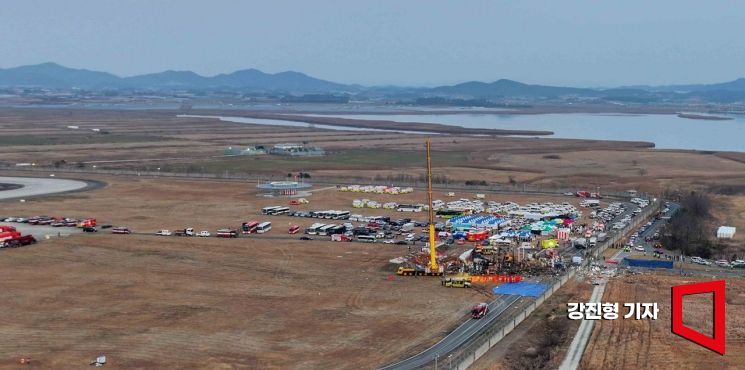 On the 29th, a Jeju Air passenger plane carrying 181 passengers collided with the outer wall of the runway while landing at Muan International Airport, causing a fire that resulted in the deaths of most passengers. The wreckage of the aircraft is placed on the runway of Muan International Airport, Jeollanam-do. Photo by Kang Jin-hyung
According to the Ministry of Land, Infrastructure and Transport, at around 8:54 a.m. that day, the passenger plane approaching runway 1 at Muan Airport attempted its first landing. The Muan Airport control tower warned of bird activity (bird strike) at 8:57 a.m., and the aircraft soon ascended again and went around.
Then, two minutes later at 8:59 a.m., the aircraft sent a distress signal 'Mayday' and attempted to land around 9 a.m. on runway 19, which is the opposite direction of the originally intended runway 01. Three minutes later, at 9:03 a.m., the aircraft landed on this runway without lowering the landing gear. The aircraft was unable to reduce speed until reaching the end of the runway, collided with airport end structures, resulting in fuselage damage and a fire.
Aviation experts see the failure of the landing gear to operate as the direct cause of the accident. Professor Choi Ki-young of Inha University’s Department of Aerospace Engineering said, "An aircraft has several braking systems, but if the landing gear does not operate, the engines reverse thrust and the spoilers on the wings, which act as air brakes, should be deployed, but it appears these did not function either."
Several experts consider a bird strike as a likely cause of the landing gear malfunction. Kim Gyu-wang, director of the Hansuh University Flight Training Center, analyzed, "If birds such as seagulls enter the engine, the engine can be damaged, and it can also affect the connected hydraulic system. The hydraulic system is responsible for raising and lowering the landing gear during takeoff and landing, so that part may have been damaged." Professor Hwang Ho-won of Korea Aerospace University’s Department of Aerospace Law (President of the Korean Aviation Security Association) explained, "It does not seem that a bird directly hit the landing gear, but rather that a bird entered the engine and burned, making it difficult to lower the landing gear."
However, there are also claims pointing to the possibility of defects in all engines, arguing that even if one engine failed due to a bird strike, the landing gear could have been operated using power from the remaining engines. Professor Jeong Yoon-sik of Catholic Kwandong University’s Department of Aviation Operations said, "Even if the hydraulic system is completely broken, there should be auxiliary equipment, but it takes time to operate. It probably took less than 3 to 4 minutes before the accident, but auxiliary equipment operation can take up to 15 minutes."
Nonetheless, experts agree that a large-scale disaster is unlikely to occur from a single engine failure caused by a bird strike alone, and they emphasize the need for thorough analysis to determine whether the accident was caused by a bird strike, aircraft defect, or poor maintenance.
There are also claims that the short runway at Muan International Airport exacerbated the accident damage. In this regard, the Ministry of Land, Infrastructure and Transport stated, "The runway at Muan Airport is 2,800 meters long, and aircraft have operated there before," drawing a line. The Muan Airport runway is shorter than Incheon Airport (3,750?4,000 meters) and Gimpo Airport (3,200?3,600 meters), but longer than other international airports such as Cheongju Airport (2,744 meters) and Daegu Airport (2,755 meters).
© The Asia Business Daily(www.asiae.co.kr). All rights reserved.












