Real Estate Experts Express Concern Over Ministry of Land's 1st New Town Relocation Plan
"Relocation Starts in 2027, But Housing Supply in 2029..."
"Gwacheon-si's 2nd Phase Reconstruction Had Oversupply... Different from Now"
Regarding the relocation demand due to the reconstruction of the 1st generation new towns, the Ministry of Land, Infrastructure and Transport (MOLIT) announced a plan to leave the housing market to handle it, stating that the probability of a 'jeonse crisis' is low. However, real estate experts pointed out that "the government should not assume that jeonse prices will not rise during the relocation period of the 1st generation new town reconstruction by comparing it to the period of oversupply in the past." They also expressed concerns about MOLIT's plan to adjust the timing of management disposition to disperse relocation demand in areas where redevelopment projects are slow, saying it "lacks practicality."
"The government says it will leave relocation demand to the market"
On the 19th, MOLIT announced the 'Relocation Measures for the 1st Generation New Town Redevelopment Project' at the Government Complex Sejong. A MOLIT official stated, "From 2027, when the relocation for the 1st generation new town reconstruction pilot districts begins, through 2031, we have identified that there is sufficient supply within 10 km from the centers of each 1st generation new town." MOLIT estimated that the average annual move-in volume over five years will be 70,000 households, exceeding the average annual relocation demand of 34,000 households.
The MOLIT official added, "In the case of the 2nd generation reconstruction in Gwacheon City, despite a relocation demand of 5,000 households from 2016 to 2018, 8,000 new households moved into Anyang, located 9 km away during a similar period, causing jeonse prices to actually fall," and said, "We will not build or operate relocation complexes solely to absorb relocation demand."
According to the Special Act on Aging Planned Cities applied to the 1st generation new town reconstruction, local governments must establish relocation measures for homeowners and tenants of houses demolished due to reconstruction. Based on this, relocation project operators such as the Korea Land and Housing Corporation (LH) are required to create relocation complexes or provide circulating housing and rental housing to relocatees.
However, MOLIT plans to have the 1st generation new towns absorb relocation demand independently in the housing market, similar to existing redevelopment and reconstruction projects like Seoul’s Dunchon Jugong (Olympic Park Foret On) or Garak Siyoung Apartments (Helio City).
7,700 households supplied temporarily where shortages occur... Completion targeted for 2029
Real estate experts express concerns about "lack of practicality"
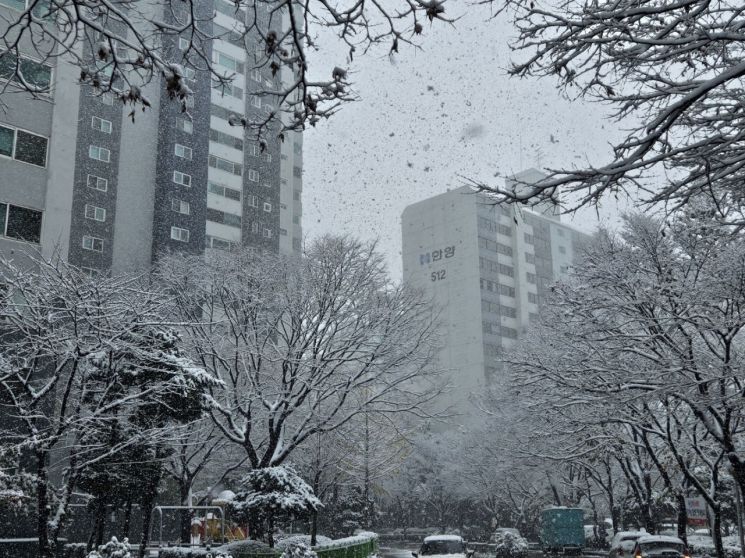 Yangji 5 Complex Hanyang Apartment, Sunae-dong, Bundang-gu, Seongnam-si, Gyeonggi Province
 (Photo by Seungwook Park)
However, MOLIT proposed measures to supply 7,700 public and private housing units on idle land inside and outside the 1st generation new towns in areas where there is a temporary and localized shortage of move-in volume. Of the 7,700 households, 3,700 will be built on sites such as the health center near Seongnam Library, with completion targeted for 2029. The sites and completion dates for the remaining 4,000 households were not disclosed.
Experts expressed concerns about MOLIT’s plan. Kwon Young-sun, team leader of the Real Estate Investment Advisory Center at Shinhan Bank, said, "The biggest problem with supplying 7,700 households using idle land is feasibility," adding, "The supply plan does not specify who will undertake the project, and it is unclear how prices will be formed, raising concerns about whether the supply can be properly executed."
He continued, "MOLIT says relocation demand will start from 2027, but the current supply plan targets completion in 2029, creating a two-year gap," and criticized, "Even if everything goes according to plan, it will inevitably stimulate jeonse prices."
Team leader Shin also pointed out that "the government cited the 2016-2018 Gwacheon case, saying that smooth supply does not stimulate jeonse prices." He said, "The situation then was completely different from now. At that time, there was an oversupply, but now there is a shortage. Even permits are only about 60% of the usual level," and warned, "It is wrong to assume that jeonse prices will not rise based on that period."
Song Seung-hyun, CEO of Urban and Economy, expressed concerns about the government’s plan to adjust the timing of management disposition to disperse relocation demand in areas where redevelopment projects are slow, saying it "lacks practicality." Song analyzed, "As with the selection of pilot districts, there will be competition among associations not to fall behind in timing," and added, "Projects delayed due to postponed management disposition will have to bear risks such as increased construction costs. Naturally, issues of fairness will inevitably arise."
Like team leader Shin, he predicted, "Even if the government supplies 3,700 households by 2029 as planned, jeonse prices will rise during the relocation demand period starting in 2027." He also said, "When considering relocation measures, the type and size of housing for relocation must be taken into account, but this itself is difficult," and concluded, "While the necessity of relocation measures is acknowledged, the current situation has resulted in abstract concepts emerging quickly without concrete plans."
© The Asia Business Daily(www.asiae.co.kr). All rights reserved.












