Increase in Birth Parents' Usage Rate
Statistics Korea: "Impact of Declining Number of Births"
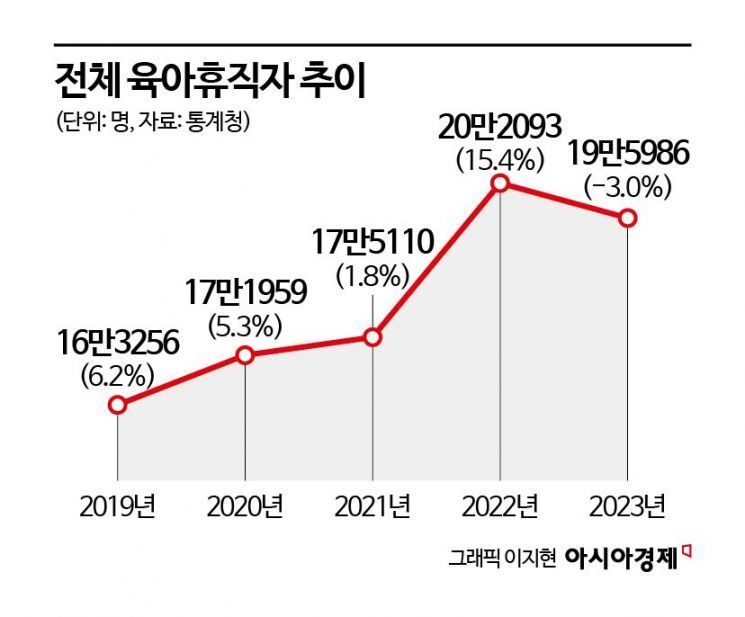
The number of parental leave takers decreased by 3.0% compared to the previous year. This is the first time since Statistics Korea began compiling related statistics that the number of leave takers has declined year-on-year. Statistics Korea analyzed that the decrease was due to a reduced number of parents eligible to take parental leave as the number of births declined last year.
According to the "2023 Parental Leave Statistics" released by Statistics Korea on the 18th, the number of people who started parental leave last year for children aged 8 or younger, or in the second grade of elementary school or below, was 195,986, a 3.0% decrease from the previous year. This marks the first time since 2010, when related statistics began to be compiled, that the growth rate turned negative.
Statistics Korea explained that the population of children aged 8 or younger, who are eligible for parental leave, decreased by 6.5% last year, and the number of births also dropped by 7.7%, which had a significant impact. A Statistics Korea official stated, "Overall, as the number of births declined, the number of eligible parental leave takers decreased."
They added, "There was also an effect from the previous year when the government introduced the 3+3 parental leave system, which led to a significant increase (14.2%) in parental leave usage." In 2022, parental leave takers increased at the largest rate in 11 years. The 3+3 parental leave system is a policy that provides maximum parental leave pay when parents take parental leave within 12 months of their child's birth."
The number of fathers taking parental leave, which had increased by 28.5% the previous year, decreased by 4,110 (-7.5%) to 50,455. Mothers taking parental leave also decreased by 1,997 (-1.4%) to 145,531. Among the total 195,986 parental leave takers, fathers accounted for 25.7% and mothers 74.3%. The proportion of fathers taking parental leave, which had been increasing annually, dropped by 1.3% compared to the previous year.
Parental Leave Usage Rate for Parents of 2023 Newborns Increased by 1.6 Percentage Points
The parental leave usage rate for babies born last year was 32.9%, up 1.6 percentage points from the previous year. The 2023 parental leave usage rate for parents of 2023 newborns was 7.4% for fathers and 73.2% for mothers. Fathers' rate increased by 0.3%, and mothers' by 2.0% compared to the previous year. A Statistics Korea official explained, "Although the total number of parental leave users decreased due to population decline, the usage rate among parents of newborns is rising," adding, "This is because institutional support is in place, which is increasing the usage rate."
By age group, mothers taking parental leave were most numerous in their 30s. Early 30s (30?34 years) accounted for 41.3%, and late 30s (35?39 years) for 33.5%, making over 70% of the total. They were followed by those aged 40 and above (35.7%) and under 30 (3.1%). Fathers taking parental leave were relatively older than mothers. The largest group was late 30s (38.2%), followed by 40 and above (35.7%), early 30s (23.0%), and under 30 (3.1%).
By company size, most parental leave takers worked at large companies. Seventy percent of fathers taking parental leave were employed at large companies with 300 or more employees. This was followed by companies with 50?299 employees (14.7%), 5?49 employees (11.0%), and 4 or fewer employees (3.7%). Similarly, 58.2% of mothers taking parental leave worked at companies with 300 or more employees, followed by 50?299 employees (14.7%), 5?49 employees (11.0%), and 4 or fewer employees (3.7%).
According to the parental leave usage rates by province compiled by Statistics Korea starting this year, Sejong (37.0%) and Gangwon (36.1%) had the highest rates, while Ulsan (29.7%) and Gyeongnam (30.7%) had the lowest. A Statistics Korea official explained, "This is likely because many public administrative institutions in Sejong do not require a minimum of six months of employment to use parental leave."
© The Asia Business Daily(www.asiae.co.kr). All rights reserved.













