Honda and Nissan, the second and third largest automobile manufacturers in Japan, are entering merger negotiations. This is a strategic move to survive in the rapidly changing global market amid increasing threats from American company Tesla and Chinese electric vehicle manufacturers such as BYD. The goal is to leap forward as the world's third-largest automobile group.
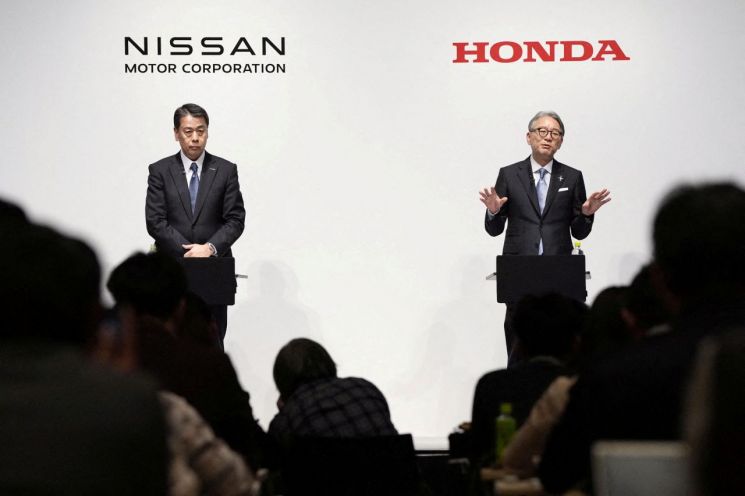
The Nihon Keizai Shimbun (Nikkei) reported on the 18th that Honda and Nissan have begun merger talks, with a likely structure involving incorporation into a holding company system that allows each brand to operate independently. Honda and Nissan are expected to soon sign a memorandum of understanding (MOU) and finalize shareholding and other details. In the future, Mitsubishi Motors, where Nissan is the largest shareholder, will also be incorporated into the holding company. The integration of the three companies will create an 'automobile giant' with annual sales exceeding 8 million units.
Notably, these merger discussions are taking place amid fierce competition from Tesla and Chinese electric vehicle companies in the global automobile market, drawing significant attention. Honda and Nissan have reportedly been conducting behind-the-scenes collaboration talks since March. In August, they also announced a strategic partnership related to software and electric vehicle infrastructure.
Nikkei conveyed the atmosphere by stating, "The rise of Chinese companies with excellent price competitiveness has greatly shaken the foundations of Japanese manufacturers in China and Southeast Asia," and "Nissan is struggling with sales not only in China but also in the United States." Nissan, which is undergoing large-scale restructuring due to management difficulties, is said to have judged that a merger with Honda is inevitable for a fresh start.
The media outlet also noted that recent alliances aimed at establishing a 'new framework' in the global automobile market are continuing, such as General Motors (GM) in the United States collaborating with Hyundai Motor on electric vehicles and software. In September, BMW announced cooperation with Toyota, and Rivian with Volkswagen.
Moreover, the Japanese automobile industry is facing uncertainty due to the inauguration of U.S. President-elect Donald Trump in January next year. There are significant concerns that Trump, who has positioned himself as a 'tariff man,' may target automobiles?one of Japan's largest export items?during his pressure on Japan, which has a trade surplus with the U.S. Earlier, Nissan and Mitsubishi had also disclosed forecasts that their operating profits next year would decrease by double digits compared to this year.
© The Asia Business Daily(www.asiae.co.kr). All rights reserved.












