6 of Top 10 Market Cap Stocks Outperform KOSPI
SK Hynix Rises Over 8%, Leading Gains
Celltrion Up 4.98%, Samsung Electronics Up 3.73%
Value-Up Related Stocks Weaken Amid Concerns Over Loss of Momentum
Amid increased volatility in the stock market following the emergency martial law and impeachment political turmoil, the top market capitalization stocks generally showed favorable price trends. The inflow of buying pressure from institutions and foreigners helped defend against price declines in this volatile market. However, value-up related stocks could not avoid price drops due to concerns over the loss of policy momentum.
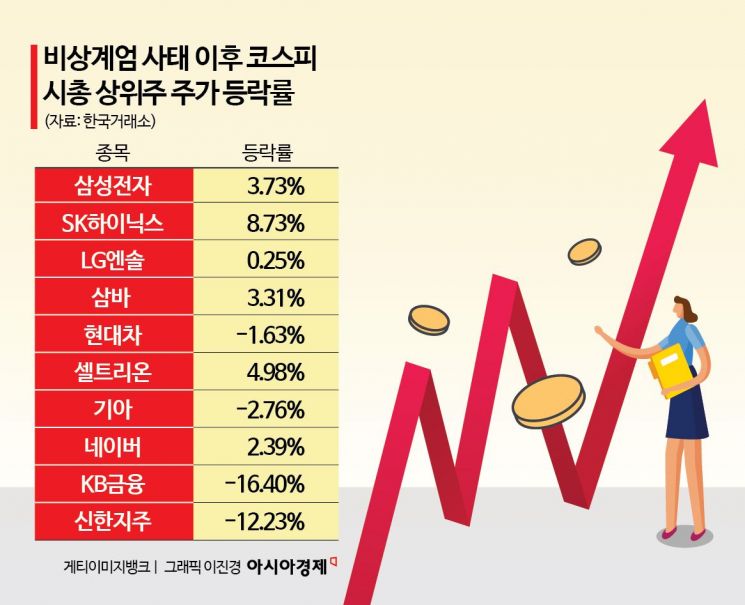
According to the Korea Exchange on the 17th, among the top 10 stocks by market capitalization on the KOSPI after the December 3 emergency martial law incident, six stocks outperformed the KOSPI index. The stock with the largest price increase was SK Hynix. SK Hynix’s stock price rose 8.73% from the emergency martial law incident until the day before. Except for just two days after the martial law incident, SK Hynix recorded gains on all other days. Celltrion followed with a 4.98% increase, Samsung Electronics 3.73%, Samsung Biologics 3.31%, Naver 2.39%, and LG Energy Solution 0.25%. During the same period, the KOSPI fell by 0.45%.
The reason these stocks withstood the volatility of the emergency martial law and impeachment political turmoil was the backing of institutional and foreign buying. Institutions contributed to price defense by evenly purchasing top market capitalization stocks from December 4, right after the martial law incident, until the day before. The stock most purchased by institutions during this period was Samsung Electronics, with net buying of 684.6 billion KRW. Institutions bought Samsung Electronics for eight consecutive trading days. Next was SK Hynix with net buying of 225 billion KRW. Other stocks net purchased by institutions included KB Financial Group (95.4 billion KRW), Hyundai Motor (88.3 billion KRW), Kia (78.2 billion KRW), Naver (60.6 billion KRW), Shinhan Financial Group (41.3 billion KRW), and LG Energy Solution (36.6 billion KRW).
SK Hynix and Naver also saw foreign buying inflows, which supported their price increases. Foreign investors ranked first and second in net purchases during this period by buying SK Hynix and Naver with 285.3 billion KRW and 230.5 billion KRW, respectively. Additionally, Samsung Biologics was purchased for 82.4 billion KRW and Celltrion for 23.3 billion KRW.
On the other hand, value-up related stocks such as financial and automobile stocks underperformed the KOSPI during this period. The decline in financial stocks was particularly notable. KB Financial Group fell 16.40% after the emergency martial law incident, marking the largest drop among the top market capitalization stocks, followed by Shinhan Financial Group, which fell 12.23%. Kia (-2.76%) and Hyundai Motor (-1.63%) also recorded declines.
Value-up related stocks showed weakness as concerns grew that the momentum for value-up policies would weaken due to the emergency martial law and impeachment political turmoil. Although individuals and institutions bought these stocks, foreign investors sold large volumes, preventing price declines from being halted.
As the domestic stock market, which experienced increased volatility during the emergency martial law and impeachment political turmoil, gradually stabilizes, concerns remain, making a significant rebound difficult. Therefore, it seems necessary to pay attention to stocks attracting buying pressure from institutions and foreigners. Jeong Da-woon, a researcher at LS Securities, said, "Recently, the KOSPI has been linked to expectations of easing political uncertainty and may rebound in the short term, but concerns such as the slowdown in Korea’s export momentum and export regulations and tariffs imposed by the Trump administration in 2025 still persist, making a significant rebound difficult. It is necessary to focus on stocks with strong performance and simultaneous net buying by institutions and foreigners this month."
© The Asia Business Daily(www.asiae.co.kr). All rights reserved.











