As the deposit interest rates of commercial banks decline due to the base rate cut, signs of a 'money move' are becoming more pronounced. In particular, with the increased political uncertainty following President Yoon Seok-yeol's declaration of martial law and the National Assembly's resolution to lift it, idle funds such as demand deposits appear to be growing.
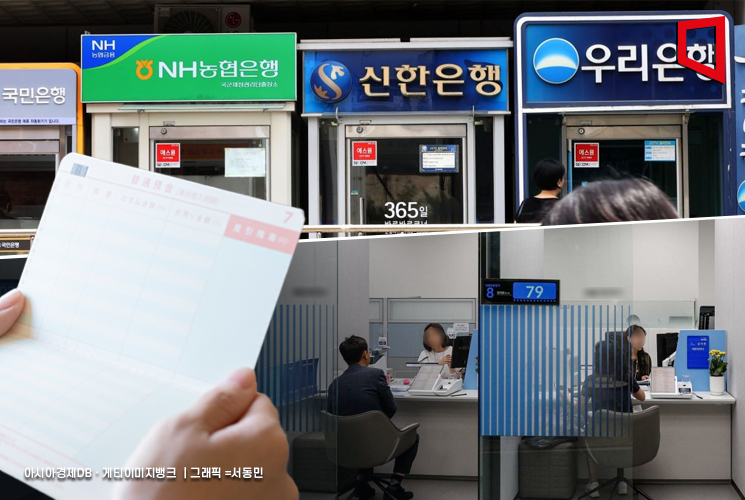
According to the financial sector on the 13th, the total balance of time deposits and installment savings at the five major commercial banks (KB Kookmin, Shinhan, Hana, Woori, and NH Nonghyup) stood at 981.6671 trillion won as of the 11th. This is a decrease of 6.0853 trillion won compared to the end of last month (987.7606 trillion won), when demand for high-interest rates peaked.
The primary cause of the decrease in time deposits and installment savings is attributed to the banks' moves to lower deposit interest rates. As the Bank of Korea cut the base rate, market interest rates have continued to decline. According to the Korea Financial Investment Association, the one-year bank bond rate, which serves as the benchmark for one-year time deposits, fell by 0.238 percentage points from 3.234% on the 11th of last month to 2.996% on the 11th of this month.
As a result, each bank has gradually started to lower deposit interest rates. For example, Woori Bank reduced the interest rates on 16 types of fixed deposits and 16 types of installment savings by 0.2 to 0.4 percentage points starting yesterday. This reflects the combined impact of the base rate cut and the decline in market interest rates.
In addition, SC First Bank and K Bank have also joined the ranks of banks lowering deposit interest rates. A representative from a commercial bank said, "Since market interest rates are falling and loans are being controlled, there is no reason to maintain deposit interest rates," adding, "Other banks are expected to soon follow suit in lowering deposit interest rates."
The funds withdrawn from time deposits and installment savings seem to have entered a 'wait-and-see mode' amid the turbulent political situation. The balance of demand deposits at the five major banks was 614.5457 trillion won as of the previous day, an increase of 6.3127 trillion won compared to the end of the previous month (608.233 trillion won). This is interpreted as reflecting the movements of companies seeking to secure cash and households looking for investment opportunities amid the increased uncertainty caused by martial law and the impeachment crisis.
However, these idle funds have not yet expanded into the stock market or other areas. This is because the political turmoil has not been resolved. In fact, the investor deposit balance, known as 'stock market standby funds,' was 52.5129 trillion won as of the 10th, a level similar to the day before President Yoon's declaration of martial law (52.3358 trillion won).
A financial sector official said, "What overseas investors are watching is whether the situation, whether positive or negative, will be resolved first," adding, "Both households and companies will likely not make any moves until the situation stabilizes."
© The Asia Business Daily(www.asiae.co.kr). All rights reserved.












