2024 Accessibility and Convenience Facilities Monitoring Meeting
Braille Blocks Not Installed... "Urgent Need for Facility Improvement"
Disability Groups Emphasize "Active Response to Rights Protection Important"
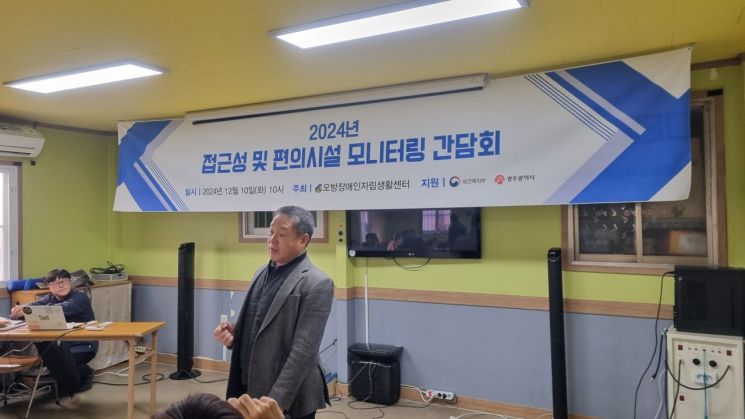 On the morning of the 10th, Kim Yongmok, director of Obang Center for Independent Living of Persons with Disabilities, gave a greeting at the 2024 Accessibility and Convenience Facilities Monitoring Meeting held at Obang Center for Independent Living of Persons with Disabilities in Duam-dong, Buk-gu, Gwangju. Photo by Min Changi
Concerns have been raised that the accessibility for people with disabilities is deteriorating and their right to vote is being infringed due to inadequate convenience facilities such as the absence of braille blocks at bus stops and polling stations in the Gwangju area.
On the morning of the 10th, about 30 representatives from local disability organizations, including the Disability Discrimination Prevention Coalition and the Disability Discrimination Abolition Coalition, participated in the '2024 Accessibility and Convenience Facilities Monitoring Meeting' held at the Obang Disabled Independent Living Center in Duam-dong, Buk-gu, Gwangju.
The meeting proceeded with explanations on monitoring cases of convenience accessibility at bus stops and polling stations in the Gwangju area, discrimination relief lawsuits, followed by discussions on future measures and a Q&A session.
According to monitoring conducted by the Disability Discrimination Prevention Coalition in 2021 on local bus stops under the Act on the Promotion of Convenience for Mobility-Impaired Persons, 15 locations in Gwangju were found to have poor accessibility.
In particular, three bus stops?Moa Jeil Apartment stop in Seo-gu, Bongseon Samik Apartment stop in Nam-gu, and Samjeong Elementary School stop in Buk-gu?lack braille blocks or BIT (Bus Information Terminal) for the visually impaired, and the width is so narrow that wheelchair entry and exit are difficult. The coalition filed a discrimination relief lawsuit under the Disability Discrimination Act in November of the same year.
The Act on the Promotion of Convenience for Mobility-Impaired Persons mandates the installation of convenience facilities for people with disabilities, such as braille blocks and guidance and information facilities, at bus stops.
After filing the lawsuit, only the Bongseon Samik Apartment bus stop had a BIT installed in May this year, and the first trial for the remaining stops is scheduled for March next year.
Lee Seungheon, an activist from the Disability Discrimination Prevention Coalition, emphasized, "It is essential to know the basic laws related to people with disabilities to monitor and respond independently. Although convenience facilities in Gwangju are lacking compared to other regions, working together to improve them is most important."
Polling stations in the Gwangju area were also found to have insufficient convenience facilities, resulting in poor accessibility and infringement of the voting rights of people with disabilities.
According to monitoring conducted by the Gwangju Disability Discrimination Abolition Coalition and others on 24 polling stations in Gwangju in April this year, the convenience facilities were inadequate: ▲2 locations inaccessible to wheelchair users ▲7 locations without braille guidance blocks ▲3 locations without elevators ▲13 locations where disabled restrooms were unusable ▲3 locations where voting booths for the disabled were unusable.
The monitoring team confirmed that in some polling stations, braille guidance blocks were covered by floor mats for floor protection, and disabled restrooms were unusable due to high thresholds and narrow entrance widths.
Baek Youngjun, an activist at the Obang Disabled Independent Living Center, explained, "Laws and systems are important to guarantee the rights of people with disabilities. We conducted accessibility monitoring of polling stations, including the installation of convenience facilities, to support activities ensuring the legitimate use rights of people with disabilities."
He added, "Ramps for wheelchairs were installed with a non-disabled person-centered approach, and disabled restrooms were too narrow to use. Before the election, it is urgent for the Election Commission to conduct investigations on convenience facilities, establish accessibility monitoring, and improve awareness education."
© The Asia Business Daily(www.asiae.co.kr). All rights reserved.












