Resignation Five Days After Martial Law Crisis
Stepping Down Amid Second Impeachment Threat
President Yoon Accepts... After 2 Years and 8 Months
Minister of the Interior and Safety Lee Sang-min tendered his resignation on the 8th, five days after the emergency martial law situation. It is reported that President Yoon Suk-yeol accepted this. The Democratic Party of Korea had submitted an impeachment motion against Minister Lee on the 7th, based on allegations of illegal premeditation of martial law, and a vote was scheduled in the National Assembly plenary session on the 10th.
In a statement released that day, Minister Lee said, "I deeply recognize the responsibility for not being able to serve the people comfortably and not supporting the President well, and I feel sorry to the people," adding, "I now wish to step down from my position as Minister of the Interior and Safety."
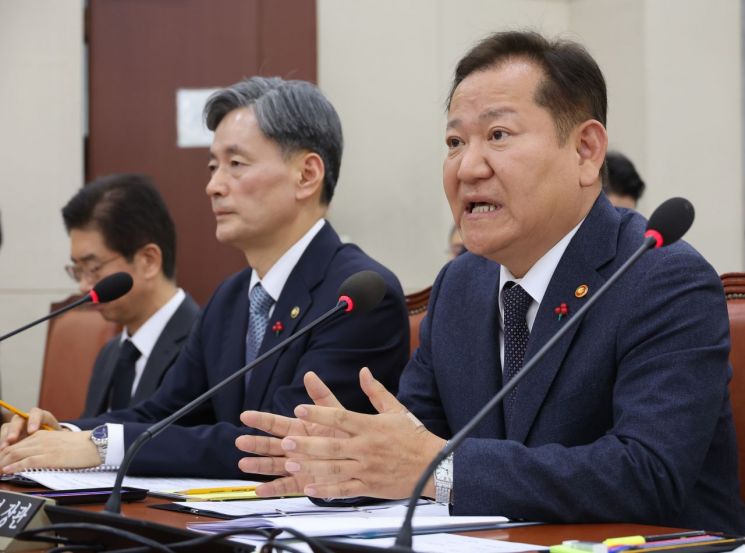
He continued, "I believe that there should be no further gaps or confusion in state affairs," and said, "I will now return as an ordinary citizen and contribute to the new leap of the free Republic of Korea." After Minister Lee’s resignation announcement, it was reported that President Yoon approved it. Minister Lee stepped down after serving as minister for 2 years and 8 months since his appointment in May 2022.
Earlier, the Democratic Party of Korea had submitted an impeachment motion to the National Assembly on the 7th, accusing Minister Lee of conspiring with President Yoon to illegally premeditate martial law and of defending it. During an emergency inquiry at the National Assembly’s Administrative Safety Committee on the 6th, Minister Lee stated regarding the Cabinet meeting held just before the martial law declaration, "All cabinet members who attended the meeting expressed concerns, and I also expressed concerns several times," but the Democratic Party maintained the position that "Minister Lee is strongly suspected of conspiring to illegally premeditate martial law, distorting the normal proceedings of the Cabinet meeting that deliberated martial law, and defending illegal martial law."
Controversy intensified especially after it was confirmed that former Minister of National Defense Kim Yong-hyun, who proposed the emergency martial law to President Yoon, had a phone call with Minister Lee 4 hours and 30 minutes before the martial law declaration. Minister Lee and President Yoon are alumni of Chung-Ang High School, as is former Minister Kim. Given the timing, it is highly likely that the call took place while Minister Lee was traveling from a provincial area to Seoul. Minister Lee, who appeared at the National Assembly the previous day, had revealed that he took the KTX from Ulsan to Seoul around 5:40 p.m. on the 3rd. Since the call occurred while Minister Lee was on the KTX, it is possible that the conversation with former Minister Kim involved more specific discussions beyond just 'attending the Cabinet meeting.'
Although Minister Lee has stepped down, investigations into the process before and after the emergency martial law will continue. Above all, the transcript of the Cabinet meeting convened by President Yoon on the night of the 3rd before declaring martial law is of utmost importance. However, Minister Lee stated, "The minutes containing the list of cabinet members will soon be published on the Ministry of the Interior and Safety’s website," but added, "There is usually no audio recording of Cabinet meetings, and the minutes only record the summary of the meeting, not the individual remarks of participants." There are concerns that even if the minutes are later released, they will be a 'shell' version lacking all individual statements.
Following the emergency martial law incident, the atmosphere inside the Ministry of the Interior and Safety is unsettled. Minister Lee’s resignation comes after he faced impeachment once during the Itaewon tragedy and was now facing a second impeachment threat, causing disruption to the ministry’s key policy initiatives. Representative examples include the ministry’s efforts to respond to regional extinction through the 'future-oriented administrative system' reform, support for the administrative integration of Daegu and Gyeongbuk, and the government organization law revision to establish a Population Strategy Planning Department. Earlier, in May of this year, the ministry formed an expert committee to intensively discuss plans for the future-oriented administrative system reform. Recently, after completing regional consultations, the ministry planned to announce the final recommendation, but it is expected to be postponed until next year.
© The Asia Business Daily(www.asiae.co.kr). All rights reserved.

![Clutching a Stolen Dior Bag, Saying "I Hate Being Poor but Real"... The Grotesque Con of a "Human Knockoff" [Slate]](https://cwcontent.asiae.co.kr/asiaresize/183/2026021902243444107_1771435474.jpg)














