'Love is the golden thread that connects our hearts'
The present me, connected to eight-year-old Han Kang
She wanted to write a brilliantly bright novel that embraces life, but...
From 'Can the living save the dead?'
to 'Can the dead save the living?'
Where can love be found? It is right here, beating in my heart.
What is love? It is the golden thread that connects heart to heart.
This is a poem written by novelist Han Kang in 1979, when she was eight years old. In January last year, while organizing her storage for a move, Han Kang discovered a poem she had written at the age of eight. She found a handmade poetry book she had created as a child, tucked away in an old shoebox.
The booklet, made by stapling together five sheets of A5-sized paper and boldly titled "Poetry Collection" on the cover, contained eight poems. Eight-year-old Han Kang, about to move to Seoul, had carefully compiled and preserved her treasured poems. In January 1980, Han Kang moved from Gwangju to Seoul.
'Love is the golden thread that connects our hearts'-The present me, connected to eight-year-old Han Kang
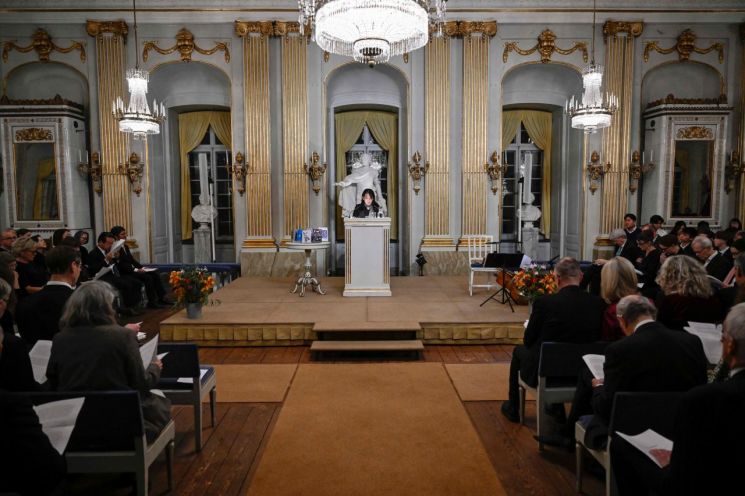
On the afternoon of December 7, 2024 (Korean time), Han Kang, recipient of the 2024 Nobel Prize in Literature, began her Nobel lecture at the Swedish Academy by sharing the story of discovering the poem she wrote at age eight while moving last year. Reflecting on her childhood poem, she said, "I felt that a few words used by that eight-year-old child are still connected to who I am today."
During the lecture, Han Kang calmly read from her prepared manuscript titled "Light and Thread."
In her 30-minute lecture, Han Kang described the process and content behind writing her five novels: "The Vegetarian," "Your Cold Hands," "Greek Lessons," "Human Acts," and "I Do Not Bid Farewell."
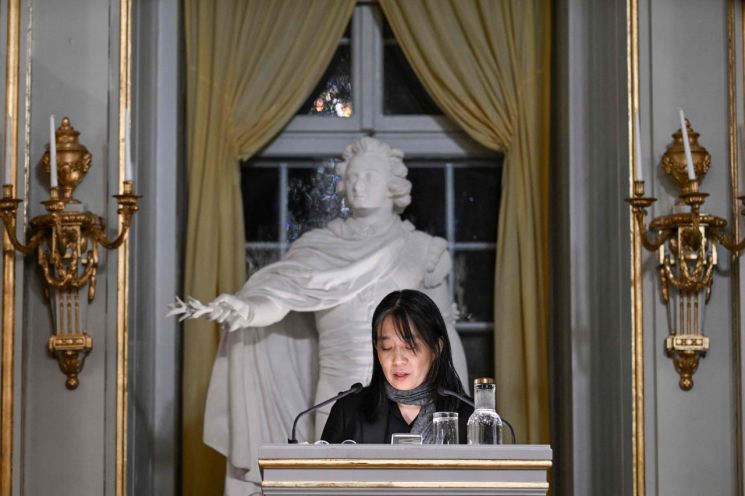
Han Kang said that while she enjoys writing poetry and short stories, she finds writing novels-sometimes taking as little as a year, other times as long as seven years-especially captivating. She explained that while writing a novel, she lives within her questions.
She stated, "A novel is exchanged for a significant period of my personal life. I appreciate being able to enter and dwell within questions that are so important and urgent that I am willing to make that exchange." She continued, "With every novel I write, I endure those questions and live inside them. It is not when I find the answers, but when I reach the end of those questions, that the novel is completed."
Han Kang first spoke about her third novel, "The Vegetarian," which she wrote between 2003 and 2005.
She revealed that the questions that tormented her while writing "The Vegetarian" were: "Is it possible for a human being to become completely innocent?" "How deeply are we able to reject violence?" and "What happens to someone who refuses to belong to the human species for that reason?"
Han Kang said that the questions she faced while writing "Your Cold Hands" and "Greek Lessons" evolved further. In "Your Cold Hands," the question was, "We cannot reject life and the world in order to reject violence. In the end, we cannot become plants. Then, how do we move forward?" While writing "Greek Lessons," the question became, "If we truly must live in this world, at what point does that become possible?"
She wanted to write a brilliantly bright novel that embraces life, but...
After "Greek Lessons," Han Kang wrote the novel "Human Acts," which deals with the May 18 Gwangju Uprising. However, she said that until the spring of 2012, after publishing "Greek Lessons," she had never considered writing a novel about Gwangju.
At that time, Han Kang wanted to write a dazzlingly bright novel that would embrace life and the world. However, after writing about 20 pages, the novel stalled. She encountered unresolved questions within herself once again. Han Kang said, "I realized that I had already lost my fundamental trust in humanity long ago-how could I embrace the world?"
The event that led Han Kang to question humanity at its core was seeing a photo album of the May 18 Gwangju Uprising for the first time at age twelve. She explained that she accidentally found the album, secretly produced and distributed by the families and survivors of May 18, placed upside down on a bookshelf, and read it without the adults knowing.
Han Kang said that viewing the album engraved in her the fundamental question, "Can humans do such things to other humans?" At the same time, seeing photos of people lining up endlessly in front of a university hospital to donate blood to gunshot victims made her wonder, "Can humans do such things for other humans?" She said, "These two questions, which seemed irreconcilable, collided and became an unsolvable riddle."
Han Kang realized that only through writing could she penetrate and move beyond these questions, and she resolved to write a novel about Gwangju.
"I obtained a book containing the testimonies of over 900 people and read it in its entirety, spending nine hours a day for about a month. I read materials covering other cases of state violence, expanding the scope to different places and times, and books about massacres that humans have repeated throughout history and across the world."
From 'Can the living save the dead?' to 'Can the dead save the living?'
At the time, the questions Han Kang grappled with were: "Can the present help the past?" and "Can the living save the dead?" The turning point that pushed her questions forward and determined the direction of the novel was the diary written on the last night by a night school teacher who died resisting until the very end of the May 18 Uprising. The teacher wrote, "God, why do I have a conscience that pierces and pains me so? I want to live."
Han Kang said, "I realized the direction of the novel in a flash." She continued, "I also realized that I needed to reverse the two questions." Thus, the questions became: "Can the past help the present?" and "Can the dead save the living?"
In this way, Han Kang completed "Human Acts," centering the story on Dongho, a middle school student who lost his life during the May 18 Uprising.
Regarding "I Do Not Bid Farewell," Han Kang said, "The real protagonist is Jeongsim, Inseon's mother," and added, "Looking into her life, in which pain and love simmered with the same density and at the same temperature throughout her life, I think I was smiling."
Han Kang reflected that from her first novel to her most recent, perhaps the deepest layer of all her questions has always been directed toward love. Just as her eight-year-old self wrote that love resides in the personal space of her heart, she believes that this has been the longest-standing and most fundamental lesson in her life.
Han Kang concluded her lecture by saying, "I am deeply grateful to everyone who has been, and will be, connected to this thread-the thread of language that links us, the thread through which the light and current of life flow, and to which my questions are connected."
© The Asia Business Daily(www.asiae.co.kr). All rights reserved.













